
Rugby strength & conditioning
An evidence-based guide to training the body rugby actually asks for. Rugby is a collision sport played in short, violent bursts across eighty minutes, so it rewards heavy strength and explosive power for the contact, the repeat-sprint fitness to keep doing it, and a sturdy neck, posterior chain and knee to keep you on the pitch. This covers the lifts that transfer, how to condition without wrecking your strength, the prehab with the best evidence, and how to fit it all around a season. Practical, honest, and grounded in published sport science.
The short version: rugby is built on maximal strength and power (to win and survive collisions, the scrum and the tackle), repeat-sprint conditioning (to keep producing that power late in a game), and injury-resilience work for the neck, hamstrings, shoulders and knees: the tissues rugby breaks most. Build those three, in that order of foundation, and you have the engine the sport needs.
On this page
A framing note before the detail. Strength and conditioning is well studied, but players differ enormously : position, age, training history, size, injury history and how much contact your rugby involves all change what's right for you. So this is written as can, tends to and is associated with, never as a guarantee, and every specific figure is a population-level guide drawn from published research rather than a personal prescription. It's general education rather than medical or coaching advice, and it isn't a personalised programme: a qualified S&C coach or clinician is the right person for that.
The demands of rugby
Rugby is a high-intensity intermittent collision sport: long stretches of walking and jogging punctuated by all-out sprints, accelerations, decelerations, and (the part that sets it apart) repeated heavy contacts. GPS tracking of matches shows players cover very roughly 4–6+ km in a game, most of it low-speed, with the high-intensity running and collisions clustered into short, decisive bursts. The load splits by position: backs tend to cover more total distance and far more high-speed running (studies report on the order of ~27 sprints a game for backs versus ~11 for forwards), while forwards spend themselves in the collision-heavy work: scrums, rucks, mauls and tackles. Both need strength and speed. The ratio differs.
Physiologically that means rugby draws on every energy system. The scrum, a big carry or a dominant tackle are near-maximal efforts fuelled by the immediate (phosphocreatine) and anaerobic systems. The ability to sprint, contact, get up and do it again minutes later rests on a strong aerobic base that clears fatigue between efforts. This is why "just being fit" and "just being strong" both fall short: rugby wants a big engine and a big output, repeatedly.
The injury profile follows from the collisions. In professional surveillance, the tackle is the single biggest injury event, and concussion has been the most commonly reported match injury in the English Premiership for over a decade, accounting for roughly a fifth to a quarter of match injuries in recent seasons (per the Rugby Football Union's Professional Rugby Injury Surveillance Project). Beyond the head, the sites that dominate rugby injury data are the knee (including ACL and MCL), the shoulder (dislocations, AC joint, rotator cuff), the hamstrings and thigh, and the ankle. That list is your prehab shopping list, and we come back to it below.
Key strength work, and why it matters
Strength is the base rugby is built on. A widely cited review of muscular strength in sport (Suchomel, Nimphius & Stone, 2016) concluded that greater maximal strength is associated with better sprinting, jumping and change-of-direction, a greater ability to express power, and a lower injury risk. In a sport decided by who can apply more force in a collision, that's about as on-the-nose as sport science gets. The job of the gym is to build force you can produce, then teach your body to produce it fast. In practice that's a handful of movement patterns:
- Heavy squat (and its variations). The bilateral knee-and-hip extensor builder: the engine behind the scrum drive, the leg drive in contact, and sprint acceleration. Maximal strength is trained with heavy loads for low reps. Standard resistance-training guidelines put this at roughly ≥85% of your one-rep max for about 2–6 reps, with full recovery between sets, keeping the emphasis on force rather than fatigue.
- Heavy hinge: deadlift, trap-bar deadlift, hip thrust, Romanian deadlift. The posterior chain (glutes, hamstrings, back) is the "contact engine": it extends your hips explosively in a carry, a tackle and a sprint, and a strong, resilient hamstring is also your best hedge against the strains rugby is notorious for. The hinge is where a lot of rugby's usable strength lives.
- Upper-body press and pull: bench/overhead press, rows, chin-ups. Fending, binding, grappling for the ball and staying square in contact all need a strong, balanced upper body. Pulling volume matters as much as pressing for shoulder health, because the shoulder is one of rugby's most commonly injured joints.
- Power and speed-strength: jumps, throws, Olympic-lift variations, sled pushes. Strength you can't express quickly is only half-useful on a pitch. Ballistic and plyometric work, and moving moderate loads with maximal intent, train the rate of force development, turning raw strength into the explosive first step, the leg drive off the line and the hit. Plyometrics also build reactive strength: the fast, stiff, spring-like contacts of cutting and landing.
- Unilateral and change-of-direction strength: split squats, single-leg RDLs, step-ups, lateral work. Rugby is rarely symmetrical. Single-leg strength underpins accelerating, decelerating and cutting off one leg (the exact moments where knees and hamstrings get hurt), so it transfers to agility and to resilience.
- Hypertrophy: targeted muscle-building. Size is armour in a collision sport: more muscle (and the connective-tissue robustness that comes with training it) helps you both give and absorb contact. This is the classic 6–12-rep, moderate-load, close-to-failure work. Our build-muscle guide covers how growth actually happens.
- References
You don't need all of these every session, and you certainly don't need to be an elite lifter to benefit. The point is the blend: heavy strength as the foundation, power work to make it fast, and enough muscle and single-leg robustness to survive the contact. That combination (base lifts plus rugby-specific accessory and explosive work) is exactly the shape of a good rugby gym plan.
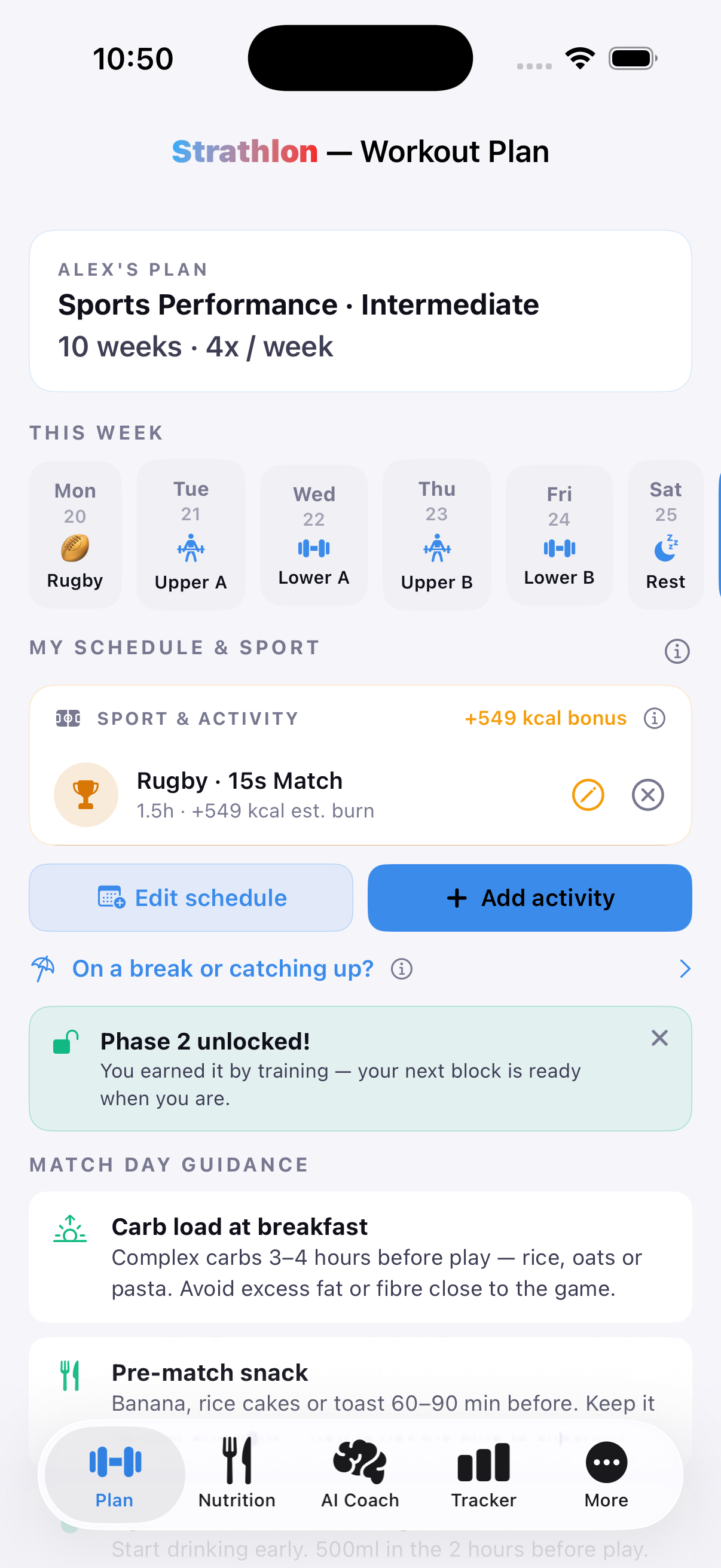
That pairing is worth dwelling on, because it captures the whole philosophy of training for a sport. The base lifts (heavy squats, presses and pulls at 85% or more for low reps) are what actually make you strong enough to give and absorb contact. They are not general filler to be dropped for rugby-looking drills. On top of that base sit the sport-specific pieces: an accessory block of single-leg, hamstring and adductor work matched to a sport of sprints, cuts and contact, with jumps, bounds and sled pushes that train reactive strength and acceleration. Neither half works alone. Accessory work on a weak base protects a player who cannot generate force. A big squat with no reactive quality does not translate to the collision.
That layering matters because the base lifts and the sport-specific work do different jobs. The base builds the raw force and muscle rugby draws on. The sport-specific accessories bias that force toward how rugby uses it: explosively, on one leg, in short bursts, and through the hamstrings, hips and groin that drive every sprint and change of direction. Drop the base and you have movements with no engine behind them. Drop the sport-specific layer and you have a strong gym-goer who hasn't trained the qualities the pitch actually asks for. You want both.
Conditioning for rugby
Rugby conditioning has to serve the game's real shape: repeated high-intensity efforts with incomplete recovery, on top of a solid aerobic base. The aerobic base isn't there to make you a distance runner: it's there so you recover between sprints and contacts, clearing fatigue fast enough to produce a good effort again a minute later. On top of that base sits the sharp end: repeat-sprint and high-intensity interval work that rehearses exactly what a match demands: short maximal sprints (with and without a change of direction or a contact) and short recoveries.
A sensible way to structure it across a week:
- Aerobic base work: easier, longer efforts (or games-based conditioning) that build the engine without much extra pounding. This is the background fitness that makes everything else repeatable.
- Repeat-sprint / high-intensity intervals: short, hard efforts (think repeated sprints of a few seconds with limited rest, or small-sided games) that train the anaerobic power and the fast recovery rugby lives on. This is the most sport-specific conditioning you can do.
- Speed and acceleration: short maximal sprints with full recovery, done fresh. Pure speed is trained rested, with fatigue kept out of it entirely. It overlaps with the power work in the gym.
The obvious worry is interference: the idea that hard endurance work blunts strength and power gains. It's real but overstated, and it's manageable. The practical rules: keep heavy lifting as a priority rather than an afterthought; separate your hardest running from your hardest lifting where you can (different days, or several hours apart); and don't try to peak maximal strength and maximal aerobic fitness in the very same week. Rugby's conditioning is largely repeat-effort rather than long slow distance, which sits more comfortably alongside strength than marathon-style volume would. The real enemy isn't the exercise order. It's total fatigue. If every session all week is maximal, strength and conditioning both suffer. Manage the overall load and the two coexist well.
Staying injury-resilient
Given the injury profile above, prehab isn't optional in rugby: it's part of the training. The good news is that the tissues rugby breaks most are the ones with the best evidence behind targeted work.
- Hamstrings: eccentric strength. Hamstring strains are among the most common non-contact rugby injuries, and eccentric work (led by the Nordic hamstring curl) is the most-studied countermeasure. A 2019 meta-analysis of more than 8,000 athletes (van Dyk, Behan & Whiteley) found that injury-prevention programmes including the Nordic exercise roughly halved hamstring-injury rates (risk ratio ~0.49). Being honest about the evidence: a 2021 methodological reappraisal argued the true protective effect is less certain than that headline once you scrutinise the trials, so treat it as a strong association worth acting on rather than a guaranteed percentage. Either way, eccentric hamstring training clearly builds eccentric strength, and pairing it with regular sprint exposure and sane loading is sound practice.
- Neck: for the head as much as the neck. A randomised trial in age-grade rugby (Attwood et al., 2022) showed that eight weeks of simple self-resisted neck training measurably increased neck strength, and greater neck strength has been associated with lower head-and-neck injury risk. That association is not proof that a stronger neck prevents your next concussion (no honest source claims rugby's head-injury risk can be trained away), but neck work is cheap, safe and sensible, and it belongs in a collision athlete's routine alongside strict return-to-play management after any head knock.
- Knees and landing/cutting mechanics. ACL and other knee injuries cluster around deceleration, landing and change-of-direction. Neuromuscular-training and landing-mechanics work (learning to decelerate, land softly and cut with a stable knee, plus the single-leg strength above) is the evidence-backed approach to lowering that risk, and it's baked into the rugby-specific warm-up programmes below.
- Shoulders: pulling and scapular strength. The shoulder is one of rugby's most commonly injured joints (dislocations, AC joint, rotator cuff). You can't make tackling risk-free, but building balanced pulling strength and rotator-cuff/scapular control gives the joint more to fall back on. Don't let a press-heavy programme outweigh your pulling.
The single highest-value habit ties much of this together: a structured movement-control warm-up. In a cluster-randomised trial in schoolboy rugby (Hislop et al., 2017), a pre-activity programme of balance, resistance, plyometric and landing/cutting drills (the work behind World Rugby's Activate programme) substantially reduced match injuries and concussions in teams that did it regularly (around three times a week). A warm-up that changes injury rates that much is the closest thing rugby prehab has to a free lunch. Do it properly, every session.
Programming it around your season
Rugby has a long season, so how you train has to change across the year: you cannot build hard and play hard at the same time forever.
- Off-season / pre-season: build. This is when you make the big gains: the most frequent, highest-volume strength and power blocks (commonly two to four gym sessions a week), the base for the conditioning to come, and any hypertrophy you're chasing. Prioritise getting genuinely stronger and more powerful now, because it's far harder to build strength once matches start eating your recovery.
- In-season: maintain. Once games begin, the goal flips from building to keeping what you built while staying fresh for matches. The reassuring evidence here: reviews of minimal training doses suggest strength and muscle can be largely maintained for months on as little as one hard session a week (even about a set per exercise), provided the load stays heavy (Spiering et al., 2021). In practice, most players hold their gains on one to two short, heavy sessions a week, cutting the volume (fewer sets) rather than the intensity. The classic in-season error is going light and high-rep, which is exactly the wrong dial to drop: you lose the strength while still accumulating fatigue.
- Fit S&C around rugby rather than the other way round. Practice and matches are the priority and already carry a big running and contact load. Slot heavy lifting where it won't rob a key session (often earlier in the week after a game, or on lighter practice days), and back off when a big fixture, travel or a stack of games has drained you. Managing fatigue across rugby plus gym plus conditioning is the whole game in-season.

Where Strathlon fits
The honest boundary: Strathlon tunes a goal-driven plan toward rugby: it's a smart, sport-aware starting point. It isn't a hand-authored, fully periodised S&C programme, and it doesn't replace a specialist coach for a serious competitive season. For individual injury history, positional demands and a true periodised block, work with a qualified S&C coach. Strathlon's job is to make the base (sensible strength progression, the right sport-specific accessories, and nutrition that moves with your training) one less thing to guess at.
Common questions
Does lifting heavy make you slow or too bulky for rugby?
It's the opposite of what most people fear. A large review of the role of strength in sport concluded that greater maximal strength is generally associated with better sprinting, jumping and change-of-direction, along with a lower injury risk. Getting stronger raises the force you can put into the ground and into a contact, and that's exactly what makes you faster and harder to move. Uncontrolled bulk from eating far too much can of course cost you speed, but that's a nutrition problem, unrelated to lifting itself. Train strength and power properly and you get quicker and more collision-proof at the same time.
What is the single most important strength quality for rugby?
If you can only build one thing, build maximal (heavy) strength: the ability to produce high force in the squat, hinge, press and pull. It is the foundation almost everything else sits on: power, sprint acceleration and the ability to hold your ground in a tackle or scrum all draw on it, and reviews of strength in sport link greater maximal strength to better jumping, sprinting and change-of-direction. Power and speed work then convert that strength into fast, on-field force. But you don't get to choose just one for long: a rounded rugby athlete needs strength, power, repeat-sprint conditioning and injury-resilience work together.
Can I keep my strength during the season without living in the gym?
Yes. Building strength takes more work than keeping it. Reviews of minimal training doses suggest that strength and muscle can be largely maintained for months on as little as one hard session a week (even down to about a set per exercise), as long as the load stays heavy. In practice most players hold gains comfortably on one to two short, heavy in-season sessions a week, dropping the volume rather than the intensity so the legs are fresh for matches. The mistake is dropping the weight (intensity) when it's the number of sets that should come down.
How do I lower my risk of a hamstring strain?
Hamstring strains are among the most common non-contact injuries in rugby, and the most-studied preventive tool is eccentric hamstring work, especially the Nordic hamstring curl. A well-known 2019 meta-analysis of over 8,000 athletes found that programmes including the Nordic exercise roughly halved hamstring-injury rates (risk ratio about 0.49). Be honest about the caveat: a 2021 reappraisal argued the true protective effect is less certain than that headline once the methods are scrutinised. The fair reading is that eccentric hamstring training reliably builds eccentric strength and is associated with fewer hamstring injuries, so it's well worth doing (alongside sprint exposure and sane loading), even if the exact percentage is debated.
Does neck training actually prevent concussion?
Neck training reliably makes your neck stronger (a randomised trial in age-grade rugby showed eight weeks of simple self-resisted neck work measurably increased neck strength), and greater neck strength has been associated with lower head-and-neck injury risk. It is honest to stop there: an association is not proof that a stronger neck prevents your next concussion, and no exercise makes rugby's head-injury risk go away. Neck strength sits inside a bigger picture: whole-body movement-control warm-up programmes (the type behind World Rugby's Activate) have been shown in a schoolboy-rugby trial to cut match injuries and concussions when done regularly. Do the neck work and the warm-up, but treat them as risk-reducers rather than a guarantee, and follow proper return-to-play rules after any head knock.
How do I add conditioning without killing my strength gains?
This is the interference question, and it's manageable. Keep your heavy lifting as the priority, separate your hardest running from your hardest lifting where you can (by a few hours or onto different days), and don't try to peak strength and maximal aerobic fitness in the exact same week. Rugby conditioning is mostly repeat-effort (short, hard sprints with incomplete recovery on top of an aerobic base), which sits reasonably well beside strength work as long as total fatigue is controlled. Fatigue management is what protects your gains, far more than any magic exercise order. If everything is hard all the time, both strength and conditioning suffer.
Takeaways
- Rugby is strength, power and repeat-effort. It's a collision sport of short violent bursts: build heavy strength and explosive power, then the conditioning to keep producing them for eighty minutes.
- Maximal strength is the foundation. Greater strength is linked to better sprinting, jumping, change-of-direction and lower injury risk (Suchomel et al., 2016). Train the squat, hinge, press and pull heavy (roughly ≥85% 1RM, low reps).
- Make strength fast. Jumps, throws, Olympic-lift variations and sprints convert raw strength into on-field power: the first step, the leg drive, the hit.
- Condition for repeat efforts. An aerobic base to recover between efforts, plus repeat-sprint and interval work. Manage total fatigue so conditioning and strength coexist.
- Prehab the sites rugby breaks. Eccentric hamstring work (associated with ~halved hamstring injuries; van Dyk et al., 2019), neck strength, landing/cutting mechanics for knees, and pulling/scapular work for shoulders.
- Do the warm-up. A structured movement-control programme (World Rugby's Activate) cut match injuries and concussions in a randomised rugby trial (Hislop et al., 2017) when done ~3×/week.
- Build off-season, maintain in-season. Strength and muscle hold for months on as little as one to two heavy sessions a week if the load stays high (Spiering et al., 2021): cut volume rather than intensity.
- Nothing here is a guarantee. Rugby carries real injury risk that training reduces but never removes. Availability (staying on the pitch) is the quiet superpower.
If you remember one thing, make it the order of operations: get strong, make it fast, condition it to repeat, and prehab the parts rugby targets, then maintain it through the season instead of chasing new gains you can't recover from. Strathlon's role is to tune that base toward rugby (with Sports Performance as one of your goals) and keep it honest, so the strength trend, the sport-specific work and the nutrition around your sessions are one less thing to guess at.
Pair this with the rugby fuelling guide: the training here builds the engine, and that guide covers how to fuel and recover it around matches and heavy weeks.
References
Numbered sources for the specific figures, effect sizes and named studies above. Where a claim reflects agreed guidance rather than a single trial, the citation is to the position stand or consensus statement of the body concerned, with the country or international remit named. Rugby has strong collision-load and injury-prevention evidence, including a randomised schools programme, and the figures below are cited to it.
- Paul L, Naughton M, Jones B, Davidow D, Patel A, Lambert M, et al. Quantifying Collision Frequency and Intensity in Rugby Union and Rugby Sevens: A Systematic Review. Sports Medicine - Open. 2022;8(1):12. Systematic review quantifying collision frequency and intensity in rugby union and sevens: the source for the collision load described. PubMed 35050440 · PMC8776953 full text
- Payne LKD, Varley MC, Driller MW, James LP. Physical Characteristics That Differentiate Playing Levels of Male Rugby Union Players: A Systematic Review. Journal of Strength and Conditioning Research. 2025;39(9):1013–1022. Systematic review of the physical characteristics that differentiate playing levels in male rugby union, the basis for the strength and power priorities. PubMed 41811121
- Brassington RJ, Mara JK, Ball N, Waddington G, Paul K, Cooke J. Match demands and physical qualities of female athletes in Australian football, rugby union, rugby sevens, and rugby league: a scoping review. Biology of Sport. 2025;43:405–428. Review of match demands and physical qualities of female athletes across rugby codes, cited so the demands are not described from the men's game alone. PubMed 41783458 · PMC12954495 full text
- Curtis C, Mitchell S, Russell M. Match-Play Demands and Anthropometric Characteristics of National and International Women's Fifteen-a-side Rugby Union: A Systematic Scoping Review. Journal of Strength and Conditioning Research. 2023;37(10):e569–e580. Scoping review of match-play demands and anthropometric characteristics in women's fifteen-a-side rugby union, the second source for the same. PubMed 37235209
- Barden C, Hancock MV, Stokes KA, Roberts SP, McKay CD. Effectiveness of the Activate injury prevention exercise programme to prevent injury in schoolboy rugby union. British Journal of Sports Medicine. 2022;56(14):812–817. Trial of the Activate injury-prevention exercise programme in schoolboy rugby union: the direct evidence that a structured programme cuts rugby injuries. PubMed 35387776
- Gianotti SM, Quarrie KL, Hume PA. Evaluation of RugbySmart: a rugby union community injury prevention programme. Journal of Science and Medicine in Sport. 2009;12(3):371–5. Evaluation of the RugbySmart community injury-prevention programme, the population-level version of the same result. PubMed 18356104
- Chavarro-Nieto C, Beaven M, Gill N, Hébert-Losier K. Hamstrings injury incidence, risk factors, and prevention in Rugby Union players: a systematic review. The Physician and Sportsmedicine. 2023;51(1):1–19. Systematic review of hamstring injury incidence, risk factors and prevention in rugby union, the sport-specific hamstring evidence. PubMed 34637371
- van Dyk N, Behan FP, Whiteley R. Including the Nordic hamstring exercise in injury prevention programmes halves the rate of hamstring injuries: a systematic review and meta-analysis of 8459 athletes. British Journal of Sports Medicine. 2019;53(21):1362–1370. Meta-analysis of Nordic hamstring prevention programmes halving hamstring injury rates, the source for the figure quoted. PubMed 30808663
- Daly E, Pearce AJ, Ryan L. A Systematic Review of Strength and Conditioning Protocols for Improving Neck Strength and Reducing Concussion Incidence and Impact Injury Risk in Collision Sports; Is There Evidence?. Journal of Functional Morphology and Kinesiology. 2021;6(1). Systematic review of strength and conditioning protocols for improving neck strength and reducing concussion incidence: the basis for the neck work prescribed. PubMed 33462169 · PMC7838928 full text
- Parmley J, Weaving D, Whitehead S, Brown J, Fairbank L, Flahive S, et al. Contact load practices and perceptions in elite English rugby league: an evaluation to inform contact load guidelines. South African Journal of Sports Medicine. 2024;36(1):v36i1a17646. Study of contact-load practice and perceptions in elite rugby league, cited in the load-management section. PubMed 39234298 · PMC11374316 full text
- McMaster DT, Gill N, Cronin J, McGuigan M. The development, retention and decay rates of strength and power in elite rugby union, rugby league and American football: a systematic review. Sports Medicine. 2013;43(5):367–84. Study of development, retention and decay rates of strength and power in elite rugby, the source for the in-season maintenance argument in this sport. PubMed 23529287
- Suchomel TJ, Nimphius S, Stone MH. The Importance of Muscular Strength in Athletic Performance. Sports Medicine. 2016;46(10):1419–49. Suchomel and colleagues on the importance of muscular strength in athletic performance: the source for greater maximal strength being associated with faster sprinting, jumping and change of direction, and with lower injury risk. PubMed 26838985
- Seitz LB, Reyes A, Tran TT, Saez de Villarreal E, Haff GG. Increases in lower-body strength transfer positively to sprint performance: a systematic review with meta-analysis. Sports Medicine. 2014;44(12):1693–702. Seitz and colleagues' systematic review with meta-analysis showing increases in lower-body strength transfer positively to sprint performance, the evidence behind the 'strength is the base' argument. PubMed 25059334
- Lauersen JB, Andersen TE, Andersen LB. Strength training as superior, dose-dependent and safe prevention of acute and overuse sports injuries: a systematic review, qualitative analysis and meta-analysis. British Journal of Sports Medicine. 2018;52(24):1557–1563. Lauersen and colleagues' meta-analysis finding strength training a superior, dose-dependent and safe prevention of acute and overuse sports injuries: the direct source for treating strength work as prehab. PubMed 30131332
- Lauersen JB, Bertelsen DM, Andersen LB. The effectiveness of exercise interventions to prevent sports injuries: a systematic review and meta-analysis of randomised controlled trials. British Journal of Sports Medicine. 2014;48(11):871–7. Lauersen and colleagues' earlier meta-analysis of exercise interventions to prevent sports injuries, the broader evidence base the prevention advice sits on. PubMed 24100287
- . American College of Sports Medicine position stand. Progression models in resistance training for healthy adults. Medicine and Science in Sports and Exercise. 2009;41(3):687–708. American College of Sports Medicine (ACSM, United States) position stand on progression models in resistance training: the source for the heavy-load and explosive-load percentage ranges quoted. PubMed 19204579
- Cuthbert M, Haff GG, Arent SM, Ripley N, McMahon JJ, Evans M, et al. Effects of Variations in Resistance Training Frequency on Strength Development in Well-Trained Populations and Implications for In-Season Athlete Training: A Systematic Review and Meta-analysis. Sports Medicine. 2021;51(9):1967–1982. Cuthbert and colleagues' systematic review of resistance-training frequency in well-trained populations, the source for the sessions-per-week guidance. PubMed 33886099 · PMC8363540 full text
- Spiering BA, Mujika I, Sharp MA, Foulis SA. Maintaining Physical Performance: The Minimal Dose of Exercise Needed to Preserve Endurance and Strength Over Time. Journal of Strength and Conditioning Research. 2021;35(5):1449–1458. Spiering and colleagues on the minimal dose of exercise needed to preserve endurance and strength: the source for maintaining in-season on as little as one to two sessions a week. PubMed 33629972
- Rønnestad BR, Nymark BS, Raastad T. Effects of in-season strength maintenance training frequency in professional soccer players. Journal of Strength and Conditioning Research. 2011;25(10):2653–60. Ronnestad and colleagues' trial of in-season strength maintenance frequency in professional footballers, the specific in-season maintenance result quoted. PubMed 21873897
- Nuzzo JL, Pinto MD, Kirk BJC, Nosaka K. Resistance Exercise Minimal Dose Strategies for Increasing Muscle Strength in the General Population: an Overview. Sports Medicine. 2024;54(5):1139–1162. Nuzzo and colleagues on minimal-dose resistance exercise strategies for increasing strength, supporting the claim that a small, well-chosen dose does most of the work. PubMed 38509414 · PMC11127831 full text
- Wilson JM, Marin PJ, Rhea MR, Wilson SM, Loenneke JP, Anderson JC. Concurrent training: a meta-analysis examining interference of aerobic and resistance exercises. Journal of Strength and Conditioning Research. 2012;26(8):2293–307. Wilson and colleagues' meta-analysis of concurrent training and the interference effect: the source for separating heavy lifting from hard conditioning. PubMed 22002517
- Schumann M, Feuerbacher JF, Sünkeler M, Freitag N, Rønnestad BR, Doma K, et al. Compatibility of Concurrent Aerobic and Strength Training for Skeletal Muscle Size and Function: An Updated Systematic Review and Meta-Analysis. Sports Medicine. 2022;52(3):601–612. An updated systematic review of the compatibility of concurrent aerobic and strength training, the more recent evidence that interference is smaller than once believed. PubMed 34757594 · PMC8891239 full text
- Ramirez-Campillo R, Sortwell A, Moran J, Afonso J, Clemente FM, Lloyd RS, et al. Plyometric-Jump Training Effects on Physical Fitness and Sport-Specific Performance According to Maturity: A Systematic Review with Meta-analysis. Sports Medicine - Open. 2023;9(1):23. Ramirez-Campillo and colleagues on plyometric-jump training effects on physical fitness and sport-specific performance, the source for the plyometric guidance. PubMed 37036542 · PMC10086091 full text
- Impellizzeri FM, Woodcock S, Coutts AJ, Fanchini M, McCall A, Vigotsky AD. What Role Do Chronic Workloads Play in the Acute to Chronic Workload Ratio? Time to Dismiss ACWR and Its Underlying Theory. Sports Medicine. 2021;51(3):581–592. Impellizzeri and colleagues on the pitfalls of the acute:chronic workload ratio: cited because it is the reason this guide talks about ramping load gradually rather than quoting a workload number. PubMed 33332011
- Baz-Valle E, Balsalobre-Fernández C, Alix-Fages C, Santos-Concejero J. A Systematic Review of The Effects of Different Resistance Training Volumes on Muscle Hypertrophy. Journal of Human Kinetics. 2022;81:199–210. Systematic review of resistance-training volume and hypertrophy, the general dose-response evidence behind the set and session recommendations. PubMed 35291645 · PMC8884877 full text
This is general educational information rather than medical or individual coaching advice. The strength-and-conditioning figures here are drawn from published research and are framed as population-level guides and associations: individual needs vary widely with position, training history, size and injury history, and are best personalised with a qualified strength-and-conditioning coach. Anyone with a current injury, pain, a history of concussion, or a health condition, or who is pregnant or postpartum, should consult a qualified S&C coach or clinician before starting or changing a training programme, and follow proper graduated return-to-play guidance after any head injury. See our Terms for more.
← All guides · Rugby fuelling guide · How muscle actually grows · Recovery & rest · Eating for results · Home