
Fuelling & performance nutrition for rugby
An evidence-based guide to fuelling the rugby body. Rugby is two sports welded together: repeated high-intensity sprinting and heavy, unavoidable collision, played out over 80 minutes by athletes who are deliberately big and powerful. That combination shapes everything about how a player should eat: more total energy and protein to build and carry the mass, plenty of carbohydrate to fuel the repeat efforts and fill match-day glycogen, careful hydration across a long game, and recovery that has to fix bruised, battered muscle as well as an empty fuel tank. This is practical, honest, and grounded in established sports-nutrition consensus.
Here's the short answer to "how should a rugby player fuel?": eat enough total energy and carbohydrate day to day to keep muscle glycogen full (around 5–8 g of carbs per kilogram of body weight, more on the hardest days), eat plenty of protein to build and hold the mass the game demands (around 1.5–2.0 g/kg/day, spread through the day), top up carbohydrate and fluid before, during and at half-time of the match, and recover from the contact with carbohydrate, protein and, genuinely, sleep. Everything below is the detail behind that sentence: the numbers, where they come from, and how forwards and backs differ.
On this page
- Why rugby is a collision and repeat-sprint sport
- Forwards vs backs: same game, different totals
- Daily carbohydrate: the fuel base
- Protein: building and holding match mass
- Match day: glycogen and the pre-game meal
- During the 80 minutes: topping up
- Hydration across a match
- Recovery from heavy contact
- Eating enough for the demands
- Common questions
- Takeaways
A framing note before the numbers. Sports nutrition is well studied, but people differ enormously: body size, position, playing level, the weather, gut tolerance, sex and health status all shift what's right on the day. So this is written as can, tends to and around, never as a guarantee, and every specific figure is a population-level guide drawn from published consensus rather than a personal prescription. It's general education rather than medical or dietary advice, and it isn't a personalised plan.
Pair this with the rugby strength & conditioning guide: this fuelling supports the engine that guide builds, so use both together around matches and heavy weeks.
Why rugby is a collision and repeat-sprint sport
Rugby's physical signature is intermittent high intensity punctuated by collision. A match is not a steady effort like a long run. It's a stop-start pattern of walking and jogging broken by repeated sprints, tackles, rucks, mauls, scrums and carries into contact. Both the fast, explosive work and the grinding contact work draw heavily on carbohydrate stored as muscle glycogen, because glycogen is the fuel that powers anaerobic sprints and high-intensity repeated efforts. When glycogen runs low, power output and work rate fall, which is exactly why the second half is where under-fuelled players fade.
How much glycogen does a match actually cost? Studies of the rugby codes put it high: professional rugby-league players have been shown to use around 40% of their muscle glycogen in a single match, and that was true regardless of how much carbohydrate they'd eaten in the preceding 36 hours. In the closely related demands of soccer, muscle glycogen commonly falls by roughly 40–60% on average across a game, with many individual fibres left near-empty. The message is the same across intermittent team sports: a match empties the tank fast, so you have to start full and refuel between games.
Layered on top of the fuel story is rugby's other defining feature: mass and power. The game rewards being big, strong and fast, so players spend the off-field hours building and maintaining muscle. That raises the bar for both total energy (a bigger body doing collision work burns a lot) and protein (to build the muscle and repair the damage the collisions cause). Fuelling rugby well means holding all of this together at once: enough carbohydrate for the work, enough protein for the mass, and enough total energy to support both.
Forwards vs backs: same game, different totals
Forwards and backs play different games inside the same match, and it shows up in how much they eat. Forwards are generally heavier and spend more time in the set piece and the collision zone (scrums, rucks, mauls, repeated tackles), so they carry more mass and burn more total energy. Backs tend to be leaner and faster, covering more ground at higher speeds and leaning hard on repeat-sprint glycogen. In a study of elite professional players, mean daily energy intake was markedly higher for forwards (around 4,600 kcal/day) than backs (around 3,800 kcal/day).
Here's the useful nuance: once you express intake per kilogram of body weight, the carbohydrate and protein targets for forwards and backs look broadly similar: the same rules per kilo, applied to different- sized bodies. So the practical difference is mostly about volume of food: a big forward simply needs more on the plate to fuel and rebuild a larger, more collision-loaded frame, while a back should be especially sure that glycogen is full so the repeated sprinting doesn't dry up. Both, incidentally, tend to eat to the day: intake naturally rises on hard training and match days and eases on lighter ones.
Daily carbohydrate: the fuel base
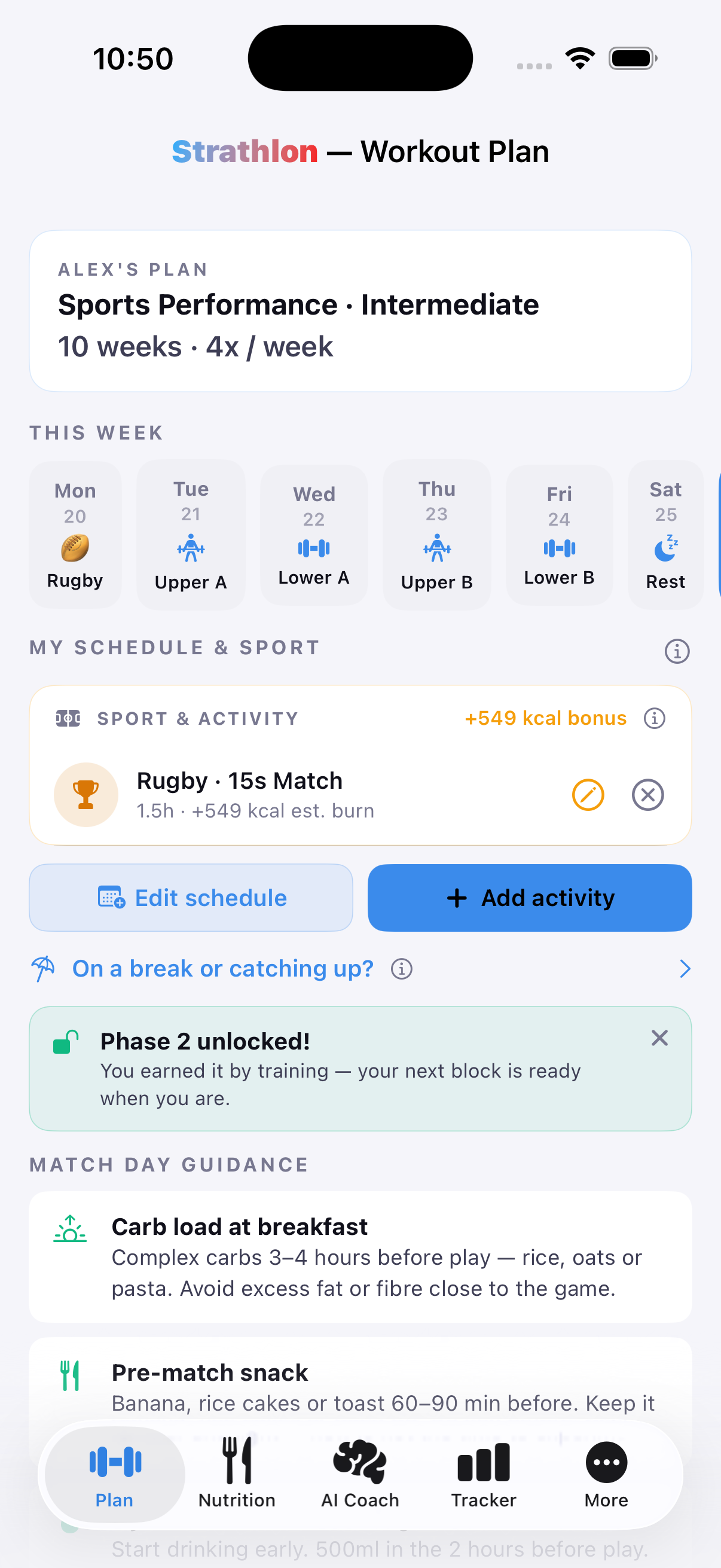
Match-day fuelling only works if the tank is reasonably full to begin with, and that comes from everyday carbohydrate matched to training. Reviews of rugby nutrition, drawing on the American College of Sports Medicine, the International Olympic Committee and the International Society of Sports Nutrition, describe daily carbohydrate for players in the region of 5–8 g per kilogram of body weight per day, rising toward 6–10 g/kg/day on the most intense training and match days. The principle is to move the dial with the week: a heavy pitch session or a match warrants more carbohydrate than a recovery day or a day off.
This is, in practice, where a lot of players fall short. Surveys of professional rugby find intakes often sit below these guideline ranges on ordinary training days, with players concentrating their carbohydrate onto game day itself. Under-fuelling the base is one of the quietest ways to end up flat, under-recovered and unable to complete high-quality training. The top-up strategies later in this guide can't fix a base that's chronically too empty.
Protein: building and holding match mass
Rugby asks players to build muscle and then batter it every week, so protein does double duty: it drives the growth that makes a player bigger and stronger, and it fuels the repair of the muscle damage that collisions cause. Rugby-specific reviews and the major sports-nutrition bodies put daily protein at around 1.5–2.0 g per kilogram of body weight per day. That sits comfortably inside the International Society of Sports Nutrition's broader position that 1.4–2.0 g/kg/day is sufficient for most people building or maintaining muscle, with the higher end, and occasionally beyond, more relevant when a player is trying to hold lean mass while dieting down.
Total protein matters, but distribution matters nearly as much. The evidence favours spreading intake into regular feeds of roughly 0.25–0.4 g/kg (about 20–40 g of quality protein) every three to four hours, rather than one or two large servings, because each feed gives muscle-protein synthesis a fresh stimulus. Protein sources rich in essential amino acids and leucine (dairy, eggs, meat, fish, or a quality blend) are the most effective at switching that repair-and-build machinery on. One important caveat for anyone chasing size: protein only turns into muscle if the total energy is there too. You cannot out-protein an overall calorie deficit if the goal is to get bigger.
Match day: glycogen and the pre-game meal
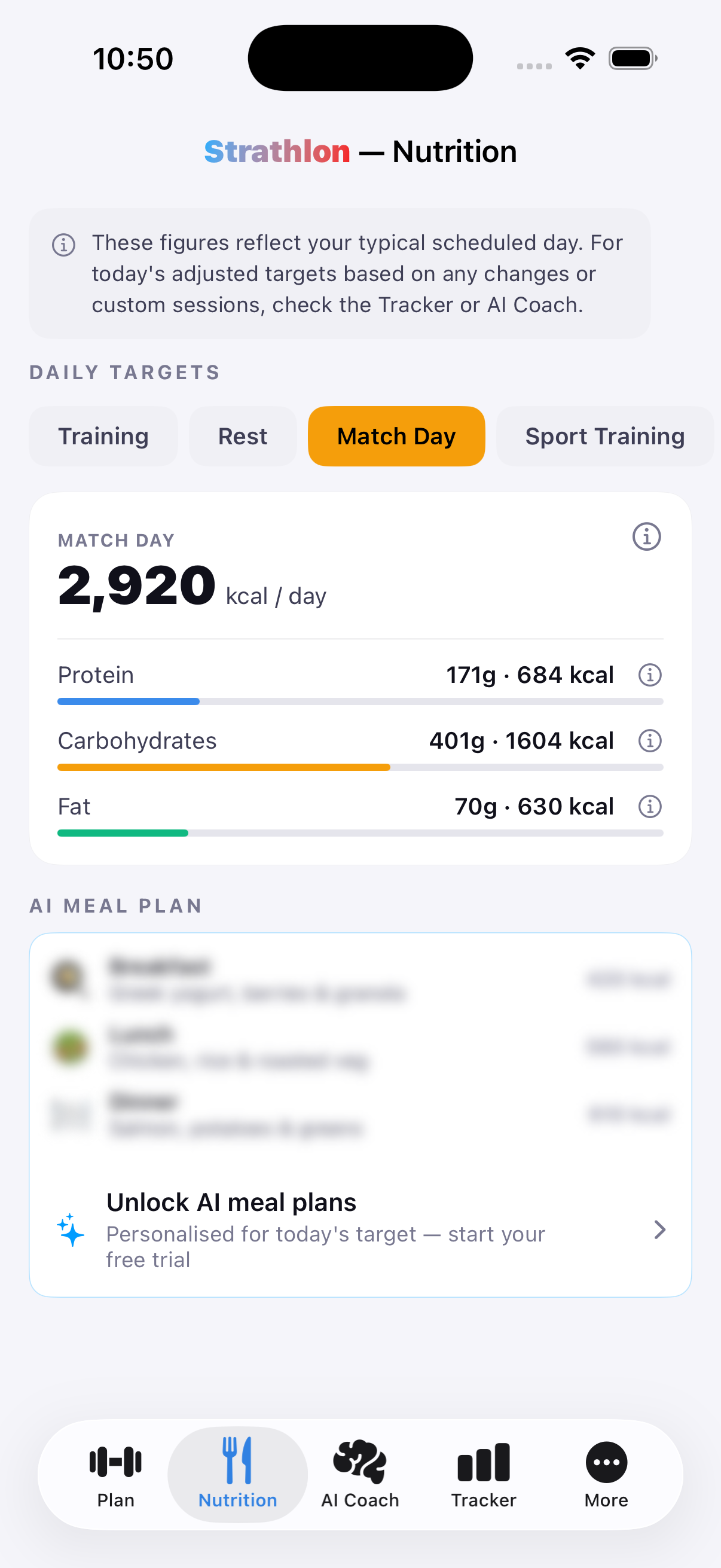
Because a match drains glycogen so quickly, the single biggest match-day lever is arriving with stores full. You don't need the brutal old "depletion" protocols marathoners once used, but for a demanding schedule a deliberate carbohydrate emphasis in the 36–48 hours before kick-off pays off. Contemporary team-sport guidance describes intakes of around 10–12 g of carbohydrate per kilogram of body weight per day across that window while easing training, which tops muscle glycogen toward its ceiling. For a single ordinary weekend fixture a well-fuelled day or two is usually enough. The full loading approach earns its place most in congested runs of matches or tournaments (rugby sevens being the extreme case), where stores must be rebuilt fast between games.
Then the pre-game meal. Position stands describe a carbohydrate-focused meal of roughly 1–4 g/kg eaten one to four hours before, larger and earlier when there's time to digest, smaller and closer to kick-off otherwise. This matches what elite players actually do: studies find they take their biggest carbohydrate hit on game day, with a pre-match meal of around 1.4 g/kg about three to four hours before kick-off and the majority of the day's calories eaten before they run out. Favour familiar, lower-fibre, lower-fat carbohydrate that sits lightly (porridge, rice, pasta, toast, a banana), and follow the golden rule: nothing new on match day.
During the 80 minutes: topping up
A rugby match runs long enough that fuelling during play helps. For intermittent efforts lasting more than an hour, the consensus is to take in carbohydrate at around 30–60 g per hour, enough to help maintain blood glucose and spare glycogen through the second half, when the fade otherwise bites. In a match that means using every legitimate break (injury stoppages, conversions, and especially half-time) to sip a carbohydrate drink or take a quick, familiar top-up.
One useful piece of sport-specific perspective: rugby does not need the very high 90 g-per-hour intakes, or the special glucose-plus-fructose blends built to absorb them, that ultra-endurance athletes chase. Those rates matter when you're racing for three or four hours straight. An 80-minute match with breaks is comfortably served by the 30–60 g/h range from ordinary sports drinks, gels or chews. Count the grams, pick the format your gut tolerates, and, as with everything here, rehearse it in training so match day is never the first attempt.
Hydration across a match
Rugby is often played in cool, wet conditions, which can mask how much fluid a hard-working, heavily-built player loses. Sweat rates in rugby commonly land somewhere around 1 to 2.5 litres per hour, and measurements in elite training have recorded rates of roughly 1.1–1.7 litres per hour depending on the session, with bigger, more contact-heavy forwards often toward the higher end. Let losses run too far and it costs you: dehydration beyond about 2% of body mass is associated with rising perceived effort and falling high-intensity performance, exactly the qualities rugby needs late in a match.
There's no universal millilitres-per-hour target, because sweat rates differ so much between players and conditions. The long-standing sports-medicine guidance is to drink enough to keep body-mass loss under about 2%, using the natural breaks in play, water carriers and half-time rather than a rigid schedule. The most reliable way to learn your own number is to weigh yourself before and after a match or hard session in representative kit and conditions: each kilogram lost is roughly a litre of sweat, which tells you how much you're under-replacing. For long or hot sessions, a drink carrying some sodium helps you hold on to what you take in, and conveniently, the same sports drinks that deliver carbohydrate usually carry sodium too, so fuelling and hydrating overlap.
Recovery from heavy contact
Recovery in rugby is uniquely demanding because it has to fix two things at once: the glycogen you burned, and the muscle damage the collisions inflicted. Tackles, carries into contact, scrums and hitting the ground all cause impact-induced muscle damage on top of the usual wear of sprinting, which can blunt force production and slow recovery for days. That's why rugby players who turn around quickly between matches or sessions can't leave recovery to chance.
Two nutrients lead the job. If the next hard session or match is soon, prioritise carbohydrate early: research on rapid recovery describes intakes of around 1.0–1.2 g per kilogram of body weight per hour in the first few hours to refill glycogen quickly. Pair it with protein (roughly 0.25–0.3 g/kg per feed, then continued across the following meals and days) to support the repair of damaged muscle. If you have a full day or more before the next demanding session, there's no need to rush. Hitting your normal daily carbohydrate and protein targets across meals refills stores comfortably.
The most under-rated recovery tool isn't a powder. It's sleep. Sleep is the body's largest daily recovery window, and deep sleep is when much of the overnight tissue repair and growth-hormone release happens, precisely what a body trying to repair collision damage and rebuild muscle depends on. (Acute sleep extension in rugby players has been shown to improve cognitive recovery, though not neuromuscular recovery.) Food and fluid fill the tank and supply the building blocks, and sleep is when much of the rebuilding actually happens.
Eating enough for the demands
For most rugby players the everyday risk isn't eating too much. It's not eating enough to support a big, hard-training, collision-loaded body. Under-fuel the base and you compromise the two things the sport is built on: the energy to complete high-quality training and matches, and the protein-plus-energy to build and repair muscle. Players who consistently sit below their needs tend to struggle to add or hold mass, recover slowly from contact, and lose sharpness late in games.
There is also a genuine health floor worth naming. Chronically taking in too little energy relative to what training burns (sports scientists call it low energy availability, and research associates dropping below roughly 30 kcal per kilogram of fat-free mass per day with problems for bone, hormones, immunity and performance) underpins what the International Olympic Committee calls Relative Energy Deficiency in Sport (RED-S), which can affect athletes of any body size or sex. It's less talked about in a mass-focused sport like rugby than in endurance running, but the principle holds: warning signs like recurrent stress injuries, frequent illness, stalled strength, poor sleep or (in women) disrupted periods are reasons to eat more rather than train harder, and to seek help from a sports physician or dietitian.
Common questions
How should a rugby player fuel on match day?
Aim to reach kick-off with muscle glycogen well topped up. That means a carbohydrate-rich day or two beforehand (for a demanding schedule, sports-nutrition guidelines describe around 10–12 g of carbohydrate per kilogram of body weight per day across the 36–48 hours before a game while easing training), then a pre-game meal built around familiar, lower-fat, lower-fibre carbohydrate roughly one to four hours out (professional players average around 1.4 g/kg about three to four hours before kick-off). Keep sipping carbohydrate and fluid before the whistle, top up at half-time, and don't try anything new on the day. Rehearse the whole plan in training first.
How much protein does a rugby player need to build and hold muscle?
Rugby-specific reviews and the major sports-nutrition bodies put daily protein for players at around 1.5–2.0 g per kilogram of body weight per day, which sits inside the International Society of Sports Nutrition's broader 1.4–2.0 g/kg/day range for building and maintaining muscle. Just as important as the total is how you spread it: roughly 0.25–0.4 g/kg (about 20–40 g of quality protein) per meal, every three to four hours across the day, tends to support muscle repair and growth better than one or two big hits. During a deliberate mass-gain block you also need enough total energy: protein alone won't build size if the overall calories aren't there.
How much should I drink during a rugby match?
There is no single number, because sweat rates vary widely: rugby players commonly lose somewhere around 1 to 2.5 litres of sweat per hour, with bigger, more contact-heavy forwards often at the higher end. The long-standing sports-medicine guidance is to drink enough to keep body-mass loss under about 2%, using the breaks in play, half-time and your own water bottle rather than a fixed schedule. The reliable way to find your number is to weigh yourself before and after a match or hard session: each kilogram lost is roughly a litre of sweat. For long, hot sessions, a drink carrying some sodium helps you hold on to what you take in.
Do forwards and backs need to fuel differently?
The principles are the same, but the totals differ. Forwards are generally heavier and spend more of the match in scrums, rucks, mauls and tackles, so they carry more mass and burn more total energy: in one study of elite professionals, forwards ate around 4,600 kcal a day versus about 3,800 for backs. Backs cover more ground at higher speed and lean heavily on repeat-sprint glycogen. Expressed per kilogram of body weight, their carbohydrate and protein targets look similar. The practical difference is that forwards simply need more food overall to fuel and rebuild a bigger, more collision-loaded body, while backs should make sure glycogen is full for repeated sprinting.
Do I need to carb-load for an 80-minute match?
You don't need the extreme depletion-then-load protocols used for marathons, but starting a match with full glycogen matters because rugby drains it fast: professional rugby-league players have been shown to use around 40% of their muscle glycogen in a single match, and team-sport studies report even larger falls. For a normal weekend fixture, a well-fuelled couple of days plus a good pre-game meal is usually enough. For a congested run of matches or a tournament, a deliberate higher-carbohydrate approach (around 10–12 g/kg/day in the 36–48 hours before) helps refill stores between games. Expect a small rise on the scale from stored glycogen and its water. That's fuel and hydration rather than fat.
How do I recover from the bruising and heavy contact of a match?
Recovery from rugby is two jobs at once: refilling the glycogen you burned and repairing the muscle damage the collisions caused. If your next session or match is soon, prioritise carbohydrate early (research on rapid recovery describes around 1.0–1.2 g per kilogram of body weight per hour in the first few hours) alongside roughly 0.25–0.3 g/kg of protein to support repair, then keep protein spread across the following days. The most under-rated recovery tool is sleep: it's the body's largest daily recovery window, and deep sleep is when much of the overnight tissue repair and growth-hormone release happens. Food, fluid and sleep together do more than any supplement.
Takeaways
- Rugby fuels two things at once. Carbohydrate powers the sprints and collisions, while protein and energy build and repair the mass you carry. Both matter equally.
- Build the carbohydrate base daily. Around 5–8 g/kg on ordinary days, up to 6–10 g/kg on the hardest training and match days, and move the dial with your week rather than saving carbs for game day.
- Eat plenty of protein, well spread. Around 1.5–2.0 g/kg/day, taken as roughly 0.25–0.4 g/kg (about 20–40 g) every three to four hours, with enough total energy to actually build.
- Start match day full. A match can burn ~40% of muscle glycogen. Emphasise carbohydrate for a day or two (up to ~10–12 g/kg/day for congested schedules) plus a familiar pre-game meal of ~1–4 g/kg, one to four hours out.
- Top up across the 80 minutes. Around 30–60 g of carbohydrate per hour via drinks or gels, using half-time and breaks. You don't need ultra-endurance rates.
- Hydrate to your own sweat rate. Rugby losses run ~1–2.5 L/h. Aim to keep body-mass loss under ~2%, weigh in and out to learn your number, and add sodium for long or hot sessions.
- Recover the fuel and the damage. Carbohydrate (~1.0–1.2 g/kg/h) plus protein (~0.25–0.3 g/kg) when turnaround is short, and treat sleep as a real recovery tool.
- Eat enough for the demands. For most players the risk is under-fuelling rather than over-eating, and chronic low energy availability harms mass, recovery, health and performance.
- References
If you remember one thing, make it this: the best-fuelled rugby players aren't the ones with the most supplements. They're the ones who eat enough, every day, to build the body the game demands and fill the tank it burns through. Strathlon's job is to keep that base honest by adjusting your targets around the matches and sessions you actually log, so the everyday fuelling that underpins every performance is one less thing to guess at.
References
Numbered sources for the specific figures, effect sizes and named studies above. Where a claim reflects agreed guidance rather than a single trial, the citation is to the position stand or consensus statement of the body concerned, with the country or international remit named. Rugby has a substantial and recent dietary-intake literature across both codes and both sexes, and the intake and energy-expenditure figures below are cited to it directly.
- Roberts CJ, Gough LA. Contemporary Themes in Dietary Intake in Rugby Union Players: A Narrative Review. Nutrients. 2024;16(17). Narrative review of contemporary themes in dietary intake in rugby union players: the anchor source for this guide. PubMed 39275326 · PMC11397367 full text
- Black KE, Hindle C, McLay-Cooke R, Brown RC, Gibson C, Baker DF, et al. Dietary Intakes Differ by Body Composition Goals: An Observational Study of Professional Rugby Union Players in New Zealand. American Journal of Men's Health. 2019;13(6):1557988319891350. Observational study showing dietary intakes differ by body-composition goal in professional rugby union players, the basis for matching intake to the job. PubMed 31775566 · PMC6883361 full text
- Wilson L, Jones B, Backhouse SH, Boyd A, Hamby C, Menzies F, et al. Energy expenditure of international female rugby union players during a major international tournament: a doubly labelled water study. Applied Physiology, Nutrition, and Metabolism = Physiologie Appliquee, Nutrition et Metabolisme. 2024;49(10):1340–1352. Study of the energy expenditure of international female rugby union players during a major tournament: the direct measure this guide's female figures rest on. PubMed 38976911
- Costello N, Deighton K, Preston T, Matu J, Rowe J, Jones B. Are professional young rugby league players eating enough? Energy intake, expenditure and balance during a pre-season. European Journal of Sport Science. 2019;19(1):123–132. Study asking whether professional young rugby league players are eating enough, the source for the under-fuelling risk in developing players. PubMed 30293523
- Souabni M, Del Sordo GC, Maso F, Peyrel P, Maviel C, Vercruyssen F, et al. Energy Balance and Dietary Intake in Young Rugby Players during a Pre-Season Micro-Cycle: A Cluster Analysis. Nutrients. 2024;16(17). Cluster analysis of energy balance and dietary intake in young rugby players during a pre-season micro-cycle, the pre-season picture. PubMed 39275179 · PMC11397292 full text
- Paul L, Naughton M, Jones B, Davidow D, Patel A, Lambert M, et al. Quantifying Collision Frequency and Intensity in Rugby Union and Rugby Sevens: A Systematic Review. Sports Medicine - Open. 2022;8(1):12. Systematic review quantifying collision frequency and intensity in rugby union and sevens, the demand this guide fuels for. PubMed 35050440 · PMC8776953 full text
- Portillo J, Del Coso J, Abián-Vicén J. Effects of Caffeine Ingestion on Skill Performance During an International Female Rugby Sevens Competition. Journal of Strength and Conditioning Research. 2017;31(12):3351–3357. Randomised trial of caffeine ingestion on skill performance during international female rugby sevens competition, the sport-specific caffeine evidence. PubMed 28002181
- Williams C, Rollo I. Carbohydrate Nutrition and Team Sport Performance. Sports Medicine. 2015;45 Suppl 1(Suppl 1):S13–22. Review of carbohydrate nutrition and team-sport performance, the source for the carbohydrate case. PubMed 26553494 · PMC4672015 full text
- Nuccio RP, Barnes KA, Carter JM, Baker LB. Fluid Balance in Team Sport Athletes and the Effect of Hypohydration on Cognitive, Technical, and Physical Performance. Sports Medicine. 2017;47(10):1951–1982. Review of fluid balance in team-sport athletes and the effect of hypohydration on performance. PubMed 28508338 · PMC5603646 full text
- Thomas DT, Erdman KA, Burke LM. Position of the Academy of Nutrition and Dietetics, Dietitians of Canada, and the American College of Sports Medicine: Nutrition and Athletic Performance. Journal of the Academy of Nutrition and Dietetics. 2016;116(3):501–528. Joint position of the Academy of Nutrition and Dietetics, Dietitians of Canada and the American College of Sports Medicine: the umbrella source for the daily energy, carbohydrate and protein ranges used throughout. PubMed 26920240
- Burke LM, Hawley JA, Wong SH, Jeukendrup AE. Carbohydrates for training and competition. Journal of Sports Sciences. 2011;29 Suppl 1:S17–27. Burke and colleagues on carbohydrate for training and competition, the source for the g/kg/day carbohydrate targets matched to training load. PubMed 21660838
- Jeukendrup A. A step towards personalized sports nutrition: carbohydrate intake during exercise. Sports Medicine. 2014;44 Suppl 1(Suppl 1):S25–33. Jeukendrup on personalising carbohydrate intake during exercise: the source for the g/h feeding rates and the duration at which they start to matter. PubMed 24791914 · PMC4008807 full text
- Jäger R, Kerksick CM, Campbell BI, Cribb PJ, Wells SD, Skwiat TM, et al. International Society of Sports Nutrition Position Stand: protein and exercise. Journal of the International Society of Sports Nutrition. 2017;14:20. International Society of Sports Nutrition (ISSN, United States) position stand on protein and exercise, the source for the daily protein range and per-meal distribution. PubMed 28642676 · PMC5477153 full text
- Schoenfeld BJ, Aragon AA. How much protein can the body use in a single meal for muscle-building? Implications for daily protein distribution. Journal of the International Society of Sports Nutrition. 2018;15:10. Schoenfeld and Aragon on how much protein the body can use in a single meal, the basis for the per-feed figure quoted. PubMed 29497353 · PMC5828430 full text
- Burke LM, van Loon LJC, Hawley JA. Postexercise muscle glycogen resynthesis in humans. Journal of Applied Physiology. 2017;122(5):1055–1067. Review of post-exercise muscle glycogen resynthesis, the source for the refuelling rates and for when a fast refuel is actually needed. PubMed 27789774
- Sawka MN, Burke LM, Eichner ER, Maughan RJ, Montain SJ, Stachenfeld NS. American College of Sports Medicine position stand. Exercise and fluid replacement. Medicine and Science in Sports and Exercise. 2007;39(2):377–90. ACSM position stand on exercise and fluid replacement: the source for the under-2% body-mass-loss guideline and the sweat-rate method. PubMed 17277604
- Barnes KA, Anderson ML, Stofan JR, Dalrymple KJ, Reimel AJ, Roberts TJ, et al. Normative data for sweating rate, sweat sodium concentration, and sweat sodium loss in athletes: An update and analysis by sport. Journal of Sports Sciences. 2019;37(20):2356–2366. Normative data for sweating rate and sweat sodium concentration in athletes, the source for how widely fluid and sodium losses vary between individuals. PubMed 31230518
- Hew-Butler T, Rosner MH, Fowkes-Godek S, Dugas JP, Hoffman MD, Lewis DP, et al. Statement of the Third International Exercise-Associated Hyponatremia Consensus Development Conference, Carlsbad, California, 2015. Clinical Journal of Sport Medicine : Official Journal of the Canadian Academy of Sport Medicine. 2015;25(4):303–20. Third International Exercise-Associated Hyponatremia Consensus statement, the basis for the warning against drinking well beyond sweat losses. PubMed 26102445
- Guest NS, VanDusseldorp TA, Nelson MT, Grgic J, Schoenfeld BJ, Jenkins NDM, et al. International society of sports nutrition position stand: caffeine and exercise performance. Journal of the International Society of Sports Nutrition. 2021;18(1):1. ISSN position stand on caffeine and exercise performance, the source for the caffeine dose and timing guidance. PubMed 33388079 · PMC7777221 full text
- Kreider RB, Kalman DS, Antonio J, Ziegenfuss TN, Wildman R, Collins R, et al. International Society of Sports Nutrition position stand: safety and efficacy of creatine supplementation in exercise, sport, and medicine. Journal of the International Society of Sports Nutrition. 2017;14:18. ISSN position stand on the safety and efficacy of creatine supplementation, cited where creatine is relevant to the sport's demands. PubMed 28615996 · PMC5469049 full text
- Maughan RJ, Burke LM, Dvorak J, Larson-Meyer DE, Peeling P, Phillips SM, et al. IOC consensus statement: dietary supplements and the high-performance athlete. British Journal of Sports Medicine. 2018;52(7):439–455. IOC consensus statement on dietary supplements and the high-performance athlete: the framing for treating supplements as optional extras. PubMed 29540367 · PMC5867441 full text
- Mountjoy M, Ackerman KE, Bailey DM, Burke LM, Constantini N, Hackney AC, et al. 2023 International Olympic Committee's (IOC) consensus statement on Relative Energy Deficiency in Sport (REDs). British Journal of Sports Medicine. 2023;57(17):1073–1097. The 2023 IOC consensus statement on Relative Energy Deficiency in Sport, the source for the consequences of under-fuelling a training load. PubMed 37752011
- Aragon AA, Schoenfeld BJ. Nutrient timing revisited: is there a post-exercise anabolic window?. Journal of the International Society of Sports Nutrition. 2013;10(1):5. Aragon and Schoenfeld on the post-exercise anabolic window, the source for timing mattering far less than daily totals. PubMed 23360586 · PMC3577439 full text
- British Dietetic Association (BDA, United Kingdom). Sport and exercise nutrition: Food Fact Sheet. British Dietetic Association (BDA, United Kingdom) Food Fact Sheet on sport and exercise nutrition, the practical UK dietetic framing. BDA Food Fact Sheet
This is general educational information rather than medical, dietary or coaching advice. The sports-nutrition figures here are drawn from established consensus and are framed as population-level guides; individual needs vary widely with body size, position, playing level, conditions, gut tolerance and health, and are best personalised with a qualified professional. Anyone with a health condition, a history of disordered eating, or who is pregnant or postpartum, or who suspects under-fuelling, stress fractures, menstrual disruption or RED-S, should consult a sports physician or registered dietitian before making changes. See our Terms for more.
← All guides · Rugby strength & conditioning · Eating for results · Understanding your stats · Home