
Golf strength & conditioning
An evidence-based guide to training the golfer's body. Golf looks gentle, but a full swing is one of the fastest rotational movements in sport: a whip that asks the whole body to store and release power in a fraction of a second, and to do it dozens of times a round without breaking down. This covers what the swing actually demands, the strength and power work that transfers to clubhead speed, how much conditioning golf really needs, prehab for the back, elbow, wrist and shoulder, and how to fit it all around a season. Practical, honest, and grounded in the sports-science literature.
Here's the short version: golf rewards rotational power, hip and thoracic mobility (to create hip–shoulder separation), and a strong, anti-rotation trunk and posterior chain. It is a power-and-mobility sport rather than an endurance one, so most of your gym time should build force and speed you can release fast instead of stamina you'll rarely use.
On this page
A framing note before the detail. Golf science is a smaller and younger field than, say, the running or lifting literature, and golfers vary enormously: age, playing level, mobility, injury history and swing style all shift what's right for a given person. So this is written as can, tends to and is associated with, never as a guarantee, and every specific figure is a study-level guide rather than a personal prescription. It's general education rather than medical or coaching advice, and it isn't a substitute for a qualified strength coach or a golf professional.
The demands of golf
Strip a golf round down and you have a skill sport built on a handful of maximal, explosive efforts. A drive lasts well under two seconds, yet in that window the body sequences a kinetic chain from the ground up: the legs push into the turf, the pelvis rotates, the trunk follows, and the arms and club arrive last and fastest, like the tip of a cracking whip. The quality that lets that whip snap is power: the ability to produce force quickly. It is telling that when researchers pooled the studies on what physical traits actually correlate with clubhead speed, the strongest links were to jump impulse, upper-body explosive strength and jumping peak power (whole-body explosiveness) while flexibility and balance showed essentially no association (Brennan et al., 2024, Sports Medicine). That single result reframes golf training: it is far more a power sport than the "just stay flexible" folklore suggests.
Rotation is the signature. Much attention goes to the X-factor: the difference between how far the shoulders turn and how far the hips turn, which sits at roughly 40–55 degrees of separation in many powerful swings. That separation loads the trunk like a wound spring. The greater the coil, the more elastic recoil is available to accelerate the trunk back toward the ball. Importantly, the biomechanics suggest it's the X-factor "stretch" (the brief increase in separation as the hips start the downswing while the shoulders are still turning back) that relates to clubhead speed, more than the raw size of the turn at the top (Meister et al., 2011, Journal of Applied Biomechanics, found X-factor at impact and peak upper-torso rotation among the variables most correlated with clubhead speed). So the swing needs both the mobility to create separation and the power to release it.
Energy-system wise, golf barely taxes your aerobic engine during the swing itself: each shot is powered by the immediate, oxygen-independent energy stores, with minutes of near-rest between efforts. The endurance element is simply the round: walking four to five miles over several hours, often carrying or pushing a bag. That matters for staying fresh late in a round, though it remains a low-intensity backdrop rather than the performance driver.
The flip side of all that speed and rotation is where golfers get hurt. The most common injury sites are the low back, elbow, wrist and shoulder. Across the epidemiology, the lumbar spine is the single most frequently reported region, and lifetime injury prevalence is higher in professionals (around 73.5%) than amateurs (around 56.6%): a signal that volume of swings, as much as the swing itself, drives breakdown (McHardy et al., systematic review). We'll come back to each of these, because the point of training isn't only to hit it further. It's to still be swinging pain-free in twenty years.
Key strength work, and why it matters
Because clubhead speed tracks with whole-body power, a good golf gym plan is built in layers: a base of general strength to raise your force ceiling, then power and rotational work to express that force fast. Here's what each layer does and why it transfers.
| Movement / pattern | Examples | What it builds | Why it transfers to golf |
|---|---|---|---|
| Lower-body strength | Back / front / goblet squat, split squat | Force production through the legs and hips | The swing pushes off the ground, and leg drive feeds the whole kinetic chain. |
| Hip hinge (posterior chain) | Deadlift, Romanian deadlift, hip thrust | Glute and hamstring strength, hip extension | Powers pelvic rotation and protects the low back under a rotational load. |
| Total-body power | Countermovement & squat jumps, trap-bar jump, throws | Rate of force development (explosiveness) | Jump metrics are the strongest correlates of clubhead speed in the research. |
| Rotational power | Med-ball rotational & shot-put throws, cable rotations | Fast, sequenced trunk and hip rotation | Trains the swing's signature action: separate, then release, at speed. |
| Anti-rotation core | Pallof press, plank, bird-dog, chops/lifts | Trunk stiffness & control of rotation | A stable trunk transmits leg and hip power to the club and spares the spine. |
| Single-leg & upper body | Lunge, step-up; rows, presses, carries | Balance under load, shoulder strength | Weight shifts onto one side in the swing, and the arms and lead shoulder need durability. |
The logic runs base-to-tip. Heavy compound lifts (squats and hinges especially) raise how much force you can produce at all. You can't express power you don't have. On top of that, ballistic and plyometric work (jumps and throws) teaches you to produce that force quickly, which is the trait that actually distinguishes long hitters. The systematic-review evidence is that combining these methods works: strength-and-conditioning interventions have raised clubhead speed, ball speed and driving distance by an average of roughly 4–6.4% where effects were significant (Ehlert, 2020, Journal of Sports Sciences). In one well-cited eight-week programme of combined weights and plyometrics in golfers, clubhead speed rose about 1.5% and driving distance about 4.3% (Fletcher & Hartwell, 2004, Journal of Strength and Conditioning Research): modest, but the kind of edge that reshapes which club you hit into a green.
Rotational power deserves its own note. Reviewers suggest that rotational-plane training may add benefit beyond straight up-and-down lifting for golf, and that maximal-power and ballistic movements belong in any golf programme (Ehlert, 2021, Journal of Strength and Conditioning Research). But the honest reading of the data is that rotation works best as part of a total-body power plan rather than instead of one: the biggest speed correlates are still whole-body jump and force metrics, so medicine-ball throws complement squats and jumps rather than replacing them. This is exactly the mix a golf-tuned plan should show: base lifts for force, jumps for speed, and rotational throws for the sport-specific expression.
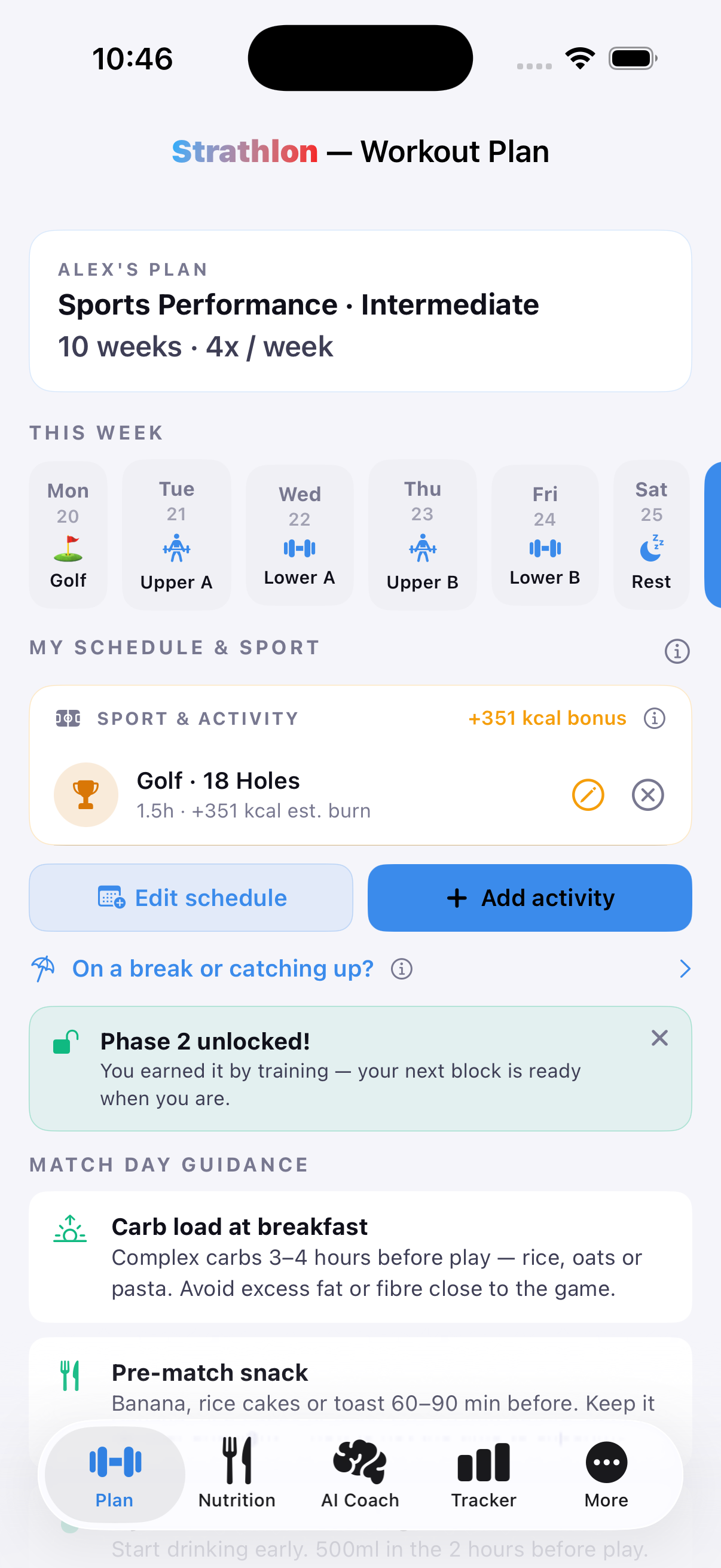
That pairing is worth dwelling on, because it captures the whole philosophy of training for a sport. The base lifts (the heavy compound work) are what actually raise your force ceiling. They are not general filler to be skipped in favour of swing-specific gadgets. On top of that base sit the sport-specific pieces: an accessory block of rotational power work matched to how a swing is sequenced, including explosive medicine-ball throws that train the speed the clubhead actually sees. Neither half works alone. Rotational drills on a weak base produce a fast movement with little force behind it. Heavy lifting that is never trained fast adds strength the swing never uses.
That layered picture is the whole point of pairing sport-specific work with a base. The rotational throws and accessory drills are what make the plan feel like golf, but they only transfer because a foundation of squat, hinge and press strength gives you force to accelerate. Skip the base and the throws have little to release. Skip the rotational work and you're strong in patterns the swing never uses. You need both, in that order of priority.
Conditioning for golf
Golf's conditioning needs are genuinely small compared with its strength and power needs, and it's worth being clear about that so you don't waste training time. The swing is fuelled by immediate energy stores and followed by long rest, so there is no repeat-sprint or high-aerobic demand to train the way there is in, say, football or running. Endless steady-state cardio does little for your golf and can eat into the recovery your power work needs.
What conditioning does earn its place is durability over a long round. Walking 18 holes is a few hours of low-intensity aerobic work, and fatigue late in a round tends to quietly degrade swing mechanics and on-course decisions. A modest aerobic base (a couple of easy-to-moderate sessions a week, or simply walking your rounds rather than riding) helps you arrive at the closing holes as fresh as the opening ones. Keep the intensity low so it doesn't compete with strength and power. This stays background fitness rather than the main course.
On the classic worry that cardio "kills" strength gains (the so-called interference effect), the practical answer for golfers is simple: the volumes of endurance work golf calls for are far too small to meaningfully blunt strength adaptation. Keep the hard aerobic work modest, separate it from your key power sessions by a few hours or a day where you can, and prioritise the gym work that actually moves clubhead speed.
Staying injury-resilient
The training that makes you powerful also makes you more durable, but golf's specific injuries reward some targeted attention. Here's each of the big four and the evidence-based response.
Low back. This is the golfer's signature injury: reviews put golf-related low-back injury incidence at roughly 15–34% in amateurs and 22–24% in professionals (McHardy & Pollard). The swing loads the spine with a fast, asymmetric mix of rotation, side-bend and extension. A 2020 review of biomechanical risk factors highlights limited hip strength and mobility, the "crunch factor" (side-bending combined with rotation toward the trail side), and rotating beyond your available range as contributors (Edwards et al., 2020, Sports Medicine and Health Science). The prehab that follows is unglamorous and effective: build hip mobility so the hips absorb rotation instead of the lumbar spine; strengthen the glutes and abdominals; use base lifts like squats and deadlifts to make the trunk more load-tolerant; and add anti-rotation core work (Pallof presses, planks, bird-dogs) so the spine stays controlled while the hips do the turning.
Elbow. "Golfer's elbow" (medial epicondylitis) is a repetitive-strain tendinopathy from gripping and wrist flexion, and it tends to strike the trail arm in a right-handed golfer, while lateral epicondylitis ("tennis elbow") more often hits the lead arm. Elbow complaints are a notable share of amateur injuries in particular. The prehab is grip and forearm strength plus eccentric wrist work (slow wrist flexion and extension against load), which is the mainstay of managing these tendons, alongside sensible practice volume, since hitting endless range balls off hard mats is a classic trigger.
Wrist. The wrists absorb the shock of impact (especially the lead wrist) and are vulnerable to strains, tendon irritation and, from catching the ground, impact injuries. Wrist and forearm strengthening and controlling practice volume are the levers here. Technique work with a professional to avoid heavy "fat" shots off unforgiving surfaces helps too.
Shoulder. The lead shoulder (left, for a right-handed golfer) is the one most often injured, typically stressed at the top of the backswing and through impact, and the shoulder makes up around 17.6% of golf injuries in the pooled data. Keeping it healthy is about rotator-cuff and scapular strength and controlled overhead and rotational mobility: rows, presses done pain-free, external-rotation work and carries all contribute. As with the other sites, the honest framing is risk reduction rather than a guarantee: no exercise makes an injury impossible, but stronger, more mobile, better-controlled tissue tolerates the swing's demands far better.
One low-cost habit ties all of this together: a rotational warm-up before you play or practise. Going from cold straight into full-speed swings is a recognised way to strain a back or a tendon. A few minutes of mobility and progressively bigger practice swings prepares the tissues for what's coming.
Programming it around your season
Golf has a long season and a lot of skill practice, so the trick is fitting strength work around it without arriving at rounds tired. The standard periodised approach works well:
- Off-season: build. This is when you raise your ceiling. Two to three gym sessions a week emphasising heavier strength and power, progressively overloaded, when there are no important rounds to protect. If you're going to make a real jump in clubhead speed, it starts here.
- In-season: maintain. You don't need to keep building to keep your gains. A systematic review and meta-analysis found no clear difference in maximal-strength development between higher and lower training frequencies in well-trained people when total work is comparable (Cuthbert et al., 2021), and the wider "maintaining performance" literature suggests as little as one quality session per week can preserve strength through a competitive block, provided the intensity stays high. Practically, one to two short, hard sessions a week hold your strength and power while leaving plenty of energy for golf.
- Manage fatigue around rounds. Place your heaviest lifting on days furthest from important rounds or competitions, and keep the day before a key round light. The goal in-season is to arrive fresh and swing fast rather than set gym personal bests.
- References
Two practical anchors. First, keep the intensity, cut the volume in-season: high effort maintains strength more than high frequency does, so shorter sessions with a few hard sets beat long ones. Second, let skill practice and gym work coexist by watching total fatigue: if your swing feels heavy or your speed drops, you're likely doing too much overall, and the fix is usually to trim volume somewhere rather than grind harder.
Where Strathlon fits, and a myth to bust

Common questions
What's the single best exercise to hit the golf ball further?
There isn't one. Clubhead speed (the main driver of distance) tracks most strongly with whole-body power rather than any single lift: in a 2024 meta-analysis, jump impulse, upper-body explosive strength and jumping peak power showed the largest associations with clubhead speed, while flexibility and balance did not. So the best "exercise" is a mix: heavy lower-body strength (squat and hinge patterns), explosive power (jumps and throws) and rotational medicine-ball work. Strength-and-power programmes have raised clubhead speed, ball speed and distance by roughly 4–6% on average across studies, so the combination (not one magic move) is what transfers.
Will lifting weights make me stiff or too bulky and ruin my swing?
This is the most common fear and it's largely unfounded. In the meta-analysis on clubhead speed, flexibility was not significantly associated with faster swings, whereas strength and power were, so getting stronger is the transfer rather than the problem. Lifting through a full range of motion tends to maintain or improve mobility rather than reduce it, and building noticeable muscle is a slow, deliberate process rather than something that happens by accident. What the swing does need is good hip and thoracic-spine mobility to create rotation. You train that alongside strength, and you don't trade one for the other.
How do I train the X-factor and rotational power?
The X-factor is the separation between how far your shoulders turn and how far your hips turn: commonly around 40–55 degrees in powerful swings. Biomechanics research suggests the "stretch" of that separation early in the downswing matters more for speed than simply making a huge backswing turn. So train the two ingredients: mobility (hips and thoracic spine) to allow the separation, and rotational power (medicine-ball rotational and shot-put-style throws, plus cable or band rotations) to express it fast. Pair that with total-body power like jumps, because whole-body explosiveness (not rotation alone) is what best predicts clubhead speed. Chasing an ever-bigger backswing turn is not the goal, and excessive trunk rotation beyond your active range is actually a back-pain risk factor.
I get low-back pain from golf: what actually helps?
Low back pain is the most common golf complaint (reviews put golf-related low-back injury at roughly 15–34% in amateurs and 22–24% in professionals) and it's multifactorial. A 2020 review of biomechanical risk factors points to limited hip strength and mobility, the "crunch factor" (side-bending combined with rotation on the trail side), and rotating beyond your available range. The evidence-supported response is to build hip mobility and glute and abdominal strength, use base lifts like squats and deadlifts to make the trunk and hips more load-tolerant, and do a rotational warm-up before you play rather than swinging hard cold. Persistent or severe pain is a job for a clinician, well past the point where more prehab helps.
How often should I train in-season without wrecking my golf?
Less than you might think. A systematic review and meta-analysis found no clear difference in maximal-strength development between higher and lower training frequencies in well-trained people when total work is similar, and reviews on maintaining performance suggest as little as one quality session per week can hold onto strength gains during a competitive block, provided the intensity stays high. Practically: build strength and power in the off-season with two or three sessions a week, then maintain in-season with one to two short, intense sessions placed away from your important rounds so you're not lifting into a competition fatigued.
Do I need to do cardio or endurance work for golf?
Golf is a power and skill sport rather than an endurance one, so conditioning plays a supporting role rather than driving performance. Even so, walking 18 holes (often four to five miles carrying or pushing a bag) is a genuine low-intensity aerobic demand, and a modest aerobic base can help you feel fresher and swing as well on the closing holes as on the first, when fatigue tends to degrade both mechanics and decisions. Keep it low-to-moderate and don't let it eat into your strength and power work, which is where the performance transfer lives.
Takeaways
- Golf is a power sport. Clubhead speed tracks with whole-body explosiveness (jump and force metrics) more than with flexibility or balance, so train force and speed over stamina.
- Build the base, then the tip. Heavy squats and hinges raise your force ceiling. Jumps and throws teach you to release it fast, and rotational work makes it golf-specific. You need all three, in that priority.
- Train the X-factor's ingredients. Hip and thoracic mobility to create hip–shoulder separation, plus rotational power to express it. A bigger backswing turn on its own isn't the point.
- Expect modest but real gains. Strength-and-power programmes have raised clubhead speed, ball speed and distance by around 4–6% on average: enough to change the club you hit in.
- Prehab the big four. Low back (hips, glutes, anti-rotation core), elbow (grip and eccentric forearm work), wrist (forearm strength, sensible volume) and lead shoulder (rotator-cuff and scapular strength), framed as risk reduction rather than a guarantee.
- Warm up rotationally before you play. Cold, full-speed swings are a classic way to strain a back or tendon.
- Build off-season, maintain in-season. One to two hard, short sessions a week can maintain strength through a competitive block: keep the intensity, cut the volume, and lift away from key rounds.
- Keep conditioning light. A modest aerobic base helps you finish rounds strong, so don't let steady-state cardio crowd out the power work that actually transfers.
If you take one idea away, make it this: golf rewards power you can release fast, in rotation, without breaking down. Build a base of strength, add speed on top, make it golf-specific with rotational work, and look after the back, elbows, wrists and shoulders that take the load. Strathlon's role is to tune that plan toward golf (with Sports Performance as one of your goals) and keep the base honest: a sport-aware starting point you then refine with a coach as your game demands.
Pair this with the golf fuelling guide: how to eat and hydrate to swing as well on the 18th as the 1st, and avoid the late-round energy dip.
References
Numbered sources for the specific figures, effect sizes and named studies above. Where a claim reflects agreed guidance rather than a single trial, the citation is to the position stand or consensus statement of the body concerned, with the country or international remit named. Golf's strength-training question has been tested directly against clubhead speed, so the transfer claims below are cited to golf trials rather than generalised from other rotational sports.
- Uthoff A, Sommerfield LM, Pichardo AW. Effects of Resistance Training Methods on Golf Clubhead Speed and Hitting Distance: A Systematic Review. Journal of Strength and Conditioning Research. 2021;35(9):2651–2660. Systematic review of resistance-training methods on golf clubhead speed and hitting distance: the direct source for the claim that lifting adds distance. PubMed 34224506
- Sheehan WB, Watsford ML, Pickering Rodriguez EC. Examination of the neuromechanical factors contributing to golf swing performance. Journal of Sports Sciences. 2019;37(4):458–466. Study of the neuromechanical factors contributing to golf swing performance, the mechanism behind that transfer. PubMed 30064296
- Robinson L, Murray A, Glover D, Coughlan D, Mountjoy M, Scott F, et al. Associations Between Physical Performance and Golf Shot Data: A Pilot Study of Touring Professional Female Players. Journal of Strength and Conditioning Research. 2025;39(6):687–694. Study associating physical performance measures with golf shot data in touring professional female players, the on-course evidence. PubMed 40267454
- Robinson L, Murray A, Coughlan D, Mountjoy M, Wells J, Hembrough R, et al. Relationships and Within-Group Differences in Physical Attributes and Golf Performance in Elite Amateur Female Players. Life. 2024;14(6). Study of physical attributes and golf performance in elite amateur female players, the second source for the same association. PubMed 38929658 · PMC11204580 full text
- Robinson L, Murray A, Mountjoy M, Wells J, Coughlan D, Glover D, et al. Practices and perceptions of strength and conditioning training in female golf: A cross-sectional survey study of high-level amateur players. Journal of Sports Sciences. 2024;42(3):270–280. Survey of strength and conditioning practice in female golf, cited for the gap between what is known and what is done. PubMed 38470315
- Murray AD, Daines L, Archibald D, Hawkes RA, Schiphorst C, Kelly P, et al. The relationships between golf and health: a scoping review. British Journal of Sports Medicine. 2017;51(1):12–19. Scoping review of the relationships between golf and health, the general health framing of the sport. PubMed 27697939 · PMC5256129 full text
- Leupold O, Cheng J, Prather H, Creighton A. Characteristics of training and lifestyle in high-level competitive golfers. PM & R : the Journal of Injury, Function, and Rehabilitation. 2026. Study of training and lifestyle characteristics in high-level competitive golfers, cited in the programming section. PubMed 42125985
- Bayes MC, Wadsworth LT. Upper extremity injuries in golf. The Physician and Sportsmedicine. 2009;37(1):92–6. Review of upper-extremity injuries in golf, the source for the sport's characteristic injury pattern. PubMed 20048492
- Yu W, Feng D, Zhong Y, Luo X, Xu Q, Yu J. Examining the Influence of Warm-Up Static and Dynamic Stretching, as well as Post-Activation Potentiation Effects, on the Acute Enhancement of Gymnastic Performance: A Systematic Review with Meta-Analysis. Journal of Sports Science & Medicine. 2024;23(1):156–176. Meta-analysis of warm-up static and dynamic stretching and post-activation potentiation effects, the basis for the warm-up advice before a round. PubMed 38455430 · PMC10915619 full text
- Suchomel TJ, Nimphius S, Stone MH. The Importance of Muscular Strength in Athletic Performance. Sports Medicine. 2016;46(10):1419–49. Suchomel and colleagues on the importance of muscular strength in athletic performance: the source for greater maximal strength being associated with faster sprinting, jumping and change of direction, and with lower injury risk. PubMed 26838985
- Seitz LB, Reyes A, Tran TT, Saez de Villarreal E, Haff GG. Increases in lower-body strength transfer positively to sprint performance: a systematic review with meta-analysis. Sports Medicine. 2014;44(12):1693–702. Seitz and colleagues' systematic review with meta-analysis showing increases in lower-body strength transfer positively to sprint performance, the evidence behind the 'strength is the base' argument. PubMed 25059334
- Lauersen JB, Andersen TE, Andersen LB. Strength training as superior, dose-dependent and safe prevention of acute and overuse sports injuries: a systematic review, qualitative analysis and meta-analysis. British Journal of Sports Medicine. 2018;52(24):1557–1563. Lauersen and colleagues' meta-analysis finding strength training a superior, dose-dependent and safe prevention of acute and overuse sports injuries: the direct source for treating strength work as prehab. PubMed 30131332
- Lauersen JB, Bertelsen DM, Andersen LB. The effectiveness of exercise interventions to prevent sports injuries: a systematic review and meta-analysis of randomised controlled trials. British Journal of Sports Medicine. 2014;48(11):871–7. Lauersen and colleagues' earlier meta-analysis of exercise interventions to prevent sports injuries, the broader evidence base the prevention advice sits on. PubMed 24100287
- . American College of Sports Medicine position stand. Progression models in resistance training for healthy adults. Medicine and Science in Sports and Exercise. 2009;41(3):687–708. American College of Sports Medicine (ACSM, United States) position stand on progression models in resistance training: the source for the heavy-load and explosive-load percentage ranges quoted. PubMed 19204579
- Cuthbert M, Haff GG, Arent SM, Ripley N, McMahon JJ, Evans M, et al. Effects of Variations in Resistance Training Frequency on Strength Development in Well-Trained Populations and Implications for In-Season Athlete Training: A Systematic Review and Meta-analysis. Sports Medicine. 2021;51(9):1967–1982. Cuthbert and colleagues' systematic review of resistance-training frequency in well-trained populations, the source for the sessions-per-week guidance. PubMed 33886099 · PMC8363540 full text
- Spiering BA, Mujika I, Sharp MA, Foulis SA. Maintaining Physical Performance: The Minimal Dose of Exercise Needed to Preserve Endurance and Strength Over Time. Journal of Strength and Conditioning Research. 2021;35(5):1449–1458. Spiering and colleagues on the minimal dose of exercise needed to preserve endurance and strength: the source for maintaining in-season on as little as one to two sessions a week. PubMed 33629972
- Rønnestad BR, Nymark BS, Raastad T. Effects of in-season strength maintenance training frequency in professional soccer players. Journal of Strength and Conditioning Research. 2011;25(10):2653–60. Ronnestad and colleagues' trial of in-season strength maintenance frequency in professional footballers, the specific in-season maintenance result quoted. PubMed 21873897
- Nuzzo JL, Pinto MD, Kirk BJC, Nosaka K. Resistance Exercise Minimal Dose Strategies for Increasing Muscle Strength in the General Population: an Overview. Sports Medicine. 2024;54(5):1139–1162. Nuzzo and colleagues on minimal-dose resistance exercise strategies for increasing strength, supporting the claim that a small, well-chosen dose does most of the work. PubMed 38509414 · PMC11127831 full text
- Wilson JM, Marin PJ, Rhea MR, Wilson SM, Loenneke JP, Anderson JC. Concurrent training: a meta-analysis examining interference of aerobic and resistance exercises. Journal of Strength and Conditioning Research. 2012;26(8):2293–307. Wilson and colleagues' meta-analysis of concurrent training and the interference effect: the source for separating heavy lifting from hard conditioning. PubMed 22002517
- Schumann M, Feuerbacher JF, Sünkeler M, Freitag N, Rønnestad BR, Doma K, et al. Compatibility of Concurrent Aerobic and Strength Training for Skeletal Muscle Size and Function: An Updated Systematic Review and Meta-Analysis. Sports Medicine. 2022;52(3):601–612. An updated systematic review of the compatibility of concurrent aerobic and strength training, the more recent evidence that interference is smaller than once believed. PubMed 34757594 · PMC8891239 full text
- Ramirez-Campillo R, Sortwell A, Moran J, Afonso J, Clemente FM, Lloyd RS, et al. Plyometric-Jump Training Effects on Physical Fitness and Sport-Specific Performance According to Maturity: A Systematic Review with Meta-analysis. Sports Medicine - Open. 2023;9(1):23. Ramirez-Campillo and colleagues on plyometric-jump training effects on physical fitness and sport-specific performance, the source for the plyometric guidance. PubMed 37036542 · PMC10086091 full text
- Impellizzeri FM, Woodcock S, Coutts AJ, Fanchini M, McCall A, Vigotsky AD. What Role Do Chronic Workloads Play in the Acute to Chronic Workload Ratio? Time to Dismiss ACWR and Its Underlying Theory. Sports Medicine. 2021;51(3):581–592. Impellizzeri and colleagues on the pitfalls of the acute:chronic workload ratio; cited because it is the reason this guide talks about ramping load gradually rather than quoting a workload number. PubMed 33332011
- Baz-Valle E, Balsalobre-Fernández C, Alix-Fages C, Santos-Concejero J. A Systematic Review of The Effects of Different Resistance Training Volumes on Muscle Hypertrophy. Journal of Human Kinetics. 2022;81:199–210. Systematic review of resistance-training volume and hypertrophy, the general dose-response evidence behind the set and session recommendations. PubMed 35291645 · PMC8884877 full text
This is general educational information rather than medical or individual coaching advice. The sports-science figures here are drawn from published studies and reviews and are framed as population-level associations and guides: individual needs vary widely with age, playing level, mobility and injury history, and are best personalised with a qualified strength-and-conditioning coach or golf professional. Anyone with pain, an injury, a health condition, or who is pregnant or postpartum, should consult a qualified clinician before starting or changing an exercise programme; recurrent low-back, elbow, wrist or shoulder pain warrants proper assessment rather than training through it. See our Terms for more.
← All guides · Golf fuelling guide · Eating for results · How muscle actually grows · Recovery & rest · Understanding your stats · Home