
Strength & conditioning for triathlon
An evidence-based guide to the gym half of triathlon. Swim, bike and run are aerobic sports, so it's tempting to treat lifting as optional, but a small, well-placed dose of strength work is one of the best-supported ways to get more economical across all three disciplines and to survive the running volume that breaks most triathletes down. This covers the demands of the sport, the lifts that actually transfer, how to fit strength around swim–bike–run without the interference effect eating your gains, the prehab that lowers overuse risk, and how to programme it across a season. Practical, honest, and grounded in sports-science consensus.
Here's the short version: for a triathlete the gym has three jobs, and only three that matter much: build maximal (heavy) strength so each pedal stroke and stride costs less oxygen, develop a little reactive, elastic strength so your running is springier, and earn structural durability so the run-dominant overuse injuries don't end your season. You get most of that from a handful of heavy compound lifts done a couple of times a week: a minimal effective dose, far short of a bodybuilding programme bolted onto an already-huge endurance week.
On this page
A framing note before the detail. Strength and conditioning is well studied, but people differ enormously: training age, background, distance raced, sex, sleep and injury history all change what's right for a given athlete. So this is written as can, tends to and is associated with, never as a guarantee, and every specific number is a population-level guide from published research rather than a personal prescription. It's general education rather than medical or individual coaching advice, and it isn't a substitute for a qualified S&C coach, especially if you're carrying an injury.
The demands of triathlon
Triathlon is three endurance sports in a row, and physiologically it's dominated by the aerobic system: even a sprint-distance race is minutes of sustained effort, and long-course racing runs for hours. That means the headline fitness (your aerobic engine, your sustainable pace) is built by swimming, cycling and running. What the gym changes is the cost of moving at a given speed (your economy) and how well the body holds together under repetitive load.
Each discipline stresses the body differently. Swimming is an upper-body, overhead sport: propulsion comes from the lats, chest and shoulders driving repeated internal rotation and adduction, which is why the shoulder is the swimmer's vulnerable joint. Cycling is a repetitive, low-impact pushing action through the quads, glutes and calves at a high pedalling cadence, where the ability to apply force without maxing out limits sustained power. Running is the high-impact discipline: each stride is a small landing your legs must absorb and return, thousands of times, which places the tendon and connective tissue of the lower limb under the most repetitive stress of the three.
That impact profile is why triathlon's injury burden is overwhelmingly overuse. Accidents are rare by comparison. A systematic review of long-distance triathlon injuries found overuse problems far outnumber acute ones, with reported overuse incidence spanning a wide 37–91% depending on the cohort, and running and cycling as the disciplines most often implicated. The most common sites were the knee (roughly 14–22% of problems), the lower leg and Achilles (roughly 10–18%), and the lower back (about 16–18%), with the shoulder the classic swim-related complaint. In other words, the tissue that most often fails is the tissue the run keeps pounding, which is exactly where sensible strength work earns its place.
Key strength work, and why it matters
The single most useful thing the gym does for a triathlete is improve economy. In a widely cited 2014 review, Rønnestad and Mujika concluded that adding strength training to endurance work improves running economy (via either heavy or explosive strength) and improves cycling economy (best via heavy strength), without harming the aerobic engine. The mechanism is mostly neuromuscular: when a lift makes your legs stronger, any given race pace uses a smaller fraction of your maximum, each contraction is more efficient, and stiffer tendons return more free elastic energy, so you spend less oxygen to hold the same speed.
The evidence is specific about how to lift for this. The loading is heavy and low-rep, well clear of light, pump-chasing sets. A systematic review and meta-analysis of heavy strength training in endurance cyclists found it improved cycling efficiency and time-trial-type performance with no change in VO2max: the analysed programmes averaged around 84% of one-rep max (1RM), roughly 3–4 sets, about twice a week for a mean of ~14 weeks, built on squats and leg-press variations. On the run side, a meta-analysis comparing methods found heavy resistance training produced a small but meaningful improvement in running economy that was somewhat larger than plyometric training alone. And most relevant of all: studies adding progressive strength work to triathletes specifically, building from moderate loads (~8–12 reps at ≤75% 1RM) toward heavy loads (~1–6 reps at ≥85% 1RM) over several months, improved both running and cycling economy without any gain in body mass. That last point is the one nervous triathletes need: added strength makes you more economical without adding weight.
Alongside heavy strength, a modest amount of plyometric / reactive work targets the run specifically. Because running is a bounce, the stretch-shortening cycle (the tendon storing and returning energy on each foot strike) is a big part of run economy. Reviews of plyometric jump training in runners report improvements in running economy commonly in the region of ~2–8%, though the average pooled effect is small and grows with consistent, longer-term dosing (more sessions, programmes running beyond ~7 weeks, or training at least twice a week) or when paired with heavy lifting, alongside shorter ground-contact times, and even a single plyometric session a week can contribute. This is why a triathlete's gym plan should include a few low hops, pogos or bounds (small doses of springiness) on top of the heavy lifting.
Put together, the priorities look like this. The exact loading is illustrative, drawn from the protocols above. Your numbers depend on your lifting experience and coach.
| Movement | Examples | Rough loading | Why it transfers |
|---|---|---|---|
| Heavy squat pattern | Back / front / goblet squat | 3–4 × 3–6, heavy | Force per stride and pedal stroke → run & bike economy. |
| Hip hinge | Deadlift, Romanian deadlift, hip thrust | 3–4 × 4–6, heavy | Posterior-chain power alongside hamstring and back robustness. |
| Single-leg strength | Split squat, step-up, single-leg press | 2–3 × 6–8 / leg | Matches the one-legged reality of running and pedalling. |
| Calf / lower leg | Heavy calf raise, heel drops | 2–3 × 6–10 | Achilles and lower-leg durability for run volume. |
| Reactive / plyometric | Pogos, low hops, short bounds | Low volume, quality | Tendon stiffness & stretch-shortening → run economy. |
| Pull & shoulder care | Rows, pull-downs, external rotations | 2–3 × 8–12 | Swim propulsion, while balancing and protecting the shoulder. |
Notice the shape of it: the heavy compound lower-body lifts are the core, because that's where the economy evidence is strongest, and everything else (calves, reactive hops, pulling and shoulder work) is complementary work that rounds the plan out for the specific demands of swim, bike and run. That combination (a goal-driven strength base plus a triathlon-relevant accessory layer) is the shape of the plan Strathlon builds around the sessions below when Sports Performance is one of your goals.
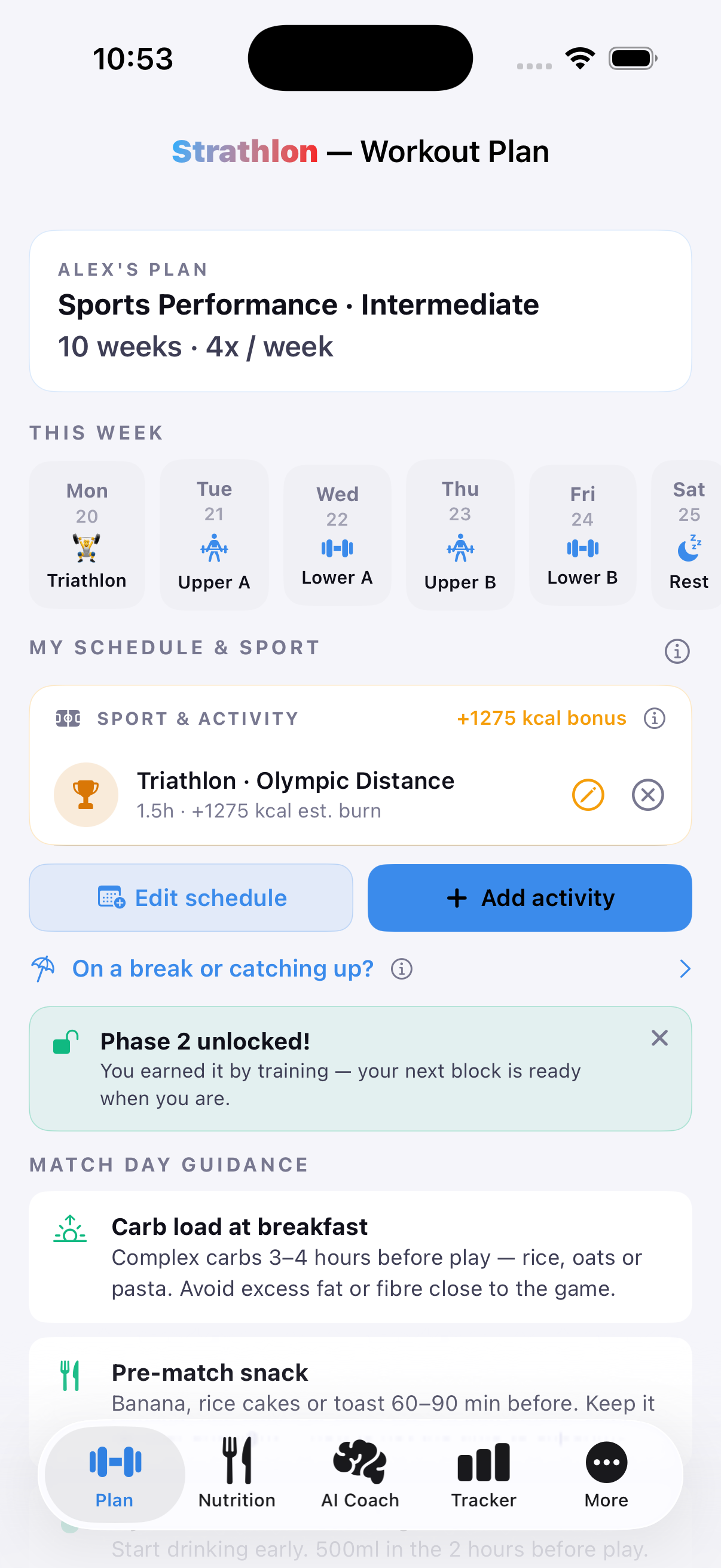
That pairing is worth dwelling on, because it captures the whole philosophy of training for three sports at once. The base lifts (heavy, low-rep compound work) are what improve economy and efficiency. They are not filler to be dropped whenever the training week gets full. On top of that base sit the sport-specific pieces: an accessory block of posterior-chain, single-leg, calf and trunk work that trains the ability to hold form late. Neither half works alone. Gym work only ever supplements the swim, bike and run, and never replaces them. But the swim, bike and run alone leave the economy gains that heavy strength work reliably delivers on the table.
Conditioning for triathlon
The conditioning side of triathlon is, mostly, the sport itself: the aerobic base and race-specific intensity you build by swimming, cycling and running. Strength work supports that engine but doesn't replace it: the gym improves economy and durability, while the swim–bike–run volume develops the cardiovascular fitness that actually sets your pace. The real conditioning question for a triathlete isn't "what intervals?" so much as "how do I fit strength around all this endurance without the two fighting each other?"
This is the interference effect: the concern that concurrent endurance training blunts strength adaptation, and vice versa. The reassuring news from recent meta-analyses is that for maximal strength and muscle size the interference is small in most people. Where it genuinely shows up is in explosive power and rate of force development. Since a triathlete is chasing economy and durability rather than a big vertical jump, the interference risk is modest, and it's manageable with scheduling rather than by avoiding one type of training.
Three practical rules keep strength and endurance out of each other's way:
- Separate the hard efforts. Where you can, put your heavy gym session and your key endurance session on different days, or at least several hours apart. Doing both hard, back-to-back, is when interference and fatigue are most likely to bite.
- Mind the order when you must combine. If a lift and a ride land in the same session, the general guidance is to lift first when strength is that day's priority. Put the heavy legs after a key run, so you don't run your quality session on tired legs.
- Protect the key sessions. Don't sandwich a race-important long run or brick between two heavy leg days. The endurance work that decides your race comes first. Strength is scheduled into the gaps around it.
- References
Kept in its lane, heavy low-rep strength coexists happily with a big endurance week, which is precisely why the economy studies above were able to add lifting to already-trained endurance athletes and see gains rather than losses.
Staying injury-resilient
Because triathlon injuries are mostly overuse, the goal of prehab is to raise the load your tissues tolerate before they complain, and to shore up the specific sites the sport keeps hammering. Strength training broadly builds tissue capacity. A few targeted exercises add site-specific protection where the evidence is strongest.
- Achilles & lower leg (the runner's Achilles heel, literally). Eccentric calf work (the heel-drop protocol popularised by Alfredson, classically 3 sets of 15, twice a day) has among the best evidence of any tendon rehab for reducing pain and improving function in midportion Achilles tendinopathy. Even used preventively, loading the calf and Achilles builds the capacity that high run mileage demands.
- Hamstrings & posterior chain. Nordic hamstring exercises are the headline here: injury-prevention programmes that include them are associated with roughly halving hamstring injury rates in team-sport meta-analyses (pooled risk ratio around 0.5 across thousands of athletes). Honesty matters, though: a later methodological reappraisal argued the protective effect is less certain than that figure suggests and should be treated as conditionally recommended. The sensible read: it's a cheap, well-tolerated exercise with a plausible and largely favourable evidence base, though nothing here is guaranteed.
- Knee & hips. The knee is triathlon's most common overuse site, and much run-related knee pain tracks back to how the hip and thigh control the leg on landing. Strengthening the glutes, quads and hips (via the squat, single-leg and hinge work above) is a reasonable, evidence-aligned way to improve that control and share load away from the knee.
- Swimming shoulder. Swim training overworks the internal rotators and can leave the external rotators and scapular stabilisers relatively weak: the imbalance behind "swimmer's shoulder." Preventive programmes of rotator-cuff and scapular strengthening (external-rotation and scapular-control work) have been shown to reduce that rotator-cuff strength imbalance over about 12 weeks, which is why a little dedicated shoulder work belongs in a triathlete's plan.
None of this makes you injury-proof: triathlon's overuse risk is driven above all by training load and how fast you ramp it, and no exercise offsets doing too much too soon. Prehab lowers the odds. Managing volume is still the main event. If something is already painful, that's a job for a clinician rather than a training article.
Programming it around your season
The way strength fits into a triathlon year changes with the calendar, and the guiding idea is simple: build strength when racing is far away, then spend as little as possible to keep it when racing is close.
In the off-season / base phase, when endurance intensity is lower, there's room to train strength properly. This is where the heavy work happens: around two sessions a week, progressing over a block of a couple of months toward genuinely heavy loads (the low-rep, ≥80% 1RM zone the economy studies used). This is also the safest time to introduce or push plyometrics, since the legs aren't already saturated with race-pace running.
As racing approaches and endurance volume and intensity climb, strength shifts from building to maintaining, and here the research is genuinely liberating. Reviews of reduced-frequency training in well-trained people show that a single session a week can maintain the strength you built, sometimes with as little as a set or two per exercise, for many weeks to months provided the load stays heavy. The critical variable is intensity, more than volume: keep lifting heavy and you can slash how much and how often without losing much. What doesn't work is dropping to once every two weeks, which has been shown to let strength and sprint performance slide. So in-season, one (or at most two) short, heavy maintenance sessions a week, parked away from key swim, bike and run days, keeps your economy dividend without adding fatigue.
Two honest caveats. First, fatigue management trumps the plan: if a strength session would compromise a race-important session, the strength session gives way. Second, near an A-race, most athletes taper strength right down (or drop the heaviest work) in the final week or two so the legs are fresh: maintenance is about holding an adaptation you've already earned. Chasing a new one this late doesn't pay off.
Common questions
Will lifting weights make me slower or bulkier as a triathlete?
For an endurance athlete, this is largely unfounded. Studies adding heavy strength training to triathletes' programmes have improved running and cycling economy (meaning you use less oxygen at a given pace) with no increase in body mass. Building large amounts of muscle needs a big food surplus and dedicated high-volume lifting that a triathlete's endurance load and appetite work against. Heavy, low-rep strength training mainly changes how well your nervous system recruits muscle and how stiff your tendons are, rather than how big you get. The usual outcome is being more economical and more durable at the same weight.
How many strength sessions a week do I actually need?
Most of the endurance-economy research used around two sessions a week during a build phase, and that is a sensible target in the off-season. In-season, the evidence is encouraging: reviews of reduced-frequency training show that a single quality session a week can maintain strength gains for many weeks, provided you keep the load heavy: intensity, more than frequency, is what preserves strength. Dropping to once every two weeks has been shown to let strength and sprint performance slip. So think roughly two sessions a week to build, and at least one heavy session a week to hold what you built.
Should I lift before or after my swim, bike or run?
The interference effect (the idea that endurance training blunts strength gains) is real mainly for explosive power, and is small for maximal strength and muscle size in most studies. To minimise it, separate your hard strength session from your hard endurance session by several hours or, better, put them on different days, so each is done fresh. If you must combine them in one session, the usual advice is to lift first when strength is the priority for that session, or to keep the two qualities on separate days when your key endurance work matters most. Avoid stacking a heavy leg session straight before a key long run.
What are the most important lifts for a triathlete?
A short list of heavy, compound lower-body movements does most of the work: a squat pattern, a hip hinge or deadlift variation, and a single-leg press or split squat, because these build the force-producing strength that improves cycling and running economy. Add calf and lower-leg work for the Achilles and run durability, some plyometric or reactive work such as low hops and pogos for elastic run economy, trunk and posterior-chain work for posture under fatigue, and horizontal pulling plus rotator-cuff and scapular work to protect the swimming shoulder. The heavy compound lifts are the priority. The rest rounds them out.
Can strength and prehab work really reduce my triathlon injuries?
It can reduce the risk, though no programme removes it. Most triathlon injuries are overuse problems concentrated in the running-related knee, lower leg and Achilles, plus the lower back and the swimming shoulder. Strength training broadly increases the load tissues tolerate. For specific sites the evidence is strongest where it is targeted: eccentric heel-drop exercises have good evidence for Achilles tendinopathy, Nordic hamstring programmes are associated with roughly halving hamstring injury rates in team-sport meta-analyses (though a later reappraisal urged caution), and rotator-cuff and scapular strengthening reduces the strength imbalance behind swimmer's shoulder. Prehab lowers the odds. It does not guarantee you stay injury-free.
Do I need to keep lifting during race season?
Yes, if you want to keep the gains. Strength fades if you stop entirely, but it is cheap to maintain: research on well-trained people shows that as little as one heavy session a week (sometimes only a set or two per exercise) can hold strength for months, as long as the load stays heavy. The mistake is cutting the weight rather than the volume. In race season, keep one or two short, heavy sessions a week, place them away from your key swim, bike and run days, and treat them as maintenance rather than a new stimulus so they do not add fatigue before racing.
Takeaways
- The gym has three jobs. Heavy strength for economy, a little reactive strength for the run, and durability against overuse: everything else is detail.
- Lift heavy. The economy benefits come from low-rep, heavy loads (around ≥80% 1RM), roughly two sessions a week in a build block, rather than high-rep circuits.
- It builds economy, without the bulk. Adding strength has improved triathletes' run and bike economy with no body-mass gain. The bulking fear is misplaced.
- Add a dash of plyometrics. Small doses of hops and bounds can improve running economy meaningfully by using the tendon spring more efficiently.
- Schedule around the interference effect. It mainly hits power. Separate hard lifting from hard endurance by hours or days, and protect your key sessions.
- Maintain cheaply in-season. One heavy session a week can hold strength for months: keep the load, cut the volume. Once every two weeks isn't enough.
- Prehab the run-dominant sites. Eccentric heel drops for the Achilles, hamstring and hip work, and rotator-cuff/scapular work for the swim shoulder lower (not remove) overuse risk.
- Manage load first. No exercise offsets ramping volume too fast. Sensible progression is still the biggest injury lever.
If you take one thing away, make it this: as a triathlete you don't need much time in the gym, but the time you spend should be heavy and specific: a few compound lifts done properly, a sprinkle of springy work, and enough prehab to protect the run. Do that a couple of times a week in the off-season and once a week in-season, and you buy real economy and durability for very little cost. Strathlon's role is to give you a starting plan, tuned for triathlon once Sports Performance is one of your goals, and to show your lifts trending up, so the gym half of triathlon is one less thing to guess at.
Pair this with the triathlon fuelling guide, strength and durability only pay off if you're fuelled to train and race, and triathlon's long durations make fuelling a discipline of its own.
References
Numbered sources for the specific figures, effect sizes and named studies above. Where a claim reflects agreed guidance rather than a single trial, the citation is to the position stand or consensus statement of the body concerned, with the country or international remit named. Triathlon's strength-training question is answered by the endurance literature rather than by triathlon trials, which is said where it applies; the demand and injury figures are triathlon-specific.
- Etxebarria N, Mujika I, Pyne DB. Training and Competition Readiness in Triathlon. Sports. 2019;7(5). Review of training and competition readiness in triathlon: the source for the three-discipline load description and the programming shape. PubMed 31035719 · PMC6571715 full text
- Bentley DJ, Cox GR, Green D, Laursen PB. Maximising performance in triathlon: applied physiological and nutritional aspects of elite and non-elite competitions. Journal of Science and Medicine in Sport. 2008;11(4):407–16. Review of maximising performance in triathlon across elite and non-elite competition, the second source for the same. PubMed 17869183
- Vleck VE, Bentley DJ, Millet GP, Cochrane T. Triathlon event distance specialization: training and injury effects. Journal of Strength and Conditioning Research. 2010;24(1):30–6. Study of triathlon event-distance specialisation and its training and injury effects, the basis for scaling the plan to the distance raced. PubMed 20042924
- Tuite MJ. Imaging of triathlon injuries. Radiologic Clinics of North America. 2010;48(6):1125–35. Review of the imaging of triathlon injuries, the source for the sport's overuse injury distribution. PubMed 21094402
- Villavicencio AT, Burneikiene S, Hernández TD, Thramann J. Back and neck pain in triathletes. Neurosurgical Focus. 2006;21(4):E7. Study of back and neck pain in triathletes, the specific evidence behind the trunk work prescribed. PubMed 17112197
- Beattie K, Kenny IC, Lyons M, Carson BP. The effect of strength training on performance in endurance athletes. Sports Medicine. 2014;44(6):845–65. Meta-analysis of the effect of strength training on performance in endurance athletes: the source for gym work improving economy without replacing the endurance training. This is general endurance evidence rather than triathlon-specific. PubMed 24532151
- Blagrove RC, Howatson G, Hayes PR. Effects of Strength Training on the Physiological Determinants of Middle- and Long-Distance Running Performance: A Systematic Review. Sports Medicine. 2018;48(5):1117–1149. Blagrove and colleagues' systematic review of strength training and the physiological determinants of middle- and long-distance running performance, the run-leg version of the same claim. PubMed 29249083 · PMC5889786 full text
- Fone L, van den Tillaar R. Effect of Different Types of Strength Training on Swimming Performance in Competitive Swimmers: A Systematic Review. Sports Medicine - Open. 2022;8(1):19. Systematic review of strength training and swimming performance, the swim-leg version. PubMed 35099631 · PMC8804114 full text
- Yermakova II, Potter AW, Chapman CL, Friedl KE. Modeling physiological and thermoregulatory responses during an Olympic triathlon. Journal of Thermal Biology. 2025;131:104203. Study modelling physiological and thermoregulatory responses during an Olympic triathlon, cited in the conditioning and heat section. PubMed 40628064
- Suchomel TJ, Nimphius S, Stone MH. The Importance of Muscular Strength in Athletic Performance. Sports Medicine. 2016;46(10):1419–49. Suchomel and colleagues on the importance of muscular strength in athletic performance: the source for greater maximal strength being associated with faster sprinting, jumping and change of direction, and with lower injury risk. PubMed 26838985
- Seitz LB, Reyes A, Tran TT, Saez de Villarreal E, Haff GG. Increases in lower-body strength transfer positively to sprint performance: a systematic review with meta-analysis. Sports Medicine. 2014;44(12):1693–702. Seitz and colleagues' systematic review with meta-analysis showing increases in lower-body strength transfer positively to sprint performance, the evidence behind the 'strength is the base' argument. PubMed 25059334
- Lauersen JB, Andersen TE, Andersen LB. Strength training as superior, dose-dependent and safe prevention of acute and overuse sports injuries: a systematic review, qualitative analysis and meta-analysis. British Journal of Sports Medicine. 2018;52(24):1557–1563. Lauersen and colleagues' meta-analysis finding strength training a superior, dose-dependent and safe prevention of acute and overuse sports injuries: the direct source for treating strength work as prehab. PubMed 30131332
- Lauersen JB, Bertelsen DM, Andersen LB. The effectiveness of exercise interventions to prevent sports injuries: a systematic review and meta-analysis of randomised controlled trials. British Journal of Sports Medicine. 2014;48(11):871–7. Lauersen and colleagues' earlier meta-analysis of exercise interventions to prevent sports injuries, the broader evidence base the prevention advice sits on. PubMed 24100287
- . American College of Sports Medicine position stand. Progression models in resistance training for healthy adults. Medicine and Science in Sports and Exercise. 2009;41(3):687–708. American College of Sports Medicine (ACSM, United States) position stand on progression models in resistance training: the source for the heavy-load and explosive-load percentage ranges quoted. PubMed 19204579
- Cuthbert M, Haff GG, Arent SM, Ripley N, McMahon JJ, Evans M, et al. Effects of Variations in Resistance Training Frequency on Strength Development in Well-Trained Populations and Implications for In-Season Athlete Training: A Systematic Review and Meta-analysis. Sports Medicine. 2021;51(9):1967–1982. Cuthbert and colleagues' systematic review of resistance-training frequency in well-trained populations, the source for the sessions-per-week guidance. PubMed 33886099 · PMC8363540 full text
- Spiering BA, Mujika I, Sharp MA, Foulis SA. Maintaining Physical Performance: The Minimal Dose of Exercise Needed to Preserve Endurance and Strength Over Time. Journal of Strength and Conditioning Research. 2021;35(5):1449–1458. Spiering and colleagues on the minimal dose of exercise needed to preserve endurance and strength: the source for maintaining in-season on as little as one to two sessions a week. PubMed 33629972
- Rønnestad BR, Nymark BS, Raastad T. Effects of in-season strength maintenance training frequency in professional soccer players. Journal of Strength and Conditioning Research. 2011;25(10):2653–60. Ronnestad and colleagues' trial of in-season strength maintenance frequency in professional footballers, the specific in-season maintenance result quoted. PubMed 21873897
- Nuzzo JL, Pinto MD, Kirk BJC, Nosaka K. Resistance Exercise Minimal Dose Strategies for Increasing Muscle Strength in the General Population: an Overview. Sports Medicine. 2024;54(5):1139–1162. Nuzzo and colleagues on minimal-dose resistance exercise strategies for increasing strength, supporting the claim that a small, well-chosen dose does most of the work. PubMed 38509414 · PMC11127831 full text
- Wilson JM, Marin PJ, Rhea MR, Wilson SM, Loenneke JP, Anderson JC. Concurrent training: a meta-analysis examining interference of aerobic and resistance exercises. Journal of Strength and Conditioning Research. 2012;26(8):2293–307. Wilson and colleagues' meta-analysis of concurrent training and the interference effect: the source for separating heavy lifting from hard conditioning. PubMed 22002517
- Schumann M, Feuerbacher JF, Sünkeler M, Freitag N, Rønnestad BR, Doma K, et al. Compatibility of Concurrent Aerobic and Strength Training for Skeletal Muscle Size and Function: An Updated Systematic Review and Meta-Analysis. Sports Medicine. 2022;52(3):601–612. An updated systematic review of the compatibility of concurrent aerobic and strength training, the more recent evidence that interference is smaller than once believed. PubMed 34757594 · PMC8891239 full text
- Ramirez-Campillo R, Sortwell A, Moran J, Afonso J, Clemente FM, Lloyd RS, et al. Plyometric-Jump Training Effects on Physical Fitness and Sport-Specific Performance According to Maturity: A Systematic Review with Meta-analysis. Sports Medicine - Open. 2023;9(1):23. Ramirez-Campillo and colleagues on plyometric-jump training effects on physical fitness and sport-specific performance, the source for the plyometric guidance. PubMed 37036542 · PMC10086091 full text
- Impellizzeri FM, Woodcock S, Coutts AJ, Fanchini M, McCall A, Vigotsky AD. What Role Do Chronic Workloads Play in the Acute to Chronic Workload Ratio? Time to Dismiss ACWR and Its Underlying Theory. Sports Medicine. 2021;51(3):581–592. Impellizzeri and colleagues on the pitfalls of the acute:chronic workload ratio, cited because it is the reason this guide talks about ramping load gradually rather than quoting a workload number. PubMed 33332011
- Baz-Valle E, Balsalobre-Fernández C, Alix-Fages C, Santos-Concejero J. A Systematic Review of The Effects of Different Resistance Training Volumes on Muscle Hypertrophy. Journal of Human Kinetics. 2022;81:199–210. Systematic review of resistance-training volume and hypertrophy, the general dose-response evidence behind the set and session recommendations. PubMed 35291645 · PMC8884877 full text
This is general educational information rather than medical, physiotherapy or individual coaching advice. The strength-and-conditioning figures here are drawn from published research and are framed as population-level guides and associations; individual needs vary widely with training age, distance, sex, injury history and recovery, and are best personalised with a qualified S&C coach. Anyone with pain, a current or recurrent injury, a health condition, or who is pregnant or postpartum, should consult a qualified clinician or sports physician before starting or changing a strength or conditioning programme. See our Terms for more.
← All guides · Triathlon fuelling · Progressive overload basics · Recovery & rest · Eating for results · Home