
Cricket strength & conditioning
An evidence-based guide to training the body cricket actually asks for. Cricket looks gentle from the boundary, but it is built from violent, repeated bursts: a bat swung at speed, a ball hurled down with the front foot absorbing several times body weight, a sprinted single with a hard turn, a flat throw from the deep, all stretched across hours or days in the field. This covers the strength qualities that transfer to the middle, how to condition the sport's stop-start engine, the prehab and workload management that keep fast bowlers' backs, hamstrings and shoulders intact, and how to fit it all around a long season. Practical, honest, and grounded in published sport science.
Here's the short version: cricket rewards players who can generate power through rotation for bat and ball, own a trunk and posterior chain strong enough to produce and survive fast-bowling loads, and sprint, brake and change direction off one leg between the wickets, all sitting on a repeat-sprint engine, with a durable throwing shoulder on top. Everything below is the detail behind that sentence: the lifts, why they transfer, the conditioning, the prehab, and how to programme it without the pieces fighting each other.
On this page
A framing note before the detail. Strength and conditioning is well studied, but people differ enormously: training age, discipline (batter, seamer, spinner, keeper, all-rounder), playing level, sex, injury history and schedule all shift what's right for a given player. So this is written as can, tends to and is associated with, never as a guarantee, and every specific figure is a population-level guide drawn from published research rather than a personal prescription. It's general education rather than medical or individual coaching advice, and it isn't a substitute for a qualified S&C coach or clinician.
The demands of cricket
Cricket is an intermittent, skill-dominated sport played over vastly different durations (a T20 innings, a one-day match, a multi-day game), but the underlying physical acts are the same, and they are short and explosive. A batter's stroke is a rapid, ground-up rotation. A fast bowler's delivery is a whole-body sequence completed in a fraction of a second. Running between the wickets is a short maximal sprint, often with a full turn and re-acceleration for a second run. Fielding mixes standing and walking with sudden dives, pick-ups and hard overarm throws. The common thread is repeated high-intensity efforts separated by rest, wrapped inside a long day.
That shapes the energy systems. The sharp actions themselves (a swing, a delivery, a sprinted single, a throw) are fuelled mainly by the immediate (ATP-PC) system. A long, fast bowling spell leans more on anaerobic glycolysis. The aerobic system works quietly underneath a full day in the field, restoring energy between efforts and holding fatigue off over hours. Fatigue costs skill as much as speed. A tired bowler's action drifts and a tired batter's timing goes.
Biomechanically, fast bowling is the most demanding act in the sport. Force is generated from a fast run-up, transferred through a braced front leg and a rotating trunk, and delivered out through the shoulder and arm. The loads are enormous: at front-foot contact the leg absorbs a peak vertical force of roughly five to nine times body weight depending on the study and phase measured, around 5.6 times body weight in one recent analysis (Fleming et al., 2024). Batting is a lower-load but highly rotational power action, and the throw from the field is an overhead action that loads the shoulder much like a serve or a baseball throw.
The injury map follows the demands, and it is unusually lopsided toward the fast bowler. In elite surveillance, fast bowlers carry by far the highest injury burden (a prevalence around 20.6%, roughly triple the all-player average), hamstring strain is the most common single injury (about 8.7 injuries per 100 players per season, a rise the authors link partly to the sprinting demands of more T20), and lumbar (lower-back) bone-stress injuries are the single greatest cause of lost playing time (Orchard et al., 2016). The shoulder, loaded by both bowling and throwing, rounds out the list. In short: train the trunk and posterior chain to make and survive bowling force, train the body to rotate and sprint, and look after the back, hamstrings and shoulder that pay the sport's biggest bills.
Key strength work (and why it matters)
Underneath every quality cricket needs sits one general one: maximal strength. Across the literature, being stronger is associated with better sprinting, jumping and change-of-direction performance, and with lower injury risk, because greater strength improves the force you can put into the ground in the fraction of a second a cricket movement allows (Suchomel, Nimphius and Stone, 2016). In cricket specifically, faster bowlers tend to be stronger in the lower and upper body and quicker over 20 m (Pyne et al., 2006). Strength is the base you then make fast. Four patterns do most of the work.
1. Posterior chain and trunk: the fast-bowling engine. Because the delivery is a whole-body action braced through a stiff front leg and a rotating trunk, the glutes, hamstrings and spinal/erector musculature both produce the power and control the deceleration of that huge front-foot load. Heavy hip hinges (deadlift and Romanian deadlift variations, hip thrusts) and squats build the hip-extension force behind the run-up and delivery, while anti-rotation and anti-lateral-flexion trunk work (Pallof presses, suitcase carries, side-plank variations) builds the trunk stiffness that resists the side-flexion and counter-rotation that load a bowler's spine. This is the least glamorous work in the plan and the most important for durability.
2. Rotational power for bat and ball. Batting and bowling are both ground-up rotational actions, so explosive rotation is among the most sport-specific qualities you can train in the gym. Rotational and overhead medicine-ball throws and cable rotations and chops, thrown or driven at maximum velocity, build the rate of force development that shows up as bat-head and racquet-arm speed. Treat these as power work: a few reps per set, moved as fast as possible, with full recovery, done fresh rather than fatigued, aiming for speed rather than a conditioning burn.
3. Single-leg strength and deceleration. Running between the wickets is repeated acceleration, hard braking, a turn and re-acceleration (mostly off one leg), and the bowling front-foot block is a single-leg absorption of several times body weight. So single-leg work (split squats, step-ups, lunges) and deliberate deceleration and landing drills are far more than garnish. They build strength in the exact stances you sprint, turn and plant from, and they even out left–right differences. The ability to brake is a strength quality in its own right, one that's often under-trained, and it is also what protects the knee and hamstring in the turns.
4. A durable throwing (and bowling) shoulder. Fielding throws and the bowling arm load the shoulder repeatedly and heavily, in an internal-rotation-dominant pattern. Balancing that with dedicated external-rotation work (band or cable) and scapular strengthening (lower trapezius and serratus anterior, via prone Y/T raises, rows and serratus work) supports the joint and helps it tolerate the load. This is where strength training and injury prevention become the same thing (more in the injuries section below).
That pairing is worth dwelling on, because it captures the whole philosophy of training for a sport. The base lifts (the hip hinges and squats that build the posterior chain, and the anti-rotation and anti-lateral-flexion trunk work under them) are what let you make and survive bowling force, far more than general filler to be dropped in favour of net sessions. On top of that base sit the sport-specific pieces: an accessory block of rotational medicine-ball work for bat and ball, single-leg strength for the crease, and shoulder care for the throwing arm. Neither half works alone. Rotational drills on a weak base produce a fast movement with little force in it. A strong hinge that has never been trained to rotate quickly does not reach the delivery stride.
That pairing captures the whole philosophy of this guide. The sport-specific work (the rotational-power, single-leg and shoulder-care accessory movements) is what makes a plan a cricket plan, and it's the part generic gym programmes leave out. But it only works because of what sits beside it: the complementary base lifts (squat, hinge, press, pull) that build the maximal strength everything else is expressed through, and the conditioning that gives you the engine to repeat it over a long day. Skip the base and the med-ball throws have little strength to convert into power. Skip the sport-specific work and you're just a stronger gym-goer who hasn't trained the qualities the middle demands. The two halves complement each other, and neither one substitutes for the other.
Conditioning for cricket
Because cricket's efforts are short and repeated, the conditioning that transfers best looks like the sport. The most specific work is repeat-sprint and change-of-direction training: short maximal bursts with a hard turn and brief recovery, mirroring a sprinted single or a two, and the run-up and recovery of a bowling spell. This trains you to be explosive, decelerate and turn safely, recover quickly, and then be explosive again, which is the physical story of a session in the middle.
The long formats add duration, though, and that calls for a genuine aerobic base. A full day in the field, or a long bowling spell across a session, is underwritten by aerobic fitness that resists fatigue over hours and speeds recovery between efforts. The practical implication is a mix: mostly repeat-sprint and multidirectional intervals, with some moderate steady aerobic work to build the base. A diet of long, slow distance running does little for the sport's explosive side and eats into the legs you need for it. Bowlers have a third strand: bowling-specific conditioning, built by progressively bowling more in training so the body (and especially the lower back) adapts to the exact load of the action itself.
The harder problem is fitting strength and conditioning together without interference. Doing a lot of hard endurance work in close proximity to hard strength work can blunt strength and power gains: the classic concurrent-training interference effect. You reduce it by keeping the two from colliding: separate hard lifting and hard conditioning by several hours or onto different days where you can, put the priority quality first when you're fresh (power and speed before you're tired), and remember that a lot of your conditioning is already delivered by net practice, fielding drills and match play, so extra running should top that up rather than bury it.
Staying injury-resilient
Prehab in cricket isn't separate from performance training: it's mostly the same strength work aimed at the tissues that take the most load, plus the discipline of managing how much you do. Three areas deserve deliberate attention, and one theme cuts across all of them.
The fast bowler's lower back. Lumbar bone-stress injuries (including stress fractures of the vertebrae) are the signature cricket injury and the biggest single cause of lost playing time (Orchard et al., 2016). Prevalence in fast bowlers runs high across the literature, and adolescents, whose spines are still maturing, are the most vulnerable. The strongest lever is workload management. A systematic review found that bowling more than about 234 deliveries in a week was associated with higher lumbar bone-stress-injury risk, and that having one fewer rest day between bowling sessions was associated with roughly double the risk (Singh, Baker and Egginton, 2025). Sharp spikes in acute bowling load relative to what a bowler is conditioned for are likewise associated with substantially higher injury risk (Hulin et al., 2014). Alongside load control, the evidence supports building trunk and lumbo-pelvic control, addressing a bowling action with excessive side-flexion or shoulder counter-rotation, and looking after bone health. Ramp volume up gradually (especially in teenagers) rather than in bursts.
The hamstrings. Hamstring strain is the most common single injury in modern cricket (Orchard et al., 2016), driven by the sprinting, turning and repeated efforts of especially the shorter formats. The best-known evidence-based prehab is the Nordic hamstring exercise: injury-prevention programmes that include it are associated with a large reduction in hamstring injuries in meta-analysis, roughly halving rates (van Dyk, Behan and Whiteley, 2019, reported a risk ratio near 0.49), though a later methodological reappraisal argued the true protective effect is less certain than that headline suggests (Impellizzeri et al., 2021). This is an associated reduction worth having, though it isn't a guarantee. Pair it with regular sprint exposure so the tissue is used to running fast, and general posterior-chain strength.
The throwing shoulder. Repeated hard throwing from the field and the bowling arm load the shoulder in an internal-rotation-dominant pattern, and overuse there is a common chronic problem. As with any overhead athlete, the staples are strengthening the rotator cuff (especially the external rotators, which are routinely outmatched by the internal rotators that drive a throw) and the scapular stabilisers (lower trapezius, serratus anterior), paired with sensible management of throwing volume so it ramps gradually.
Cutting across all of it is workload management. The single most reliable injury-prevention tool in cricket is often simply not doing too much, too soon: building a high, well-tolerated chronic training base and then avoiding sudden spikes on top of it (Hulin et al., 2014). No amount of gym work substitutes for sensible bowling counts and adequate rest between sessions.
Programming it around your season
The goal changes with the calendar, and so should the plan. Cricket's calendar can be long and congested, with overlapping formats.
Off-season and pre-season: build. With few or no matches, this is when you develop maximal strength and power: heavier compound lifts, dedicated rotational-power and plyometric work, and a higher training frequency (commonly two to three S&C sessions a week). For bowlers, this is also when you build bowling volume gradually so you arrive at the season with a high, protective chronic workload rather than ramping into matches cold. This block raises your ceiling, and the sport-specific speed and power sit on top of the strength you build here.
In-season: maintain, don't build. Once fixtures are frequent, the aim shifts to keeping what you built while staying fresh to play. The reassuring evidence: strength can be maintained for a long stretch on surprisingly little, up to around 32 weeks on as little as one session per week and even a single set per exercise, provided you keep the load (intensity) high (Spiering et al., 2021). A review of training frequency likewise found no clear strength difference between frequencies when total volume and load are matched, which frees you to spread a little lifting across a busy week (Cuthbert et al., 2021). In practice, one to two short, heavy sessions a week (keep the load, cut the volume) is usually enough to hold your strength and power through a season.
Fitting it around practice and fatigue. Schedule hard lifting away from matches and heavy bowling days, put power and speed work when you're freshest, and back off (a deload, or simply fewer sets) when a congested block or accumulated fatigue tells you to. For bowlers especially, the gym has to respect the bowling load: a heavy leg session the day before or after a long spell is poor planning. Skills, match play and bowling volume are the main event. The gym exists to support them, so let the week's playing load set how much extra you add, rather than a rigid template.
Common questions
What strength work should I prioritise for cricket?
Prioritise four things: a strong trunk and posterior chain, rotational power, single-leg strength, and a durable throwing shoulder. Fast bowling is a whole-body kinetic-chain action that slams the front foot down under a peak force of roughly five to nine times body weight (around 5.6 times in one recent analysis, Fleming et al., 2024), so heavy hinges, squats and anti-rotation trunk work build the strength to produce and survive that load. Batting and bowling are both ground-up rotational actions, so explosive medicine-ball throws and cable rotations build the rotational power that transfers to bat and ball speed. Underneath it all, greater maximal strength and faster sprinting are associated with faster ball-release speed in bowlers (Pyne et al., 2006) and with better sprinting, jumping and change of direction generally (Suchomel, Nimphius and Stone, 2016). You don't have to choose. A good cricket plan rotates through all of them on top of a strong base.
How do fast bowlers avoid lower-back stress fractures?
Lumbar bone-stress injuries are the single biggest cause of lost playing time in cricket and hit fast bowlers hardest (Orchard et al., 2016), and the strongest lever is managing bowling workload. A systematic review found that bowling more than about 234 deliveries in a week was associated with higher lumbar bone-stress-injury risk, and that having one fewer rest day between bowling sessions was associated with roughly double the risk (Singh, Baker and Egginton, 2025). Sharp spikes in acute bowling load relative to what a bowler is conditioned for are also associated with substantially higher injury risk (Hulin et al., 2014). On top of load management, the evidence points to building trunk and lumbo-pelvic control, addressing a bowling action with excessive side-flexion or counter-rotation, and (especially in teenage bowlers, who are most vulnerable) ramping volume up gradually rather than in bursts. Persistent low-back pain in a bowler should be assessed by a clinician rather than bowled through.
Will lifting heavy make me slow, bulky or stiff for cricket?
That's the most common fear and the evidence points the other way. Greater maximal strength is associated with improved sprint, jump and change-of-direction performance (Suchomel, Nimphius and Stone, 2016), and in cricket specifically, stronger bowlers who sprint faster tend to bowl faster (Pyne et al., 2006). Cricket strength work is low in volume compared with bodybuilding, and training heavy and explosive with low reps builds force and power rather than size. Meaningful muscle gain is slow, deliberate work that takes many sessions to show, unlikely to happen from just a couple of gym sessions a week. Keep mobility, net practice and skill work in the week and the gym tends to make you move, hit and throw harder without adding stiffness.
How do I reduce hamstring injuries from sprinting between wickets and bowling?
Hamstring strain is the most common single injury in modern cricket, at around 8.7 injuries per 100 players per season in one elite surveillance study, a rise the authors link partly to more T20 (Orchard et al., 2016): the sprinting, turning and repeated efforts of the format load the hamstrings hard. The best-known evidence-based prehab is the Nordic hamstring exercise: injury-prevention programmes that include it are associated with a large reduction in hamstring injuries in meta-analysis, roughly halving rates (van Dyk, Behan and Whiteley, 2019, reported a risk ratio near 0.49), although a later methodological reappraisal argued the true protective effect is less certain than that headline figure (Impellizzeri et al., 2021). Treat it as an association worth having rather than a guarantee, and pair it with sprint exposure so the tissue is used to running fast, plus sensible loading of the posterior chain.
How many strength sessions a week do I need in-season?
Fewer than you might think to hold on to what you built. Research on maintaining performance found that strength can be preserved for up to around 32 weeks on as little as one session per week and even a single set per exercise, provided you keep the load (intensity) high (Spiering et al., 2021). A broader review likewise found no clear strength difference between training frequencies when total volume and load are matched, which lets you spread a little lifting across a busy fixture list (Cuthbert et al., 2021). So in-season, one to two short, heavy sessions a week is usually enough to maintain strength and power around matches and bowling. The off-season and pre-season are when you build.
Do I need to run long distances to get fit for cricket?
Not really. The sharp physical acts of cricket are short and explosive: a quick single or a two is a burst of sprinting with a hard turn, and the bowling run-up and delivery are over in seconds, so repeat-sprint and multidirectional interval work transfers better than long, slow running. What long formats add is duration: a day in the field, or a long bowling spell, calls for an aerobic base that resists fatigue over hours and speeds recovery between efforts. The practical answer is a mix: mostly repeat-sprint and change-of-direction conditioning, with some moderate aerobic work for the base, and bowlers building bowling-specific fitness by progressively bowling more in training. A diet of long slow running does little for the sport's explosive side and can eat into the legs you need for it.
Takeaways
- Four qualities matter most: a strong trunk and posterior chain (to make and survive bowling force), rotational power (for bat and ball), single-leg strength (for sprinting, turning and the bowling block), and a durable throwing shoulder, on top of a repeat-sprint engine.
- Build strength as the base. Greater maximal strength is associated with faster sprinting, jumping and change of direction, and lower injury risk (Suchomel, Nimphius and Stone, 2016). Stronger, faster bowlers tend to bowl quicker (Pyne et al., 2006).
- Respect the bowling load. Fast bowling loads the front foot to roughly five to nine times body weight (about 5.6 in one recent analysis, Fleming et al., 2024), and the trunk and posterior chain have to produce and absorb it.
- Protect the fast bowler's back. Lumbar bone-stress injury is cricket's biggest time-loss injury (Orchard et al., 2016). Bowling over ~234 balls a week, or one fewer rest day, is associated with higher risk (Singh, Baker and Egginton, 2025), as are sharp workload spikes (Hulin et al., 2014). Manage load, especially in teenagers.
- Guard the hamstrings. Hamstring strain is the most common cricket injury (Orchard et al., 2016). Nordic-hamstring programmes are associated with roughly halving hamstring injuries (van Dyk, Behan and Whiteley, 2019), though the true effect is debated (Impellizzeri et al., 2021).
- Condition like the sport plays. Repeat-sprint and change-of-direction work plus a modest aerobic base for the long formats beat long slow running. Bowlers build fitness by bowling more.
- Maintain in-season on little. One to two short, heavy sessions a week hold strength when the load stays high (Spiering et al., 2021; Cuthbert et al., 2021). Build in the off-season.
- References
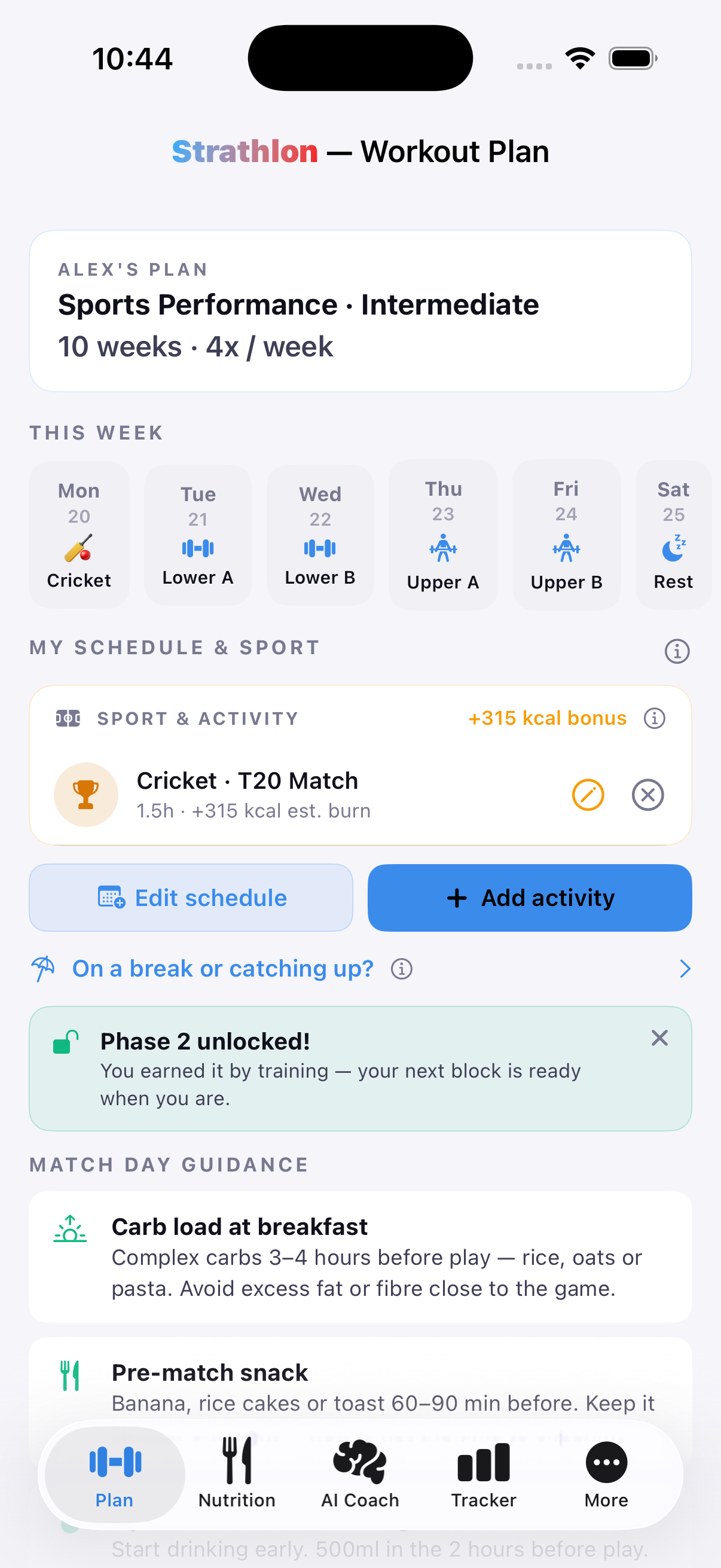
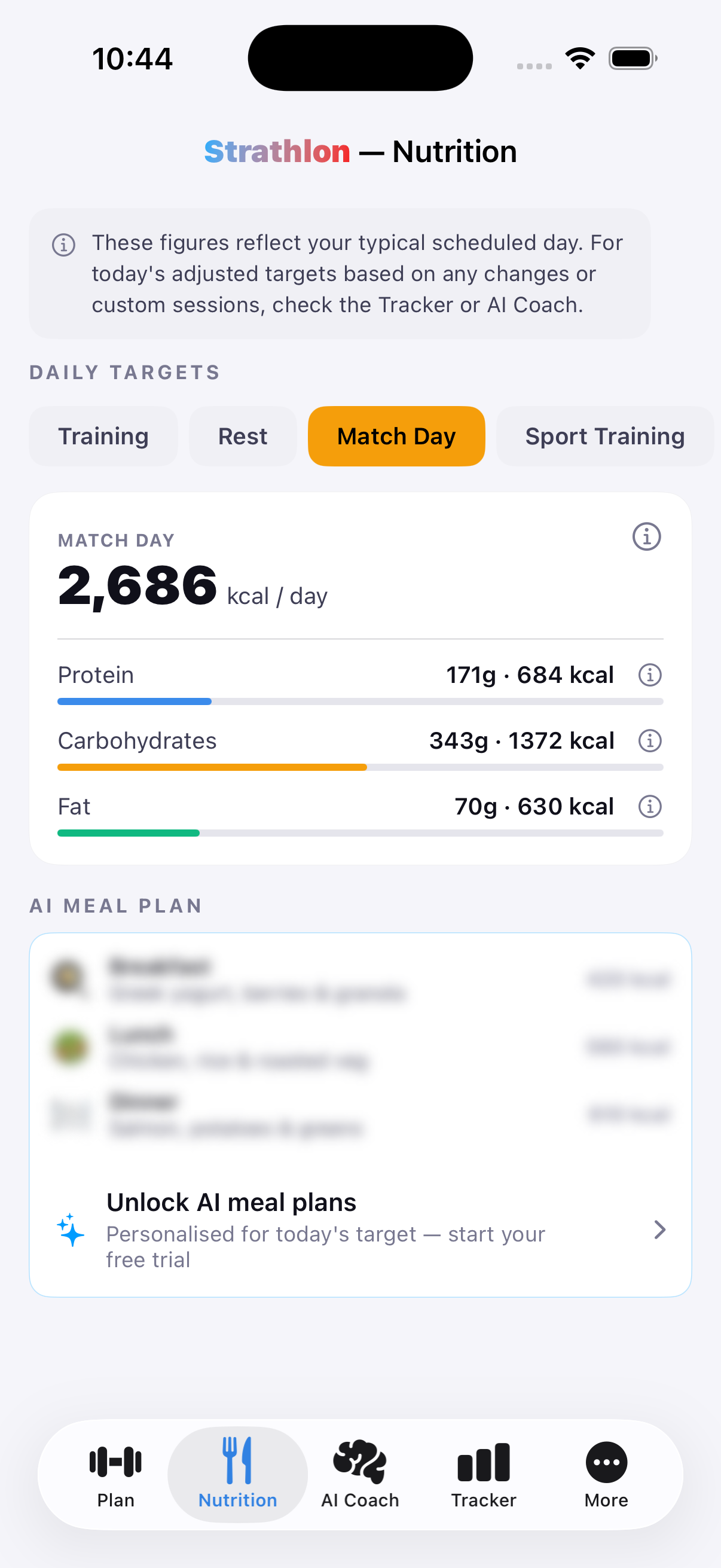
If you remember one thing, make it the shape of the plan: build a strong, powerful base with a bomb-proof trunk and posterior chain, add the cricket-specific rotational, single-leg and shoulder work on top, condition with short sharp efforts, guard the back, hamstrings and shoulder, and above all, manage bowling load. Strathlon's job is to tune that base toward your sport (with Sports Performance as one of your goals) and keep the trend honest: a sport-aware starting point you can build on, ideally alongside a coach for the competitive details and a clinician for a bowler's back.
References
Numbered sources for the specific figures, effect sizes and named studies above. Where a claim reflects agreed guidance rather than a single trial, the citation is to the position stand or consensus statement of the body concerned, with the country or international remit named. Cricket has one of the better injury-surveillance literatures in sport, and the bowling-load, lumbar-injury and hamstring figures below are cited to it directly.
- Fleming J, Perrett C, Melchi O, McClelland J, Middleton K. Quantification of Ground Reaction Forces During the Follow Through in Trained Male Cricket Fast Bowlers: A Laboratory-Based Study. Sports. 2024;12(12). Fleming and colleagues' quantification of ground reaction forces during the fast-bowling follow-through: the source for the front-foot loading figure quoted. PubMed 39728856 · PMC11680029 full text
- Orchard JW, Kountouris A, Sims K. Incidence and prevalence of elite male cricket injuries using updated consensus definitions. Open Access Journal of Sports Medicine. 2016;7:187–194. Orchard and colleagues on the incidence and prevalence of elite male cricket injuries using updated consensus definitions, the source for lumbar bone stress and hamstring strain being the leading problems. PubMed 28008292 · PMC5167453 full text
- Orchard JW, Ranson C, Olivier B, Dhillon M, Gray J, Langley B, et al. International consensus statement on injury surveillance in cricket: a 2016 update. British Journal of Sports Medicine. 2016;50(20):1245–1251. The 2016 international consensus statement on injury surveillance in cricket, the definitions the incidence figures rest on. PubMed 27281775
- Hulin BT, Gabbett TJ, Blanch P, Chapman P, Bailey D, Orchard JW. Spikes in acute workload are associated with increased injury risk in elite cricket fast bowlers. British Journal of Sports Medicine. 2014;48(8):708–12. Hulin and colleagues showing spikes in acute workload are associated with increased injury risk in elite fast bowlers: the direct source for respecting the bowling load. PubMed 23962877
- Orchard JW, Blanch P, Paoloni J, Kountouris A, Sims K, Orchard JJ, et al. Cricket fast bowling workload patterns as risk factors for tendon, muscle, bone and joint injuries. British Journal of Sports Medicine. 2015;49(16):1064–8. Study of cricket fast-bowling workload patterns as risk factors for tendon, muscle, bone and joint injuries, the source for the weekly-ball guidance. PubMed 25755276
- Alway P, Brooke-Wavell K, Langley B, King M, Peirce N. Incidence and prevalence of lumbar stress fracture in English County Cricket fast bowlers, association with bowling workload and seasonal variation. BMJ Open Sport & Exercise Medicine. 2019;5(1):e000529. Study of lumbar stress fracture incidence in English county fast bowlers and its association with bowling workload, the specific lumbar evidence. PubMed 31205746 · PMC6540320 full text
- Daniels AP, Weeks BK, Beck BR. Incidence, prevalence and risk factors for symptomatic lumbar bone stress injury in female and male youth cricket bowlers. Journal of Science and Medicine in Sport. 2026. Recent study of symptomatic lumbar bone stress injury in female and male youth cricket bowlers, included because the risk is not limited to elite men. PubMed 42448493
- Orchard JW, Kountouris A, Sims K. Risk factors for hamstring injuries in Australian male professional cricket players. Journal of Sport and Health Science. 2017;6(3):271–274. Study of risk factors for hamstring injuries in Australian professional cricket players, the sport-specific hamstring evidence. PubMed 30356627 · PMC6189243 full text
- van Dyk N, Behan FP, Whiteley R. Including the Nordic hamstring exercise in injury prevention programmes halves the rate of hamstring injuries: a systematic review and meta-analysis of 8459 athletes. British Journal of Sports Medicine. 2019;53(21):1362–1370. Meta-analysis finding Nordic hamstring programmes halve hamstring injury rates, the source for the roughly-halving figure. PubMed 30808663
- Freeston JL, Carter T, Whitaker G, Nicholls O, Rooney KB. Strength and Power Correlates of Throwing Velocity on Subelite Male Cricket Players. Journal of Strength and Conditioning Research. 2016;30(6):1646–51. Study of strength and power correlates of throwing velocity in cricket players, supporting the rotational-power section. PubMed 26479022
- Suchomel TJ, Nimphius S, Stone MH. The Importance of Muscular Strength in Athletic Performance. Sports Medicine. 2016;46(10):1419–49. Suchomel and colleagues on the importance of muscular strength in athletic performance: the source for greater maximal strength being associated with faster sprinting, jumping and change of direction, and with lower injury risk. PubMed 26838985
- Seitz LB, Reyes A, Tran TT, Saez de Villarreal E, Haff GG. Increases in lower-body strength transfer positively to sprint performance: a systematic review with meta-analysis. Sports Medicine. 2014;44(12):1693–702. Seitz and colleagues' systematic review with meta-analysis showing increases in lower-body strength transfer positively to sprint performance, the evidence behind the 'strength is the base' argument. PubMed 25059334
- Lauersen JB, Andersen TE, Andersen LB. Strength training as superior, dose-dependent and safe prevention of acute and overuse sports injuries: a systematic review, qualitative analysis and meta-analysis. British Journal of Sports Medicine. 2018;52(24):1557–1563. Lauersen and colleagues' meta-analysis finding strength training a superior, dose-dependent and safe prevention of acute and overuse sports injuries: the direct source for treating strength work as prehab. PubMed 30131332
- Lauersen JB, Bertelsen DM, Andersen LB. The effectiveness of exercise interventions to prevent sports injuries: a systematic review and meta-analysis of randomised controlled trials. British Journal of Sports Medicine. 2014;48(11):871–7. Lauersen and colleagues' earlier meta-analysis of exercise interventions to prevent sports injuries, the broader evidence base the prevention advice sits on. PubMed 24100287
- . American College of Sports Medicine position stand. Progression models in resistance training for healthy adults. Medicine and Science in Sports and Exercise. 2009;41(3):687–708. American College of Sports Medicine (ACSM, United States) position stand on progression models in resistance training: the source for the heavy-load and explosive-load percentage ranges quoted. PubMed 19204579
- Cuthbert M, Haff GG, Arent SM, Ripley N, McMahon JJ, Evans M, et al. Effects of Variations in Resistance Training Frequency on Strength Development in Well-Trained Populations and Implications for In-Season Athlete Training: A Systematic Review and Meta-analysis. Sports Medicine. 2021;51(9):1967–1982. Cuthbert and colleagues' systematic review of resistance-training frequency in well-trained populations, the source for the sessions-per-week guidance. PubMed 33886099 · PMC8363540 full text
- Spiering BA, Mujika I, Sharp MA, Foulis SA. Maintaining Physical Performance: The Minimal Dose of Exercise Needed to Preserve Endurance and Strength Over Time. Journal of Strength and Conditioning Research. 2021;35(5):1449–1458. Spiering and colleagues on the minimal dose of exercise needed to preserve endurance and strength: the source for maintaining in-season on as little as one to two sessions a week. PubMed 33629972
- Rønnestad BR, Nymark BS, Raastad T. Effects of in-season strength maintenance training frequency in professional soccer players. Journal of Strength and Conditioning Research. 2011;25(10):2653–60. Ronnestad and colleagues' trial of in-season strength maintenance frequency in professional footballers, the specific in-season maintenance result quoted. PubMed 21873897
- Nuzzo JL, Pinto MD, Kirk BJC, Nosaka K. Resistance Exercise Minimal Dose Strategies for Increasing Muscle Strength in the General Population: an Overview. Sports Medicine. 2024;54(5):1139–1162. Nuzzo and colleagues on minimal-dose resistance exercise strategies for increasing strength, supporting the claim that a small, well-chosen dose does most of the work. PubMed 38509414 · PMC11127831 full text
- Wilson JM, Marin PJ, Rhea MR, Wilson SM, Loenneke JP, Anderson JC. Concurrent training: a meta-analysis examining interference of aerobic and resistance exercises. Journal of Strength and Conditioning Research. 2012;26(8):2293–307. Wilson and colleagues' meta-analysis of concurrent training and the interference effect: the source for separating heavy lifting from hard conditioning. PubMed 22002517
- Schumann M, Feuerbacher JF, Sünkeler M, Freitag N, Rønnestad BR, Doma K, et al. Compatibility of Concurrent Aerobic and Strength Training for Skeletal Muscle Size and Function: An Updated Systematic Review and Meta-Analysis. Sports Medicine. 2022;52(3):601–612. An updated systematic review of the compatibility of concurrent aerobic and strength training, the more recent evidence that interference is smaller than once believed. PubMed 34757594 · PMC8891239 full text
- Ramirez-Campillo R, Sortwell A, Moran J, Afonso J, Clemente FM, Lloyd RS, et al. Plyometric-Jump Training Effects on Physical Fitness and Sport-Specific Performance According to Maturity: A Systematic Review with Meta-analysis. Sports Medicine - Open. 2023;9(1):23. Ramirez-Campillo and colleagues on plyometric-jump training effects on physical fitness and sport-specific performance, the source for the plyometric guidance. PubMed 37036542 · PMC10086091 full text
- Impellizzeri FM, Woodcock S, Coutts AJ, Fanchini M, McCall A, Vigotsky AD. What Role Do Chronic Workloads Play in the Acute to Chronic Workload Ratio? Time to Dismiss ACWR and Its Underlying Theory. Sports Medicine. 2021;51(3):581–592. Impellizzeri and colleagues on the pitfalls of the acute:chronic workload ratio: cited because it is the reason this guide talks about ramping load gradually rather than quoting a workload number. PubMed 33332011
- Baz-Valle E, Balsalobre-Fernández C, Alix-Fages C, Santos-Concejero J. A Systematic Review of The Effects of Different Resistance Training Volumes on Muscle Hypertrophy. Journal of Human Kinetics. 2022;81:199–210. Systematic review of resistance-training volume and hypertrophy, the general dose-response evidence behind the set and session recommendations. PubMed 35291645 · PMC8884877 full text
This is general educational information rather than medical or individual coaching advice. The sport-science figures here are drawn from published research and are framed as population-level guides and associations rather than guarantees: individual needs vary widely with training age, level, discipline, sex, history and schedule, and are best personalised with a qualified strength & conditioning coach. Anyone with pain, an injury, a health condition, or who is pregnant or postpartum, should consult a qualified clinician before starting or changing a training programme, and any persistent low-back, hamstring or shoulder pain (particularly a fast bowler's back pain) should be assessed rather than trained through. See our Terms for more.
Pair this with the cricket fuelling guide for the nutrition side of playing and training. More: Tennis strength & conditioning · How muscle actually grows · Recovery & rest · Eating for results · All guides · Home