
Baseball strength & conditioning
An evidence-based guide to training the baseball body. Baseball looks like a game of skill and patience, but underneath it is a rotational power sport played in short, maximal bursts: a swing, a throw, a sprint out of the box. This covers the physical qualities that matter most, the strength and power work that develops them, how to condition without blunting your speed, and the arm-care and lower-body prehab that keep shoulders, elbows and hamstrings healthy across a long season. Practical and honest, grounded in published sports-science research.
Here's the short answer to "what should a baseball player train?": build heavy lower-body force and whole-body rotational power (the qualities behind bat and throwing velocity) and protect the throwing arm with dedicated rotator-cuff and scapular work, all wrapped around sensible throwing workload. Everything below is the detail behind that sentence: the lifts, why each one transfers, and how to fit it around games without wearing yourself down.
On this page
A framing note before the detail. Strength and conditioning is well studied, but people differ enormously: training age, position, throwing history, mobility, genetics and health status all change what's right for an individual. So this is written as can, tends to and is associated with, never as a guarantee, and every specific figure is a population-level finding from published research rather than a personal prescription. It's general education rather than medical or individual coaching advice.
The demands of baseball
Almost everything a baseball player does explosively is rotational. A swing and a throw are both a sequenced release of power that starts at the ground, runs up through the hips and trunk, and finishes at the bat or the ball: the "kinetic chain." Force is generated by the big, slow muscles of the legs and hips, transmitted and amplified by a fast-rotating trunk, and delivered by the arm. When that sequence is well-timed, the arm is the tip of a whip rather than the engine. That single idea (power flows from the ground up and from the centre out) is why lower-body and trunk training matter so much for a sport that looks like it's all about the arms.
Energetically, baseball is a power sport. The efforts that decide games (a swing, a throw, a sprint down the line, a burst to a ball in the gap) last only a few seconds and are separated by long rests, so they draw overwhelmingly on the body's immediate (alactic / ATP-PC) energy system rather than on prolonged aerobic work. A moderate aerobic base still helps you recover between efforts and get through a training week, but what the sport actually rewards is the ability to be maximally explosive, recover, and repeat that burst again and again through a game.
That explosive, repeated-throwing demand also explains where baseball players get hurt. The most common serious injury sites are:
- The throwing shoulder: the rotator cuff and the labrum, stressed by the enormous forces of decelerating the arm after ball release, and by the range-of-motion adaptations throwing creates over time.
- The elbow: specifically the ulnar collateral ligament (UCL) on the inside of the elbow, the ligament repaired by "Tommy John" surgery, loaded heavily every time a high-velocity throw is decelerated.
- The hamstrings: the classic sprinter's injury, risked every time a player accelerates out of the box or chases a ball at full tilt.
- References
The rest of this guide is organised around building the power those demands reward, and protecting the tissues those demands threaten.
Key strength work, and why it matters
Think of baseball strength as three layers that stack: a base of general strength, a heavy lower-body engine for force, and explosive rotational and jumping work to express that force fast, with dedicated arm care running alongside all of it. Here's what goes in each, and why it transfers.
Heavy lower-body strength: the engine
The squat, the trap-bar deadlift and hip-hinge patterns build the lower-body and hip force that every swing and throw draws on. The transfer here is well established: a systematic review with meta-analysis found that increases in back-squat strength transferred strongly to faster sprinting: the pooled relationship between squat gains and sprint improvement was very large (Seitz et al., 2014). Sprint speed and the explosive leg drive behind a throw or swing share the same root quality, so getting stronger in the big lower-body lifts tends to raise the ceiling on power output. Lower-body and rotational strength are also associated with faster bat swing velocity in college players (see the collegiate bat-velocity literature). Train these heavy, for low reps, at high effort, chasing force rather than muscular fatigue.
Rotational power: the sport-specific layer
This is the layer that most looks like baseball. Medicine-ball throws (rotational scoop tosses, shotput-style throws, overhead slams) train the trunk to rotate fast and to sequence the hips, trunk and arm in the right order, which is exactly the pattern of a swing or a throw. The evidence lines up well: whole-body rotational power measured by a rotational medicine-ball throw correlated with bat swing velocity (r ≈ 0.65), pitching velocity (r ≈ 0.62) and batted-ball velocity (r ≈ 0.53) in college players, and, notably, out-performed vertical and broad jumps as a predictor of those baseball-specific skills (Taniyama et al., 2021). And adding rotational medicine-ball training to a periodised resistance programme improved torso and sequential hip-to-arm rotational strength and power more than resistance training alone over 12 weeks in high-school players (Szymanski et al., 2007).
The honest caveat is that medicine-ball work is a supplement to heavy strength training rather than replacing it. You build the force with the barbell and then teach the body to release it fast with throws and jumps. Skipping the strength base and only throwing medicine balls leaves the engine underpowered.
The throwing arm: cuff, scapula and forearm
The muscles that decelerate the arm, the rotator cuff (particularly the external rotators) and the scapular stabilisers (serratus anterior, the traps and rhomboids), take a beating every throw, so strengthening them directly deserves a place in the plan rather than being left to chance. The Thrower's Ten family of exercises is the best-known template: a 2025 systematic review of the programme reported it was consistently associated with improvements in rotator-cuff strength, scapular stability and shoulder range of motion in overhead athletes. During the season these are typically done for higher reps (around 10–15) a few times a week, and not immediately before pitching. Don't neglect the forearm and grip either: they contribute to a stable wrist at release and to bat control.
| Quality | Example movements | Why it transfers to baseball |
|---|---|---|
| Lower-body force | Back/front squat, trap-bar deadlift, hip thrust, split squat | Builds the ground force behind a throw, swing and sprint. Squat strength transfers directly to sprint speed. |
| Rotational power | Rotational med-ball scoop & shotput throws, cable/band rotations | Trains fast, sequenced trunk rotation. Correlates with bat and pitching velocity. |
| Explosive / reactive | Jumps, bounds, short sprints, Olympic-lift variations (if coached) | Develops rate of force development for the burst out of the box and in the field. |
| Arm durability | External-rotation & scapular work (Thrower's Ten style), forearm/grip | Strengthens the tissues that decelerate the arm. Supports a healthy throwing shoulder. |
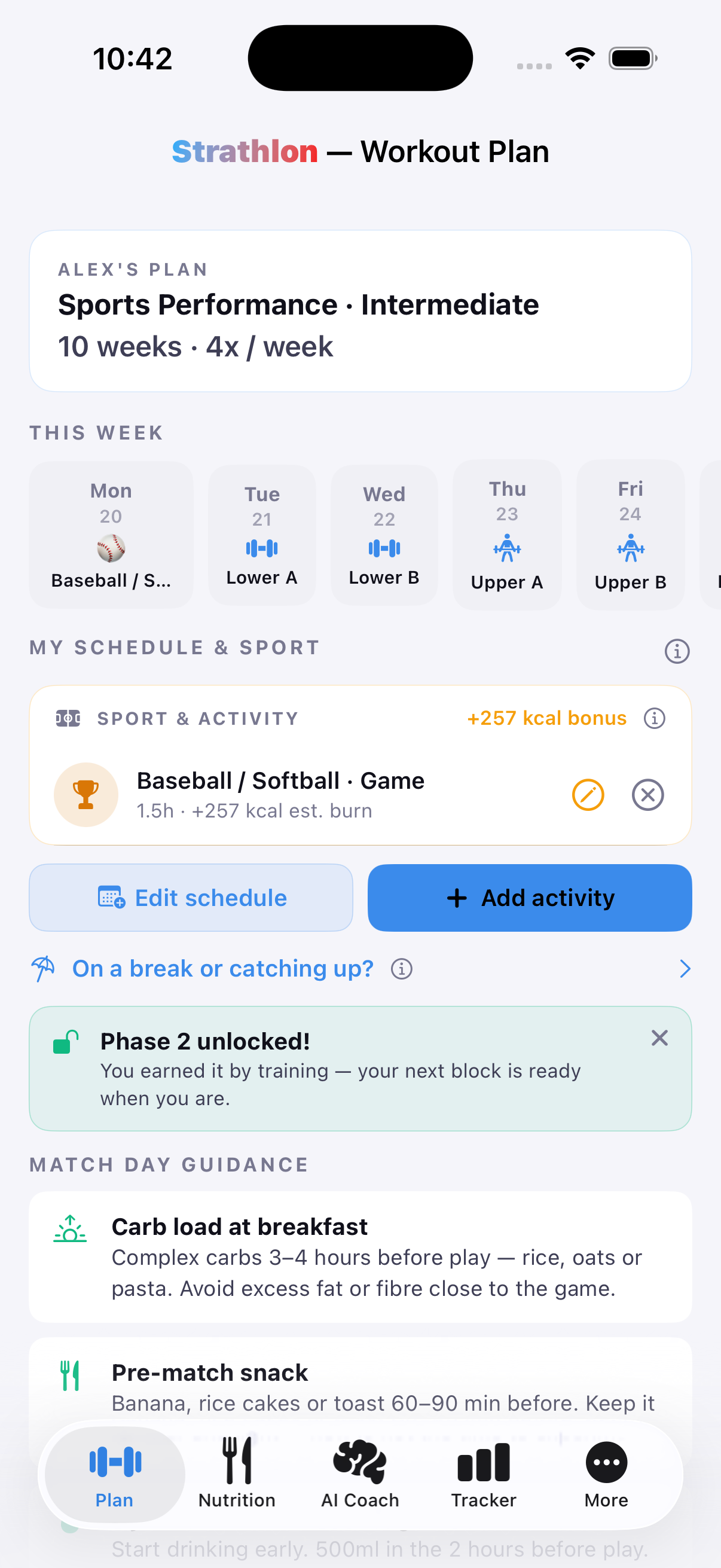
That pairing is worth dwelling on, because it captures the whole philosophy of training for a sport. The base lifts (the heavy squats, trap-bar pulls and hinges) are what actually raise the force behind every swing, throw and sprint. They are not general filler to be dropped for baseball-looking drills. On top of that base sit the sport-specific pieces: an accessory block of rotational medicine-ball throws and cable rotations where you express that power fast, cuff and scapular arm care, and forearm and grip work. Neither half works alone. Medicine-ball throws build sequencing but little raw force. A heavy squat that is never trained to move quickly does not reach the bat.
That screen is the whole point of this section made concrete. The base lifts build the force, and the accessory block carries the rotational-power and arm-care work baseball needs, with medicine-ball throws where you express that force fast. Neither works alone. Heavy lifting without rotational work leaves you strong but slow to express it. Medicine-ball throws without a strength base leave the engine small. And neither protects your shoulder unless the cuff and scapular work is actually in the plan. The layering is what turns general gym work into baseball-relevant training.
Conditioning for baseball
Because baseball is a power sport, its conditioning should look like the game: short, maximal efforts with full recovery. The efforts that matter are a swing, a throw, and sprints of roughly 27 metres (home to first) or a burst in the field: a few seconds of all-out work, then a long rest. Training that mirrors this (short sprints, base-running accelerations, jumps and med-ball throws done fresh, with generous rest between reps) develops the alactic power the sport actually uses.
A moderate aerobic base still earns its place, but as a support quality: it helps you recover between bursts, get through long training weeks and tolerate volume without excessive fatigue. The key is proportion. Long, slow, high-volume running is a poor match for baseball and, if overdone, can compete with the very speed and power qualities the sport rewards: the classic "interference" problem, where too much endurance work blunts strength and power adaptations. Keep aerobic work light and general (easy movement, light tempo runs, or simply an active lifestyle), and put your hard conditioning into short repeat-sprint and power work.
Two practical rules keep strength and conditioning working together without interference. First, prioritise by proximity to the game's demands: speed, power and strength come first, with general aerobic work filling in around them. Second, separate hard qualities where you can: do your explosive and heavy work when you're fresh (early in a session, or on their own days), and keep any endurance work easy so it aids recovery rather than adding fatigue. For a baseball player, "conditioning" mostly means repeating high-quality bursts, with the ability to jog forever mattering far less.
Staying injury-resilient
Baseball's big three injuries, the throwing shoulder, the elbow (UCL), and the hamstring, each have evidence-based prehab that lowers the risk. None of it is exotic. The hard part is doing it consistently.
Shoulder and elbow: manage workload, then build durability
For the throwing arm, the single most important lever isn't an exercise at all: it's throwing workload. High pitch counts, pitching while fatigued, and year-round throwing are the most consistently identified risk factors for elbow (UCL) injury, and research on former Little League World Series pitchers linked exceeding youth pitch-count limits to a higher chance of later requiring UCL reconstruction (American Sports Medicine Institute position statement, Fleisig and colleagues). Respecting pitch counts, rest days and off-seasons from throwing is genuinely protective, especially for younger players.
On top of workload management, dedicated arm care builds durability. Rotator-cuff and scapular strengthening (the Thrower's Ten family) and posterior-shoulder mobility work target the tissues and the range-of-motion patterns that matter. Throwers commonly develop glenohumeral internal rotation deficit (GIRD), a loss of internal rotation on the throwing side (defined as roughly ≥20° less than the other shoulder) linked in some studies to higher shoulder-injury risk, and stretches such as the sleeper and cross-body stretch can help restore that motion (studies show they speed the recovery of internal rotation after throwing). Importantly, a structured shoulder stretching and strengthening prevention programme reduced the incidence of shoulder and elbow injuries in high-school and youth baseball players in controlled studies, roughly halving elbow injuries in one youth trial (Sakata et al.). Prehab like this works only when it becomes a habit instead of a one-off.
Hamstrings: get strong in a lengthened position
The hamstring is the base-runner's and outfielder's injury, struck during hard acceleration. The best-known preventive tool is the Nordic hamstring exercise, an eccentric (lowering) drill that builds strength in a lengthened position. A widely cited meta-analysis of 8,459 athletes found that including the Nordic hamstring exercise in prevention programmes was associated with roughly halving the rate of hamstring injuries (risk ratio ≈ 0.49; van Dyk et al., 2019). Honesty requires a caveat: a later methodological reappraisal argued the protective effect is less certain than that headline suggests, and that the benefit depends heavily on athletes actually doing the exercise (compliance). So treat Nordics as a well-supported association, short of a guarantee: a low-cost tool worth including, done consistently, alongside sensible sprint exposure so the tissue is prepared for speed.
Programming it around your season
Baseball's calendar splits cleanly, and your training should follow it.
- Off-season: build. This is when you make the big adaptations: heavier strength work to raise force, a solid block of rotational power and jumps, and the base of arm-care and mobility that will carry through the year. Frequency can be higher (commonly three-ish quality sessions a week) because you're not competing, and there's room to push loads and volume with proper recovery.
- Pre-season: sharpen. Shift the emphasis toward power and speed as games approach: more explosive throws, jumps and short sprints, with strength maintained rather than pushed. This is where the force you built starts turning into bat and throwing velocity.
- In-season: maintain. The goal now is to keep what you built while games and practice take priority. The good news is that maintaining strength takes far less work than building it: a systematic review and meta-analysis found no clear difference in strength development between higher and lower training frequencies in well-trained people over 6–12 weeks when volume is accounted for: meaning strength holds up well on a reduced schedule, commonly one to two short, hard sessions a week (Cuthbert et al., 2021). Keep a couple of heavy compound lifts and your arm-care work, cut the total volume, and schedule lifting on lower-throwing days so it doesn't pile onto game fatigue.
Across all of it, fit S&C around the sport instead of piling it on top. Throwing and games are themselves a large stress on the arm and legs, so the weight room should complement that load rather than compound it: lighter lifting after heavy throwing days, harder lifting when throwing is light, and honest attention to fatigue. If you're tired, under-recovered or sore in a joint (as opposed to a muscle), treat that as information instead of weakness to push through.
Common questions
What strength work should a baseball player prioritise?
Two things carry the most weight: heavy lower-body force (squat and trap-bar/hip-hinge patterns) and rotational power (medicine-ball throws), sitting on top of a base of general strength. Lower-body strength transfers to the speed qualities baseball needs: a meta-analysis found gains in squat strength transferred strongly to faster sprinting (Seitz et al., 2014), and whole-body rotational power measured by a rotational medicine-ball throw correlates with bat swing velocity, batted-ball velocity and pitching velocity in college players (Taniyama et al., 2021). Wrap that around dedicated rotator-cuff and scapular work for the throwing arm. Numbers are individual, so treat these as priorities rather than a prescription.
Will lifting heavy make me slow, tight or muscle-bound for baseball?
The evidence points the other way. Getting stronger in the squat transfers positively to sprint speed (Seitz et al., 2014), and rotational power (the quality behind bat and throwing velocity) comes from combining heavy strength work with explosive throws. Avoiding the weight room doesn't build it. The goal for a baseball player is force you can express fast, so pair heavy compound lifts with medicine-ball and jump work rather than chasing bodybuilding-style fatigue. Strength training done for power does not have to add unwanted size or reduce mobility when it is programmed sensibly.
How do I protect my throwing shoulder and elbow?
Two levers matter most. First, manage throwing workload: high pitch counts, pitching while fatigued and year-round throwing are the most consistently identified risk factors for elbow (UCL) injury, and exceeding youth pitch-count limits has been linked to a higher chance of later UCL reconstruction (American Sports Medicine Institute, Fleisig et al.). Second, do dedicated arm care: rotator-cuff and scapular strengthening (as in the Thrower's Ten family of exercises) and posterior-shoulder mobility work. A shoulder stretching and strengthening prevention programme reduced the incidence of shoulder and elbow injuries in high-school and youth baseball players in controlled studies (Sakata et al.). Respect rest, and see a clinician for any pain that lingers.
Do medicine-ball throws actually build bat speed and throwing velocity?
They are a well-matched tool for the rotational, sequenced power baseball needs. Rotational medicine-ball throw velocity correlates with bat swing velocity, batted-ball velocity and pitching velocity in college players (Taniyama et al., 2021), and adding rotational medicine-ball training to a periodised resistance programme improved torso and hip-to-arm rotational strength and power in high-school players over 12 weeks (Szymanski et al., 2007). The honest caveat is that medicine-ball work is best used as a supplement to heavy strength training. On its own it doesn't replace the barbell: build the force with lifting, then learn to express it fast with throws.
How do I keep strength up in-season without wearing down?
You need far less work to keep strength than to build it. A systematic review and meta-analysis found no clear difference in strength development between higher and lower training frequencies in well-trained people over 6 to 12 weeks when volume is accounted for, which means strength can be maintained on a reduced in-season schedule: commonly around one to two short, hard sessions a week (Cuthbert et al., 2021). In practice, keep a couple of heavy compound lifts and your arm-care work, cut the total volume, and schedule lifting on lower-throwing days so it does not compete with games and practice.
How much running and conditioning does a baseball player need?
Baseball is played in short, maximal bursts (a swing, a throw, a sprint to first, a dive in the field) each lasting a few seconds and separated by long rests, so it draws overwhelmingly on the immediate (alactic/ATP-PC) energy system rather than long-distance endurance. That means short sprints, med-ball throws and jumps matched to the game's efforts do more than long-slow running, which if overdone can eat into the power qualities the sport rewards. A moderate aerobic base still helps you recover between efforts and tolerate training volume, but it plays a supporting role behind speed and power. Build those first, and keep general conditioning light and repeat-sprint flavoured.
Takeaways
- Baseball is a rotational power sport. Power flows from the ground up and the centre out, with the arm acting as the tip of the whip rather than the engine.
- Build lower-body force. Squats, trap-bar deadlifts and hinges raise the force behind every swing, throw and sprint: squat strength transfers to sprint speed (Seitz et al., 2014).
- Train rotational power. Medicine-ball throws develop the fast, sequenced trunk rotation that correlates with bat and pitching velocity (Taniyama et al., 2021; Szymanski et al., 2007), working as a supplement to lifting rather than a replacement for it.
- Condition like the game. Short maximal sprints and power work with full rest beat long-slow running. Keep aerobic work light so it aids recovery without blunting power.
- Protect the arm with workload + arm care. Respect pitch counts and rest (ASMI), and do cuff/scapular and mobility work: prevention programmes cut shoulder and elbow injuries in youth players (Sakata et al.).
- Prehab the hamstrings. Eccentric (Nordic) work is associated with roughly halving hamstring injuries when done consistently (van Dyk et al., 2019), a well-supported association rather than a guarantee.
- Periodise around the season. Build in the off-season, sharpen pre-season, and maintain in-season on ~1–2 hard sessions a week (Cuthbert et al., 2021).
If you remember one thing, make it this: baseball rewards force you can express fast, on a body durable enough to repeat it all season. Build the strength, learn to release it rotationally, look after the throwing arm, and keep just enough of it going once games start. Strathlon's role is to give you a sport-aware plan and to keep your lifts trending in the right direction: the rest is showing up.
Pair this with the baseball fuelling guide for the nutrition side: fuelling around games, doubleheaders and long seasons.
References
Numbered sources for the specific figures, effect sizes and named studies above. Where a claim reflects agreed guidance rather than a single trial, the citation is to the position stand or consensus statement of the body concerned, with the country or international remit named. Baseball's throwing-injury literature is unusually strong, and the arm-care and workload advice below is cited to it directly rather than generalised from other overhead sports.
- Taniyama D, Matsuno J, Yoshida K, Pyle B, Nyland J. Rotational Medicine Ball Throw Velocity Relates to NCAA Division III College Baseball Player Bat Swing, Batted Baseball, and Pitching Velocity. Journal of Strength and Conditioning Research. 2021;35(12):3414–3419. Taniyama and colleagues showing rotational medicine-ball throw velocity relates to bat swing and batted-ball speed: the direct source for the rotational-power claim. PubMed 34570055
- Szymanski DJ, Szymanski JM, Bradford TJ, Schade RL, Pascoe DD. Effect of twelve weeks of medicine ball training on high school baseball players. Journal of Strength and Conditioning Research. 2007;21(3):894–901. Szymanski and colleagues' twelve-week medicine-ball training trial in high-school baseball players, the intervention evidence behind the same claim. PubMed 17685676
- Szymanski DJ, McIntyre JS, Szymanski JM, Bradford TJ, Schade RL, Madsen NH, et al. Effect of torso rotational strength on angular hip, angular shoulder, and linear bat velocities of high school baseball players. Journal of Strength and Conditioning Research. 2007;21(4):1117–25. Szymanski and colleagues on torso rotational strength and angular hip, shoulder and bat velocities, the mechanism linking trunk strength to bat speed. PubMed 18076221
- Freeston JL, Carter T, Whitaker G, Nicholls O, Rooney KB. Strength and Power Correlates of Throwing Velocity on Subelite Male Cricket Players. Journal of Strength and Conditioning Research. 2016;30(6):1646–51. Study of strength and power correlates of throwing velocity, supporting the ground-up description of where throwing power comes from. PubMed 26479022
- Sakata J, Nakamura E, Suzuki T, Suzukawa M, Akeda M, Yamazaki T, et al. Throwing Injuries in Youth Baseball Players: Can a Prevention Program Help? A Randomized Controlled Trial. The American Journal of Sports Medicine. 2019;47(11):2709–2716. Randomised controlled trial of a throwing-injury prevention programme in youth baseball players: the evidence that prevention programmes cut shoulder and elbow problems. PubMed 31336051
- Popchak A, Burnett T, Weber N, Boninger M. Factors related to injury in youth and adolescent baseball pitching, with an eye toward prevention. American Journal of Physical Medicine & Rehabilitation. 2015;94(5):395–409. Review of factors related to injury in youth and adolescent baseball pitching with an eye toward prevention, the source for the pitch-count and rest guidance. PubMed 25251251
- Leenen AJR, Hoozemans MJM, van Dis F, van der Graaff E, Veeger HEJ, Verhagen EALM. Shoulder and Elbow Symptoms in Dutch High School Baseball Pitchers: Results of a Two-Season Prospective Study. Journal of Athletic Training. 2024;59(11):1118–1125. Two-season prospective study of shoulder and elbow symptoms in high-school pitchers, the epidemiology behind the arm-care emphasis. PubMed 38629480 · PMC11611363 full text
- Gauthier ML, Unverzagt CA, Davies GJ. Evaluation and Treatment of Baseball Pitchers: There's More to Assess than the Arm. International Journal of Sports Physical Therapy. 2025;20(1):113–126. Evaluation and treatment of baseball pitchers, cited for the point that the arm is the tip of the whip and the assessment has to look further down the chain. PubMed 39758696 · PMC11698006 full text
- van Dyk N, Behan FP, Whiteley R. Including the Nordic hamstring exercise in injury prevention programmes halves the rate of hamstring injuries: a systematic review and meta-analysis of 8459 athletes. British Journal of Sports Medicine. 2019;53(21):1362–1370. Meta-analysis finding injury-prevention programmes including the Nordic hamstring exercise halve hamstring injury rates: the source for the roughly-halving figure quoted. PubMed 30808663
- Cools AM, Johansson FR, Borms D, Maenhout A. Prevention of shoulder injuries in overhead athletes: a science-based approach. Brazilian Journal of Physical Therapy. 2015;19(5):331–9. Cools and colleagues on preventing shoulder injuries in overhead athletes, the basis for the cuff and scapular arm-care work. PubMed 26537804 · PMC4647145 full text
- Suchomel TJ, Nimphius S, Stone MH. The Importance of Muscular Strength in Athletic Performance. Sports Medicine. 2016;46(10):1419–49. Suchomel and colleagues on the importance of muscular strength in athletic performance: the source for greater maximal strength being associated with faster sprinting, jumping and change of direction, and with lower injury risk. PubMed 26838985
- Seitz LB, Reyes A, Tran TT, Saez de Villarreal E, Haff GG. Increases in lower-body strength transfer positively to sprint performance: a systematic review with meta-analysis. Sports Medicine. 2014;44(12):1693–702. Seitz and colleagues' systematic review with meta-analysis showing increases in lower-body strength transfer positively to sprint performance, the evidence behind the 'strength is the base' argument. PubMed 25059334
- Lauersen JB, Andersen TE, Andersen LB. Strength training as superior, dose-dependent and safe prevention of acute and overuse sports injuries: a systematic review, qualitative analysis and meta-analysis. British Journal of Sports Medicine. 2018;52(24):1557–1563. Lauersen and colleagues' meta-analysis finding strength training a superior, dose-dependent and safe prevention of acute and overuse sports injuries: the direct source for treating strength work as prehab. PubMed 30131332
- Lauersen JB, Bertelsen DM, Andersen LB. The effectiveness of exercise interventions to prevent sports injuries: a systematic review and meta-analysis of randomised controlled trials. British Journal of Sports Medicine. 2014;48(11):871–7. Lauersen and colleagues' earlier meta-analysis of exercise interventions to prevent sports injuries, the broader evidence base the prevention advice sits on. PubMed 24100287
- . American College of Sports Medicine position stand. Progression models in resistance training for healthy adults. Medicine and Science in Sports and Exercise. 2009;41(3):687–708. American College of Sports Medicine (ACSM, United States) position stand on progression models in resistance training: the source for the heavy-load and explosive-load percentage ranges quoted. PubMed 19204579
- Cuthbert M, Haff GG, Arent SM, Ripley N, McMahon JJ, Evans M, et al. Effects of Variations in Resistance Training Frequency on Strength Development in Well-Trained Populations and Implications for In-Season Athlete Training: A Systematic Review and Meta-analysis. Sports Medicine. 2021;51(9):1967–1982. Cuthbert and colleagues' systematic review of resistance-training frequency in well-trained populations, the source for the sessions-per-week guidance. PubMed 33886099 · PMC8363540 full text
- Spiering BA, Mujika I, Sharp MA, Foulis SA. Maintaining Physical Performance: The Minimal Dose of Exercise Needed to Preserve Endurance and Strength Over Time. Journal of Strength and Conditioning Research. 2021;35(5):1449–1458. Spiering and colleagues on the minimal dose of exercise needed to preserve endurance and strength: the source for maintaining in-season on as little as one to two sessions a week. PubMed 33629972
- Rønnestad BR, Nymark BS, Raastad T. Effects of in-season strength maintenance training frequency in professional soccer players. Journal of Strength and Conditioning Research. 2011;25(10):2653–60. Ronnestad and colleagues' trial of in-season strength maintenance frequency in professional footballers, the specific in-season maintenance result quoted. PubMed 21873897
- Nuzzo JL, Pinto MD, Kirk BJC, Nosaka K. Resistance Exercise Minimal Dose Strategies for Increasing Muscle Strength in the General Population: an Overview. Sports Medicine. 2024;54(5):1139–1162. Nuzzo and colleagues on minimal-dose resistance exercise strategies for increasing strength, supporting the claim that a small, well-chosen dose does most of the work. PubMed 38509414 · PMC11127831 full text
- Wilson JM, Marin PJ, Rhea MR, Wilson SM, Loenneke JP, Anderson JC. Concurrent training: a meta-analysis examining interference of aerobic and resistance exercises. Journal of Strength and Conditioning Research. 2012;26(8):2293–307. Wilson and colleagues' meta-analysis of concurrent training and the interference effect: the source for separating heavy lifting from hard conditioning. PubMed 22002517
- Schumann M, Feuerbacher JF, Sünkeler M, Freitag N, Rønnestad BR, Doma K, et al. Compatibility of Concurrent Aerobic and Strength Training for Skeletal Muscle Size and Function: An Updated Systematic Review and Meta-Analysis. Sports Medicine. 2022;52(3):601–612. An updated systematic review of the compatibility of concurrent aerobic and strength training, the more recent evidence that interference is smaller than once believed. PubMed 34757594 · PMC8891239 full text
- Ramirez-Campillo R, Sortwell A, Moran J, Afonso J, Clemente FM, Lloyd RS, et al. Plyometric-Jump Training Effects on Physical Fitness and Sport-Specific Performance According to Maturity: A Systematic Review with Meta-analysis. Sports Medicine - Open. 2023;9(1):23. Ramirez-Campillo and colleagues on plyometric-jump training effects on physical fitness and sport-specific performance, the source for the plyometric guidance. PubMed 37036542 · PMC10086091 full text
- Impellizzeri FM, Woodcock S, Coutts AJ, Fanchini M, McCall A, Vigotsky AD. What Role Do Chronic Workloads Play in the Acute to Chronic Workload Ratio? Time to Dismiss ACWR and Its Underlying Theory. Sports Medicine. 2021;51(3):581–592. Impellizzeri and colleagues on the pitfalls of the acute:chronic workload ratio: cited because it is the reason this guide talks about ramping load gradually rather than quoting a workload number. PubMed 33332011
- Baz-Valle E, Balsalobre-Fernández C, Alix-Fages C, Santos-Concejero J. A Systematic Review of The Effects of Different Resistance Training Volumes on Muscle Hypertrophy. Journal of Human Kinetics. 2022;81:199–210. Systematic review of resistance-training volume and hypertrophy, the general dose-response evidence behind the set and session recommendations. PubMed 35291645 · PMC8884877 full text
This is general educational information rather than medical or individual coaching advice. The strength-and-conditioning research here is drawn from published studies and is framed as population-level findings and associations: individual response varies widely with training age, position, throwing history and health, and mechanisms are described as tendencies rather than certainties. Anyone with pain, an injury (especially of the throwing shoulder or elbow), a health condition, or who is pregnant or postpartum, should consult a qualified strength coach, physiotherapist or physician before starting or changing a training programme. See our Terms for more.
← All guides · Baseball fuelling guide · How muscle actually grows · Recovery & rest · Eating for results · Home