
Fuelling & performance nutrition for walking
An honest, evidence-based guide to fuelling for walking. The headline is refreshingly simple: everyday walking rarely needs any special fuelling at all: your normal meals cover it, and the sport's real value is as a health, fat-loss and daily-activity tool rather than a performance event. This covers why that's true, how to hydrate on longer and hotter walks, the one situation where fuelling genuinely matters (very long hikes), why you shouldn't carb-load for a walk, and how logging a walk adjusts your day's calorie allowance. Practical, grounded in established consensus, and careful not to invent demands that aren't there.
Here's the short answer to "how should a walker fuel?": for everyday walking you don't need any special fuelling: normal balanced meals and water to thirst cover it completely. Only on very long, multi-hour walks do modest carbohydrate snacks and extra fluids start to matter, and the real payoff of walking is as a low-cost, low-fatigue way to add to your daily activity and support fat loss. Everything below is the detail behind that sentence (including, honestly, why so little of it applies to a normal walk).
Pair this with the walking strength and conditioning guide for the strength side of walking fitness, the training companion to this fuelling guide.
On this page
- Why walking is different from endurance sport
- Everyday walking: normal meals already cover it
- Walking as a health and fat-loss tool
- Water on longer and hotter walks
- When fuelling actually matters: the multi-hour hike
- Don't carb-load for a walk
- Logging a walk and your daily allowance
- Common questions
- Takeaways
A framing note before the (very few) numbers. Sports nutrition is well studied, but the honest starting point for walking is that most of what fills a running or cycling fuelling guide simply doesn't apply. So this is written as can, tends to and around, never as a guarantee, and the small handful of specific figures are population-level guides drawn from published consensus rather than personal prescriptions. It's general education rather than medical or dietary advice, and it isn't a personalised plan.
Why walking is different from endurance sport
Your body runs on a blend of two main fuels: fat and carbohydrate. Fat is almost limitless even in a lean person but burns slowly. Carbohydrate (stored as glycogen in muscle and liver) burns fast and is what you lean on at higher intensities. The single most important fact for a walker is this: walking is a low-intensity effort, so it's fuelled mostly by fat, and it barely touches your limited glycogen stores. That's the opposite of running or hard cycling, where the whole game is not running the glycogen tank dry.
Because of that, the classic endurance-fuelling machinery (carbohydrate targets per hour, gels, sports drinks, carb-loading, "hitting the wall") is mostly irrelevant to a normal walk. You are unlikely to run out of fuel on a walk you'd do on an ordinary day, because you're sipping slowly from an almost bottomless fat tank rather than sprinting through a small carbohydrate one. The practical upshot is liberating: for the great majority of walking, the right fuelling strategy is nothing special at all.
Everyday walking: normal meals already cover it
For the walking most people actually do (a commute on foot, a dog walk, a lunchtime loop, a brisk hour to clear your head), the fuelling plan is simply your ordinary diet. You don't need to eat beforehand specially, you don't need to carry food, and you don't need anything during the walk beyond water if you're thirsty. Whatever balanced meals you're already eating provide more than enough energy for a low-intensity effort that draws largely on fat.
Protein is worth a sentence only to say it, too, needs no special handling for walking. Everyday walking doesn't meaningfully raise your protein requirement above the general baseline the diet already meets: the Dietary Reference Intake for protein sits at around 0.8 g per kilogram of body weight per day for a healthy adult, and normal eating comfortably clears that. (If you're also strength-training or chasing other goals, your protein target may be higher, but that's a reason from those activities, separate from walking, and the eating-for-results guide covers it.) In short: walk, then eat as you normally would.
Walking as a health and fat-loss tool
If walking isn't really a fuelling event, what is it for? A great deal, as it happens, just on the health and body-composition side of the ledger rather than the performance side. National and international physical-activity guidance points to accumulating roughly 150–300 minutes of moderate-intensity activity a week for substantial health benefits, and brisk walking is the most common way people hit that target. Regular walking is associated with lower risk of heart disease, type 2 diabetes, several cancers and early death: a return no gel or sports drink can offer.
For weight and fat loss, walking's quiet superpower is that it adds to your daily energy expenditure without being tiring or hard to recover from, so you can do it often and consistently. A lot of that contribution falls under what researchers call NEAT: non-exercise activity thermogenesis, the energy you burn through everyday movement rather than formal workouts. It adds up: in work by James Levine and colleagues, increasing standing and walking by around two-and-a-half hours a day was estimated to raise daily energy expenditure by roughly 350 kcal. Walking is one of the most practical levers most people have on that number, precisely because it's sustainable.
One honest caveat, though: for fat loss, what you eat does most of the work. Walking is a superb supporting act (it burns extra energy, curbs stress, and is easy to keep up), but you can out-eat a walk in minutes, so it works best paired with sensible nutrition rather than treated as a licence to eat more. Our fat-loss fundamentals guide lays out how the eating side and the activity side fit together.
Water on longer and hotter walks
Hydration is the one piece of "fuelling" that does scale up with a walk's length and the weather. For a short walk you barely need to think about it: drink normally to thirst before and after, and you'll be fine. For longer walks (beyond about an hour), and especially in heat, it's worth carrying water and sipping when you're thirsty, because you're losing fluid to sweat the whole time even at an easy pace.
There's no universal millilitres-per-hour number to memorise, because sweat rates vary widely between people and conditions. A practical rule from the American College of Sports Medicine's position on exercise and fluid replacement is to drink enough to keep body-mass loss under about 2% over a long effort: i.e. don't finish a long, hot walk having sweated off a couple of percent of your body weight unreplaced. For the low intensity of walking, drinking to thirst is a reasonable guide most of the time. The 2% figure is mainly a reminder not to badly under-drink on long, hot outings.
On long, hot or multi-hour walks, replacing a little sodium alongside fluid (through a salty snack or an electrolyte drink) helps you hold on to what you drink and can reduce cramping in people who sweat saltily. That's a hiking-scale concern more than a stroll-around-the-block one.
When fuelling actually matters: the multi-hour hike
There is one honest exception to "a walk needs no fuelling", and it's the long walk: a full-day hike, a big coastal or hill route, an all-day ramble of several continuous hours. Once you're on your feet and moving for a long time (particularly with a pack, or over hilly ground that lifts the intensity), the effort starts to resemble endurance exercise, and topping up energy and fluid keeps you comfortable and steady rather than flagging late on.
Even here, the demands are modest. Sports-nutrition consensus (the joint position stand from the Academy of Nutrition and Dietetics, Dietitians of Canada and the American College of Sports Medicine, echoed by the International Society of Sports Nutrition) suggests that little or no carbohydrate is needed for efforts under about an hour, and around 30–60 g of carbohydrate per hour for efforts running beyond roughly one to two-and-a-half hours. For a long hike, that translates to something completely ordinary: a banana, a cereal bar, trail mix, a sandwich, eaten every so often, plus water. You don't need gels or engineered products. You just need to eat a bit as you go and carry enough to drink.
| Walk length & type | Fuelling | Fluid | Notes |
|---|---|---|---|
| Up to ~1 hour (stroll, dog walk, commute) | None needed | To thirst | Normal meals cover it entirely. Carry nothing. |
| ~1–2 hours, brisk or hilly | None to a small snack if hungry | Carry water, sip to thirst | Still largely fat-fuelled. Food is optional comfort rather than a requirement. |
| ~2 hours+ (long hike, all-day walk, with a pack) | ~30–60 g carbs/hour | Water + some sodium | The only case that resembles endurance fuelling: ordinary snacks are plenty. |
Treat those carbohydrate grams as a gentle ceiling for the longest walks rather than a target for a normal one. Most walks sit in the top two rows of that table, where the right answer is "water, and eat if you feel like it." Only genuine multi-hour outings reach the bottom row.
Don't carb-load for a walk
It's worth saying plainly, because the idea sometimes leaks over from running culture: you do not carb-load for a walk. Carbohydrate loading (deliberately eating a lot of extra carbohydrate in the day or two before an event to maximally fill muscle glycogen) is a strategy for hard, continuous efforts lasting well beyond about 90 minutes that genuinely threaten to drain those stores. A marathon qualifies. A walk, even a long one, essentially doesn't, because its low intensity means it burns mostly fat and barely dents glycogen.
So loading up on pasta the night before a walk just adds food (and a little water weight) your body has no special use for. Eat normally. If you've got a big all-day hike coming up, a regular meal beforehand and some snacks to carry is the whole of it: no loading protocol required.
Logging a walk and your daily allowance
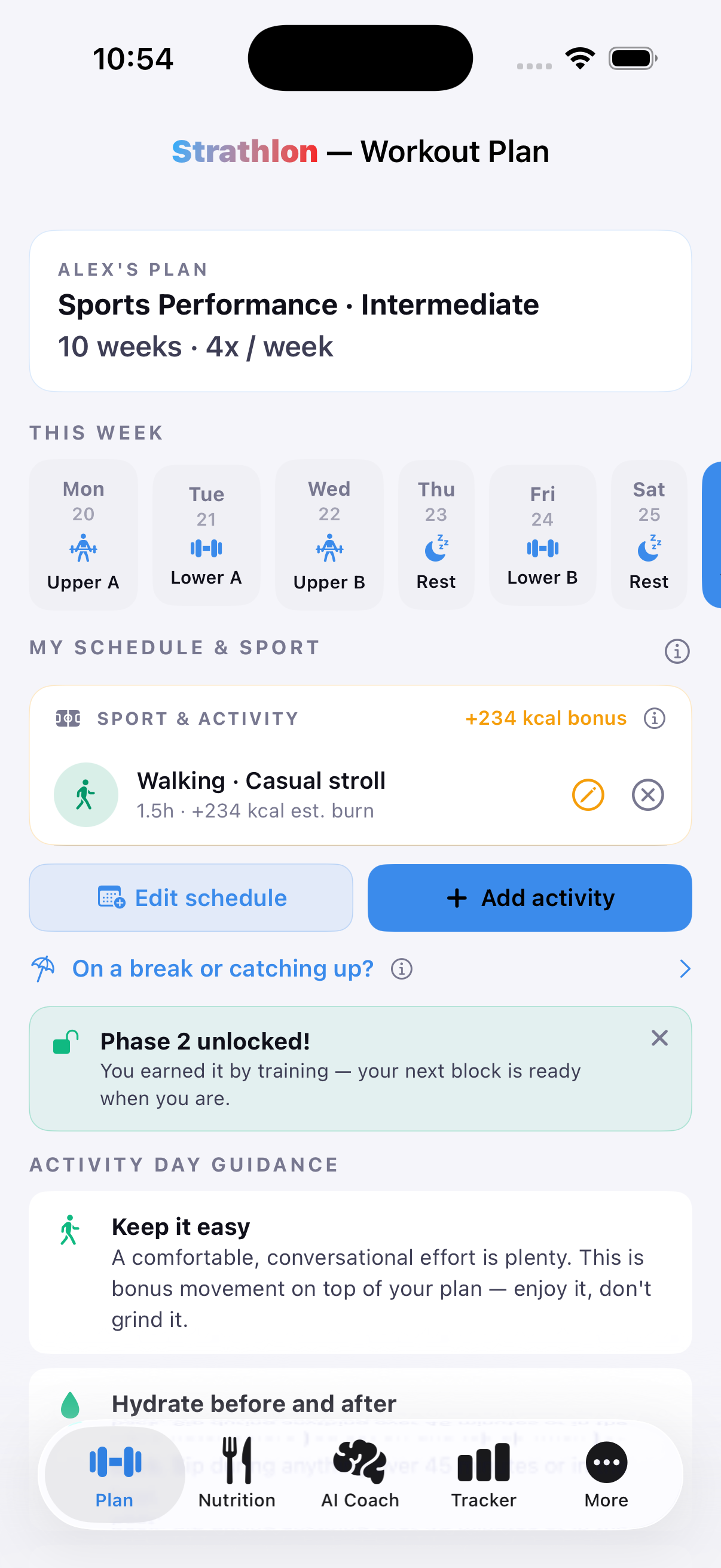
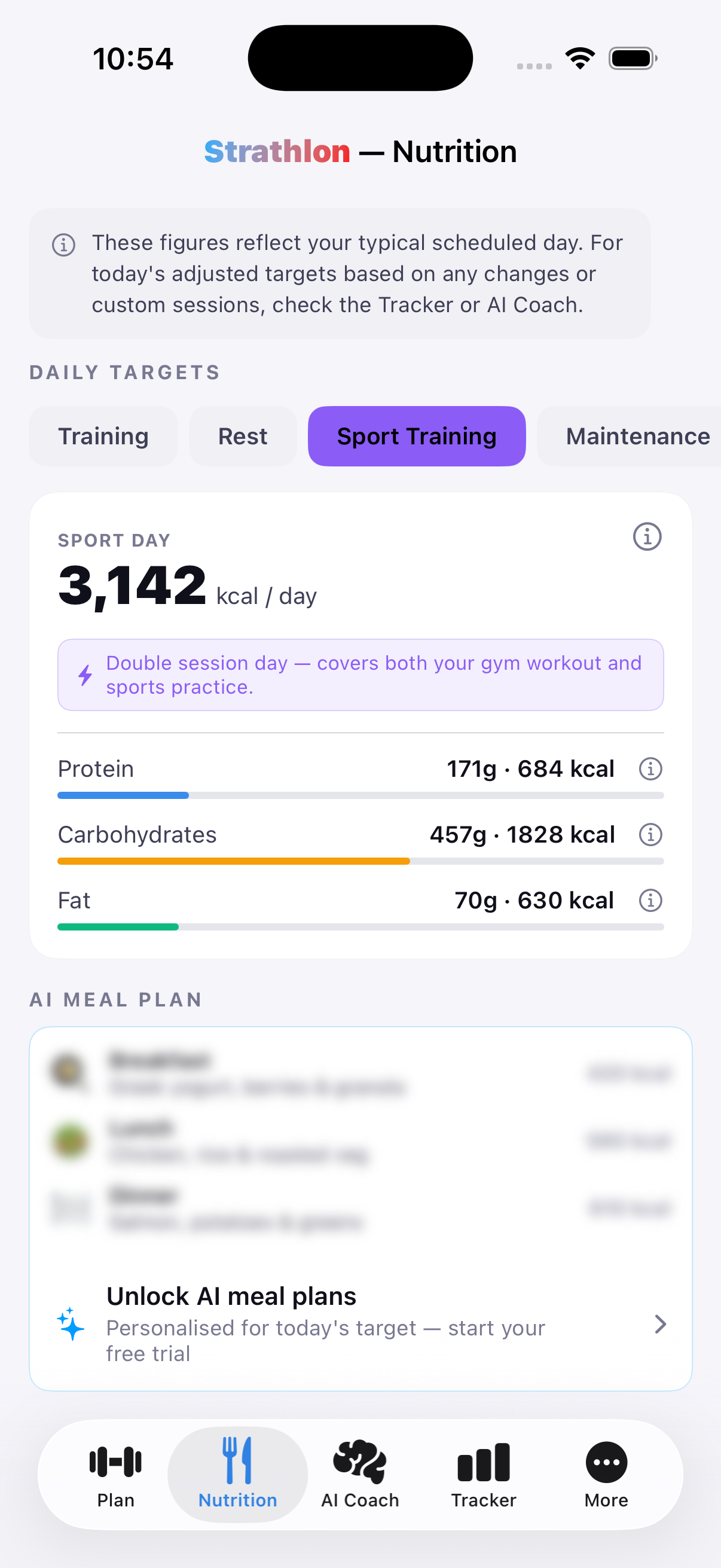
If walking isn't about race-day fuelling, the useful "nutrition" question becomes a bookkeeping one: how does a walk fit into your day's energy budget? That's where logging it matters. Recording a walk means the energy it burned is accounted for (it can adjust the day's calorie and target allowance rather than vanishing unnoticed), which is exactly what you want if you're managing weight or fat loss.
Common questions
Do I need to eat anything special before a walk?
For everyday walking (a stroll, a dog walk, a walking commute, even a brisk hour), you almost never need special fuelling. A walk is low-intensity and largely powered by fat, so your normal meals already cover it, and there is no need for gels, sports drinks or a dedicated pre-walk snack. Just walk. Fuelling only starts to matter on unusually long outings of several hours, such as a full-day hike, which is covered below.
Should I use energy gels or sports drinks on a walk?
For an ordinary walk, no: they add sugar and calories your body doesn't need for such a gentle effort, and can quietly undo the modest energy that walking helps you burn. They only become useful on very long, continuous walks lasting several hours, like a big hike, where taking in some easy-to-digest carbohydrate and carrying water helps you keep going comfortably. For anything under a couple of hours, plain water and your normal meals are enough.
How much water should I drink on a walk?
For short walks, just drink normally to thirst: you rarely need to carry anything. On longer walks (beyond about an hour), and especially in heat, carry water and sip when thirsty. A useful rule from sports-medicine guidance is to avoid losing more than roughly 2% of your body weight as sweat over a long effort. On long, hot or multi-hour walks, including some sodium (through a snack or an electrolyte drink) helps you hold on to the fluid. There is no need to force large amounts down on a normal walk.
Should I carb-load before a long walk?
No. Carbohydrate loading is a strategy for hard, continuous endurance events lasting well over 90 minutes that genuinely drain the muscles' glycogen stores, like a marathon. A walk isn't one of them. Walking is gentle enough that it burns mostly fat and barely dents glycogen, so loading up on carbohydrate beforehand just adds extra food you don't need. Eat normally. For a long hike, a regular meal beforehand plus some snacks to carry is all it takes.
Does logging a walk change how much I should eat?
In Strathlon, logging a walk through Add activity adds it to the day's activity ledger, so the app can adjust your calorie and target allowance for the day: a walk earns back a little of your energy budget. That is the honest way to account for walking: it nudges your daily numbers rather than calling for special fuelling. If your goal is fat loss, this helps you see how walking adds to the energy you burn without over-crediting it.
Can walking help with fat loss?
Yes: walking is one of the most useful tools there is, mainly because it adds to your daily energy expenditure without being tiring or hard to recover from, and it is easy to do consistently. Much of its value comes through what scientists call NEAT, the energy you burn through everyday movement. Walking works best for fat loss when it's paired with sensible eating. The diet side does most of the heavy lifting, which our fat-loss fundamentals guide covers in depth.
Takeaways
- Everyday walking needs no special fuelling. It's low-intensity and fat-fuelled, so your normal meals cover it: no gels, sports drinks or pre-walk snacks required.
- Walking's value is as a health and activity tool. It adds to your daily energy expenditure and NEAT, supports fat loss, and carries strong health benefits: that's the point, rather than race-day performance.
- Diet does most of the fat-loss work. Walking is a superb supporting act, but you can out-eat it easily. Pair it with sensible eating (see the fat-loss fundamentals guide).
- Hydrate to thirst. Carry water when it's long or hot. On long walks aim to keep body-mass loss under ~2%, and add a little sodium on multi-hour or hot outings. Don't over-drink.
- Only very long walks need fuelling. Beyond a couple of hours, roughly 30–60 g of carbohydrate an hour from ordinary snacks (a banana, a bar, a sandwich) plus water is plenty.
- Never carb-load for a walk. Loading is for hard, glycogen-draining events. A gentle walk barely touches glycogen, so extra carbohydrate is just extra food.
- Log the walk, skip the feed plan. Recording a walk in Strathlon adjusts your day's calorie allowance: the honest way to account for walking without inflating its demands.
- References
If you remember one thing, make it this: walking is the rare kind of exercise where the best "fuelling strategy" is usually to stop thinking about fuelling and just go. Eat normally, drink to thirst, carry water and a snack only when the walk turns into a genuine multi-hour hike, and let the real benefit, a bit more activity in your day, do its quiet work. Strathlon's job here is small and honest: log the walk, adjust the day's numbers, and never sell you a gel you don't need.
References
Numbered sources for the specific figures, effect sizes and named studies above. Where a claim reflects agreed guidance rather than a single trial, the citation is to the position stand or consensus statement of the body concerned, with the country or international remit named. Walking is fuelled by ordinary eating rather than by sports nutrition, so the sources below are mostly population health evidence and national dietary guidance rather than performance trials. That is the honest shape of the evidence for this activity.
- Herrmann SD, Willis EA, Ainsworth BE, Barreira TV, Hastert M, Kracht CL, et al. 2024 Adult Compendium of Physical Activities: A third update of the energy costs of human activities. Journal of Sport and Health Science. 2024;13(1):6–12. The 2024 Adult Compendium of Physical Activities, the source for the energy cost of walking at different speeds and gradients, and therefore for how modest the extra fuelling need is. PubMed 38242596 · PMC10818145 full text
- Rodríguez-Gutiérrez E, Torres-Costoso A, Del Pozo Cruz B, de Arenas-Arroyo SN, Pascual-Morena C, Bizzozero-Peroni B, et al. Daily steps and all-cause mortality: An umbrella review and meta-analysis. Preventive Medicine. 2024;185:108047. Umbrella review and meta-analysis of daily steps and all-cause mortality, the health context this guide sits in. PubMed 38901742
- Stens NA, Bakker EA, Mañas A, Buffart LM, Ortega FB, Lee DC, et al. Relationship of Daily Step Counts to All-Cause Mortality and Cardiovascular Events. Journal of the American College of Cardiology. 2023;82(15):1483–1494. Meta-analysis relating daily step counts to all-cause mortality and cardiovascular events, the second source for the same. PubMed 37676198
- Anton SD, Duncan GE, Limacher MC, Martin AD, Perri MG. How much walking is needed to improve cardiorespiratory fitness? An examination of the 2008 Physical Activity Guidelines for Americans. Research Quarterly for Exercise and Sport. 2011;82(2):365–70. Study of how much walking is needed to improve cardiorespiratory fitness, the source for the intensity at which fuelling starts to matter at all. PubMed 21699118 · PMC4126169 full text
- Reynolds A, Mann J, Cummings J, Winter N, Mete E, Te Morenga L. Carbohydrate quality and human health: a series of systematic reviews and meta-analyses. Lancet. 2019;393(10170):434–445. Series of systematic reviews and meta-analyses of carbohydrate quality and human health, the basis for the food-quality guidance. PubMed 30638909
- National Health Service (NHS, United Kingdom). Physical activity guidelines for adults aged 19 to 64. NHS physical activity guidance for adults, the weekly target this guide's advice is scaled to. NHS physical activity guidelines
- National Health Service (NHS, United Kingdom). Water, drinks and hydration. NHS guidance on water, drinks and hydration, the everyday hydration baseline for a long walk. NHS Live Well
- Herrmann SD, Willis EA, Ainsworth BE, et al. 2024 Adult Compendium of Physical Activities: MET values used for activity energy cost. The Adult Compendium of Physical Activities reference used for the MET values behind the burn estimates quoted. Adult Compendium of Physical Activities
- Thomas DT, Erdman KA, Burke LM. Position of the Academy of Nutrition and Dietetics, Dietitians of Canada, and the American College of Sports Medicine: Nutrition and Athletic Performance. Journal of the Academy of Nutrition and Dietetics. 2016;116(3):501–528. Joint position of the Academy of Nutrition and Dietetics, Dietitians of Canada and the American College of Sports Medicine, the umbrella source for the daily energy, carbohydrate and protein ranges used throughout. PubMed 26920240
- Burke LM, Hawley JA, Wong SH, Jeukendrup AE. Carbohydrates for training and competition. Journal of Sports Sciences. 2011;29 Suppl 1:S17–27. Burke and colleagues on carbohydrate for training and competition, the source for the g/kg/day carbohydrate targets matched to training load. PubMed 21660838
- Jeukendrup A. A step towards personalized sports nutrition: carbohydrate intake during exercise. Sports Medicine. 2014;44 Suppl 1(Suppl 1):S25–33. Jeukendrup on personalising carbohydrate intake during exercise, the source for the g/h feeding rates and the duration at which they start to matter. PubMed 24791914 · PMC4008807 full text
- Jäger R, Kerksick CM, Campbell BI, Cribb PJ, Wells SD, Skwiat TM, et al. International Society of Sports Nutrition Position Stand: protein and exercise. Journal of the International Society of Sports Nutrition. 2017;14:20. International Society of Sports Nutrition (ISSN, United States) position stand on protein and exercise, the source for the daily protein range and per-meal distribution. PubMed 28642676 · PMC5477153 full text
- Schoenfeld BJ, Aragon AA. How much protein can the body use in a single meal for muscle-building? Implications for daily protein distribution. Journal of the International Society of Sports Nutrition. 2018;15:10. Schoenfeld and Aragon on how much protein the body can use in a single meal, the basis for the per-feed figure quoted. PubMed 29497353 · PMC5828430 full text
- Burke LM, van Loon LJC, Hawley JA. Postexercise muscle glycogen resynthesis in humans. Journal of Applied Physiology. 2017;122(5):1055–1067. Review of post-exercise muscle glycogen resynthesis, the source for the refuelling rates and for when a fast refuel is actually needed. PubMed 27789774
- Sawka MN, Burke LM, Eichner ER, Maughan RJ, Montain SJ, Stachenfeld NS. American College of Sports Medicine position stand. Exercise and fluid replacement. Medicine and Science in Sports and Exercise. 2007;39(2):377–90. ACSM position stand on exercise and fluid replacement, the source for the under-2% body-mass-loss guideline and the sweat-rate method. PubMed 17277604
- Barnes KA, Anderson ML, Stofan JR, Dalrymple KJ, Reimel AJ, Roberts TJ, et al. Normative data for sweating rate, sweat sodium concentration, and sweat sodium loss in athletes: An update and analysis by sport. Journal of Sports Sciences. 2019;37(20):2356–2366. Normative data for sweating rate and sweat sodium concentration in athletes, the source for how widely fluid and sodium losses vary between individuals. PubMed 31230518
- Hew-Butler T, Rosner MH, Fowkes-Godek S, Dugas JP, Hoffman MD, Lewis DP, et al. Statement of the Third International Exercise-Associated Hyponatremia Consensus Development Conference, Carlsbad, California, 2015. Clinical Journal of Sport Medicine : Official Journal of the Canadian Academy of Sport Medicine. 2015;25(4):303–20. Third International Exercise-Associated Hyponatremia Consensus statement, the basis for the warning against drinking well beyond sweat losses. PubMed 26102445
- Guest NS, VanDusseldorp TA, Nelson MT, Grgic J, Schoenfeld BJ, Jenkins NDM, et al. International society of sports nutrition position stand: caffeine and exercise performance. Journal of the International Society of Sports Nutrition. 2021;18(1):1. ISSN position stand on caffeine and exercise performance, the source for the caffeine dose and timing guidance. PubMed 33388079 · PMC7777221 full text
- Kreider RB, Kalman DS, Antonio J, Ziegenfuss TN, Wildman R, Collins R, et al. International Society of Sports Nutrition position stand: safety and efficacy of creatine supplementation in exercise, sport, and medicine. Journal of the International Society of Sports Nutrition. 2017;14:18. ISSN position stand on the safety and efficacy of creatine supplementation, cited where creatine is relevant to the sport's demands. PubMed 28615996 · PMC5469049 full text
- Maughan RJ, Burke LM, Dvorak J, Larson-Meyer DE, Peeling P, Phillips SM, et al. IOC consensus statement: dietary supplements and the high-performance athlete. British Journal of Sports Medicine. 2018;52(7):439–455. IOC consensus statement on dietary supplements and the high-performance athlete, the framing for treating supplements as optional extras. PubMed 29540367 · PMC5867441 full text
- Mountjoy M, Ackerman KE, Bailey DM, Burke LM, Constantini N, Hackney AC, et al. 2023 International Olympic Committee's (IOC) consensus statement on Relative Energy Deficiency in Sport (REDs). British Journal of Sports Medicine. 2023;57(17):1073–1097. The 2023 IOC consensus statement on Relative Energy Deficiency in Sport, the source for the consequences of under-fuelling a training load. PubMed 37752011
- Aragon AA, Schoenfeld BJ. Nutrient timing revisited: is there a post-exercise anabolic window?. Journal of the International Society of Sports Nutrition. 2013;10(1):5. Aragon and Schoenfeld on the post-exercise anabolic window, the source for timing mattering far less than daily totals. PubMed 23360586 · PMC3577439 full text
- British Dietetic Association (BDA, United Kingdom). Sport and exercise nutrition: Food Fact Sheet. British Dietetic Association (BDA, United Kingdom) Food Fact Sheet on sport and exercise nutrition, the practical UK dietetic framing. BDA Food Fact Sheet
This is general educational information rather than medical, dietary or coaching advice. The few figures here are drawn from established consensus and framed as population-level guides: individual needs vary with body size, pace, terrain, conditions, heat and health status, and are best personalised with a qualified professional. Anyone with a health condition, who is pregnant or postpartum, or who is planning long or strenuous walks in challenging conditions, should consult a physician or registered dietitian before making changes. See our Terms for more.
← All guides · Walking strength and conditioning · Eating for results · Fat-loss fundamentals · Understanding your stats · Home