
Fuelling & performance nutrition for tennis
An evidence-based guide to fuelling one of sport's most awkward challenges: a game that is long, stop-start and often played in the heat, with no clock to tell you when it ends. We cover carbohydrate before and during a match, drinking to your own sweat rate, sodium and cramp, and how to recover between matches and across a full tournament day: grounded in established sports-nutrition consensus, written in plain English, with the common myths corrected.
Here's the whole thing in one sentence: fuel a tennis match like the long, intermittent, heat-exposed effort it is: start with full carbohydrate stores, top up carbohydrate steadily once a match runs beyond about an hour, drink to roughly match your sweat rate with enough sodium, and refuel hard between matches and days. Tennis rewards the player who is still fresh in the third set, and that freshness is built as much in the kitchen and on the changeovers as on the practice court.
Pair this with the tennis strength & conditioning guide: the strength, rotational power and prehab that keep you moving well on court, which all this fuelling is there to support.
On this page
- What tennis asks of your fuel
- Before the match: filling the tank
- During the match: carbohydrate that keeps you sharp
- Hydration: drink to your sweat rate
- Sodium, electrolytes and cramp
- Multi-match days and tournaments
- Between-match and between-day recovery
- Protein and the daily picture
- Common questions
- Takeaways
A framing note before the detail. Fuelling principles are well established in sports nutrition, but people differ enormously: body size, fitness, sweat rate, sweat saltiness, the weather, the surface and how long the match runs all shift what any individual needs. So this is written as can, tends to and is associated with, never as a guarantee, and the figures are general guides drawn from published position stands and tennis research rather than a prescription for you personally. It's general education rather than medical or dietetic advice.
What tennis asks of your fuel
Tennis is a long-duration intermittent sport, and that phrase does a lot of work. Long because a match has no fixed length: a routine one might run 90 minutes, a tight one two to three hours, and a five-setter far longer. Intermittent because the play itself is a stitched-together sequence of short, sharp efforts: explosive sprints, lunges, changes of direction and serves, separated by the natural pauses between points and games. The rallies are fuelled heavily by your body's fast carbohydrate systems (studies of racquet sports show blood lactate rising well above resting levels during hard play) while the low-level movement and the recovery between points lean on a mix of fuels.
Two consequences follow. First, because the intense bursts draw repeatedly on muscle glycogen (your stored carbohydrate), a long match can gradually run that store down, and as it falls, the sharp end of your game tends to fade: slower first steps, a less reliable serve, sloppier decisions late on. Second, all that movement generates heat, and shedding heat means sweating, sometimes copiously. Add an outdoor court in summer and you have a sport that quietly taxes both your carbohydrate stores and your fluid-and-salt balance at the same time. Good tennis fuelling is really about defending those two things across an unpredictable length of time.
Before the match: filling the tank
You can't top up mid-match what you didn't store beforehand. Because the intense bursts of tennis draw on glycogen, the single most useful thing you can do is arrive with those stores full, which is a function of your carbohydrate intake over the day or two before, well beyond the pre-match meal. Sports-nutrition position stands put general daily carbohydrate for active people in a broad band of roughly 5–12 g per kg of body weight per day, with the higher end (around 8–10 g/kg/day) reserved for heavy training or competition loads. For a typical match-day player, sitting in the middle of that band (think meals genuinely built around carbohydrate rather than treating it as a side) is what keeps the tank topped up.
For the pre-match meal itself, the same guidance suggests around 1–4 g of carbohydrate per kg of body weight in the hours beforehand. In practice that means a carbohydrate-based meal (porridge, toast, rice, pasta, a bagel, fruit) eaten far enough ahead (commonly two to four hours for a full meal) that it has settled and won't sit heavy when you start moving. Keeping the meal lower in fat and fibre than usual helps it digest cleanly and reduces the risk of a queasy stomach on court. A small, easy top-up in the final hour (a banana, a few dates, a sports drink) can be worthwhile if you expect a long match, provided it's food you know agrees with you.
During the match: carbohydrate that keeps you sharp
For short matches on full stores, water is often enough. But once a match runs beyond about an hour (and many do) taking in carbohydrate during play helps keep blood glucose steady and spares your dwindling glycogen, which tends to protect the sharp, high-intensity parts of your game late on. Sports-nutrition position stands on nutrient timing recommend that for prolonged efforts beyond roughly 60–90 minutes, carbohydrate be taken at about 30–60 g per hour, often as a 6–8% carbohydrate-electrolyte drink sipped across the session. That range conveniently doubles as your drink, so hydration and fuelling happen in the same mouthful.
Tennis makes this easy in one respect: the changeovers (every two games) and the ends of sets are built-in fuelling windows. Rather than waiting until you flag, take a little on most changeovers (a few sips of a sports drink, a bite of banana, a couple of chews or a piece of a gel) so the supply is steady. For an exceptionally long or brutal match, the broader endurance-nutrition literature suggests intakes can climb toward the higher end (up to around 90 g per hour) but only when the carbohydrate comes from a mix of types (such as glucose plus fructose), which the gut absorbs faster together than glucose alone, and only if your stomach is trained for it. Most tennis players never need that much. It's a ceiling for the rare marathon rather than a target.
| Match length | Carbohydrate during | Fluid focus | Practical approach |
|---|---|---|---|
| Under ~60 min | Little or none | Water to thirst | Arrive fuelled. Sip water on changeovers. |
| ~1–2 hours | ~30–60 g/h | Drink to sweat rate | A carbohydrate-electrolyte drink covers both fuel and fluid. |
| 2 hours+ / hot | ~60 g/h (up to ~90) | Fluid + added sodium | Mixed-carb drink/gels. Take a little on most changeovers and add salt. |
The numbers are illustrative bands: a small junior and a large adult won't need the same, and a cool indoor match asks less than a humid outdoor one. Read the table as a direction of travel: the longer and hotter the match, the more deliberately you fuel and drink.
Hydration: drink to your sweat rate
Hydration is where tennis genuinely differs from the gym. Measured sweat rates in tennis match play average around 1.1 litres per hour, but the individual spread is enormous: one study of indoor play recorded a range from roughly 0.3 up to 2.0 litres per hour, and in hot outdoor conditions or for a heavy sweater, rates can reach around 2.5 litres per hour. Over a two- or three-hour match, that is a lot of fluid to leave the body. The reason it matters is performance: losing more than about 2% of your body weight as sweat is associated with measurable drops in accuracy, power and endurance: precisely the qualities that decide tight matches.
Because sweat rates vary so much, the honest advice is to drink to your own rate instead of a fixed number. The single most useful measurement in this whole guide is a simple weigh-in: weigh yourself (minimal clothing) before and after a match, and each kilogram lost is roughly a litre of fluid you didn't replace. Do that a few times in different weather and you'll know whether you tend to under-drink. As a practical starting point on court, tennis hydration guidance suggests drinking on the changeovers: very roughly 200 ml per changeover in mild conditions, rising toward 400 ml for heavy sweaters in the heat, then adjusting up or down based on what the scale tells you. Sip steadily rather than gulping a bottle at one changeover, which tends to sit uncomfortably.
Sodium, electrolytes and cramp
Sweat isn't just water: it carries salt, and sodium is the electrolyte that matters most here. In tennis, whole-body sweat sodium concentrations have been measured at around 41 mmol per litre on average (about 41 ± 15 mmol/L in one indoor-tennis study), with the broader range across players sitting somewhere around 20–80 mmol per litre. A single indoor match in one study cost players roughly 1.1 g of sodium on average, and that's indoors, in moderate conditions. Play a hot outdoor match, or two matches in a day, and a "salty sweater" can shed a great deal more. Water alone replaces the fluid but not the salt, and over a long or repeated effort that growing sodium deficit is what tips some players into trouble.
There is direct tennis evidence that sodium does more than keep fluid balance: it helps performance. In a controlled trial in nationally ranked players, a higher-sodium drink (around 50 mmol per litre) improved groundstroke performance compared with plain water, in a dose-dependent way, while also lowering players' perceived effort, thirst and stomach discomfort. So for long or hot matches, choosing a drink with meaningful sodium (or adding electrolytes) is a reasonable, evidence-supported move, and the major sports-medicine bodies advise taking in sodium during exercise when sweat sodium losses are large.
Cramp deserves an honest word, because tennis players fear it and the science has moved on. For decades, heat-related muscle cramp in tennis was pinned squarely on sweating out too much salt, and in players who sweat heavily and saltily across long or back-to-back matches, restoring fluid and sodium balance is still the best-supported way to reduce the risk. But the current view is that exercise-associated cramp is multifactorial: muscle fatigue from sustained, repetitive effort appears to play a large role too. The practical upshot balances both factors: hydrate and replace sodium properly, especially in the heat and across a tournament, but also train your fitness so the muscles fatigue later, and don't treat electrolytes as a guaranteed cramp cure.
Multi-match days and tournaments
Recreational and competitive tennis often stacks matches: a league doubleheader, a weekend tournament, back-to-back rounds. This changes the problem from "fuel one match" to "arrive at the next match as recovered as possible," and it's where casual fuelling quietly costs players. Everything you spent in match one (glycogen, fluid, sodium) is what you'll be missing in match two unless you deliberately replace it in the gap.
When the next match is only a few hours away, sports-nutrition guidance is to make the between-match window an active refuelling window. Prioritise carbohydrate to rebuild glycogen quickly: for rapid restoration when time is short (under about four hours), position stands point to roughly 1 g of carbohydrate per kg of body weight per hour, leaning on higher-glycaemic, easy-to-digest choices (fruit, a sandwich, a rice or pasta box, a recovery drink) because comfort and speed matter more than "clean eating" here. Alongside that, keep drinking and replacing sodium to make good the sweat deficit (aim to more than replace the fluid you lost if there's time), and include some protein. Keep sipping and nibbling between matches rather than waiting to feel hungry: appetite is an unreliable guide when you're hot and wired. Then, in the evening, eat a proper carbohydrate-rich meal so tomorrow's first match starts on a full tank.
Between-match and between-day recovery
Even without a second match today, what you do afterwards sets up tomorrow's training and your longer-term progress. The recovery job has three parts, and they map neatly onto what a match depletes:
- Refill carbohydrate (glycogen). If another session is close (within roughly four hours), position stands suggest a brisk intake of around 1.2 g of carbohydrate per kg per hour using higher-glycaemic sources, or about 0.6–1.0 g/kg in the first 30 minutes and again every couple of hours. With a full day or more before you next play, you don't need to chase the clock: simply eating enough carbohydrate across your normal meals refills stores in good time.
- Replace fluid and sodium. Rehydrate steadily rather than in one go, and include sodium (from a recovery drink, an electrolyte tab, or simply salted food) to help you hold on to the fluid you drink. Using your before/after weigh-in tells you how much ground there is to make up.
- Include protein. A serving of protein with your recovery meal supports repair of the muscle you've worked. It isn't urgent in the way carbohydrate is between two same-day matches, but it's part of a complete recovery plate.
- References
None of this needs to be elaborate. A meal or substantial snack that combines carbohydrate, some protein, fluid and a little salt (plus good sleep that night) covers the vast majority of recovery. The eating-for-results guide covers the everyday-nutrition side in full, and it's the foundation the match-day tactics here sit on top of.
Protein and the daily picture
Protein isn't a fuel you take mid-match, but it underpins the muscle that powers your sprints, lunges and serves, and it drives recovery between sessions. Sports-nutrition position stands commonly suggest around 1.4–2.0 g of protein per kg of body weight per day for active people, which comfortably covers most tennis players. What tends to help is spreading it (servings of roughly 20–40 g, about 0.25 g/kg) every three to four hours across the day, including one in your post-match recovery meal, rather than loading it all into dinner.
Zoom out and the tennis day has a clear shape: carbohydrate is the star around matches (before, during and immediately after), fluid and sodium are the co-stars whenever you sweat, and protein and total energy do their work in the background of your daily eating. Get those priorities in the right order and the details mostly sort themselves out.
Common questions
How should a tennis player fuel for a match?
Go in with full carbohydrate stores from a higher-carbohydrate day and a carbohydrate-based meal a few hours before. During a match that runs beyond about an hour, take in carbohydrate steadily (sports-nutrition position stands suggest roughly 30–60 g per hour for prolonged efforts) while drinking to roughly match your sweat rate and adding sodium, especially in heat or across a long or multi-match day. Then refuel with carbohydrate and protein soon after to be ready for the next match.
What should I eat before a tennis match?
Base the pre-match meal on carbohydrate. Sports-nutrition guidance suggests around 1–4 g of carbohydrate per kg of body weight in the hours before, eaten far enough ahead (commonly 2–4 hours for a full meal) that it sits comfortably. Familiar, lower-fat, lower-fibre choices (such as porridge, toast, rice, pasta, fruit or a bagel) tend to digest most easily. A small top-up of easy carbohydrate, like a banana or a sports drink, in the last hour can help if the match is long. Never trial a new food on a big match day.
How much should I drink during a tennis match?
Aim to roughly match your own sweat rate rather than follow a fixed number. Measured sweat rates in tennis average around 1.1 litres per hour but vary widely and can reach roughly 2.5 litres per hour in heat or in heavy sweaters. Practically, tennis hydration guidance suggests drinking on the changeovers: very roughly 200 ml each changeover in mild conditions, and up to around 400 ml for heavy sweaters in the heat. The best guide is to weigh yourself before and after: aim to finish having lost no more than about 2% of body weight, and drink more if you routinely lose more than that.
Do I need extra salt or electrolytes for tennis, and will it stop cramp?
Sodium matters more in tennis than in many sports because matches are long, often hot, and can repeat across a day. Sweat sodium losses in tennis are typically around 20–80 mmol per litre, so a heavy-sweating player in heat can lose a lot over a match and even more across a tournament day. A controlled trial found that a higher-sodium drink improved groundstroke performance and lowered perceived effort compared with plain water. Sodium and fluid balance is the best-supported way to reduce the risk of heat-related cramp, but cramp is now understood to be multifactorial, with muscle fatigue also playing a part, so electrolytes are not a guaranteed fix.
How do I fuel across a multi-match day or a tournament?
Treat the gap between matches as an active refuelling window. When the next match is only a few hours away, sports-nutrition guidance points to prioritising carbohydrate (on the order of about 1 g per kg per hour in the first hours, using higher-glycaemic, easy-to-digest choices) plus fluid and sodium to rebuild what you sweated out, and some protein. Keep sipping and snacking between matches rather than waiting to feel hungry, and top up carbohydrate stores again in the evening so tomorrow starts full.
How much protein does a tennis player need?
Protein isn't a during-match fuel. It supports recovery and the muscle you rely on for repeated sprints and serves. Sports-nutrition position stands commonly suggest around 1.4–2.0 g of protein per kg of body weight per day for active people, spread across the day in servings of roughly 20–40 g every few hours, including one soon after play. Carbohydrate remains the priority around matches. Protein does its work in the background of your daily eating.
Takeaways
- Fuel it like the long, intermittent, hot sport it is. The effort is stop-start but the clock is endurance: plan for the match that runs long.
- Arrive full. A higher-carbohydrate day or two beforehand (broadly ~5–12 g/kg/day depending on load) plus a carbohydrate-based meal (~1–4 g/kg) a few hours before is what stocks the tank you can't refill mid-match.
- Top up carbohydrate once past ~an hour. Roughly 30–60 g per hour, often as a 6–8% carbohydrate-electrolyte drink, taken a little at a time on the changeovers. Only the longest matches need to push toward ~90 g/h with mixed carbs.
- Drink to your own sweat rate. Tennis sweat rates average ~1.1 L/h but reach ~2.5 L/h in heat. Weigh before and after and aim to finish having lost no more than ~2% of body weight.
- Take sodium seriously. Sweat sodium runs ~20–80 mmol/L. A higher-sodium drink has been shown to improve groundstroke performance, and sodium-plus-fluid balance is the best-supported way to lower heat-cramp risk, though fatigue matters too.
- Refuel fast between matches. In a same-day gap, start soon and prioritise carbohydrate (~1 g/kg/h early), fluid, sodium and some protein: don't wait for the tournament to end.
- Protein and total energy in the background. Around 1.4–2.0 g/kg/day, spread across the day, supports the muscle and recovery behind your on-court fuelling.
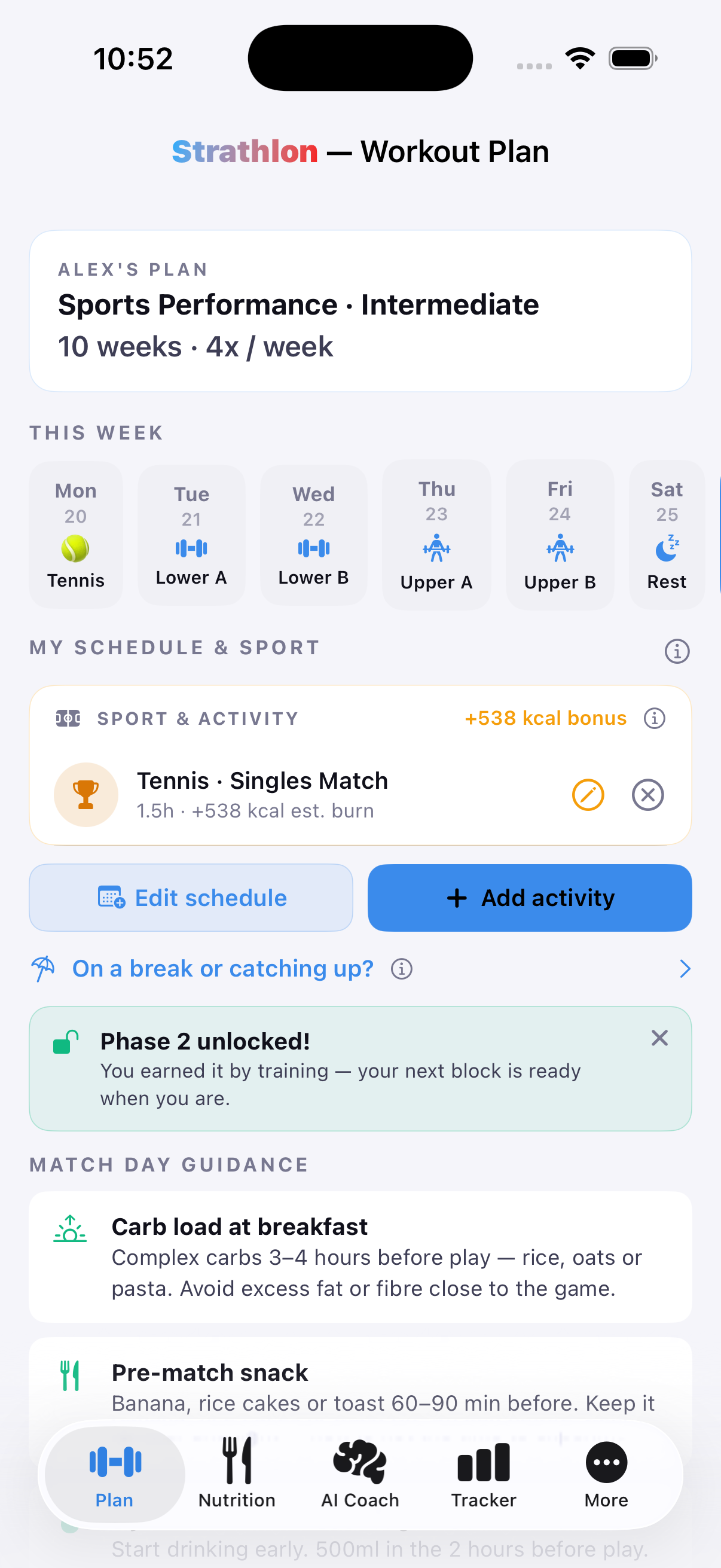
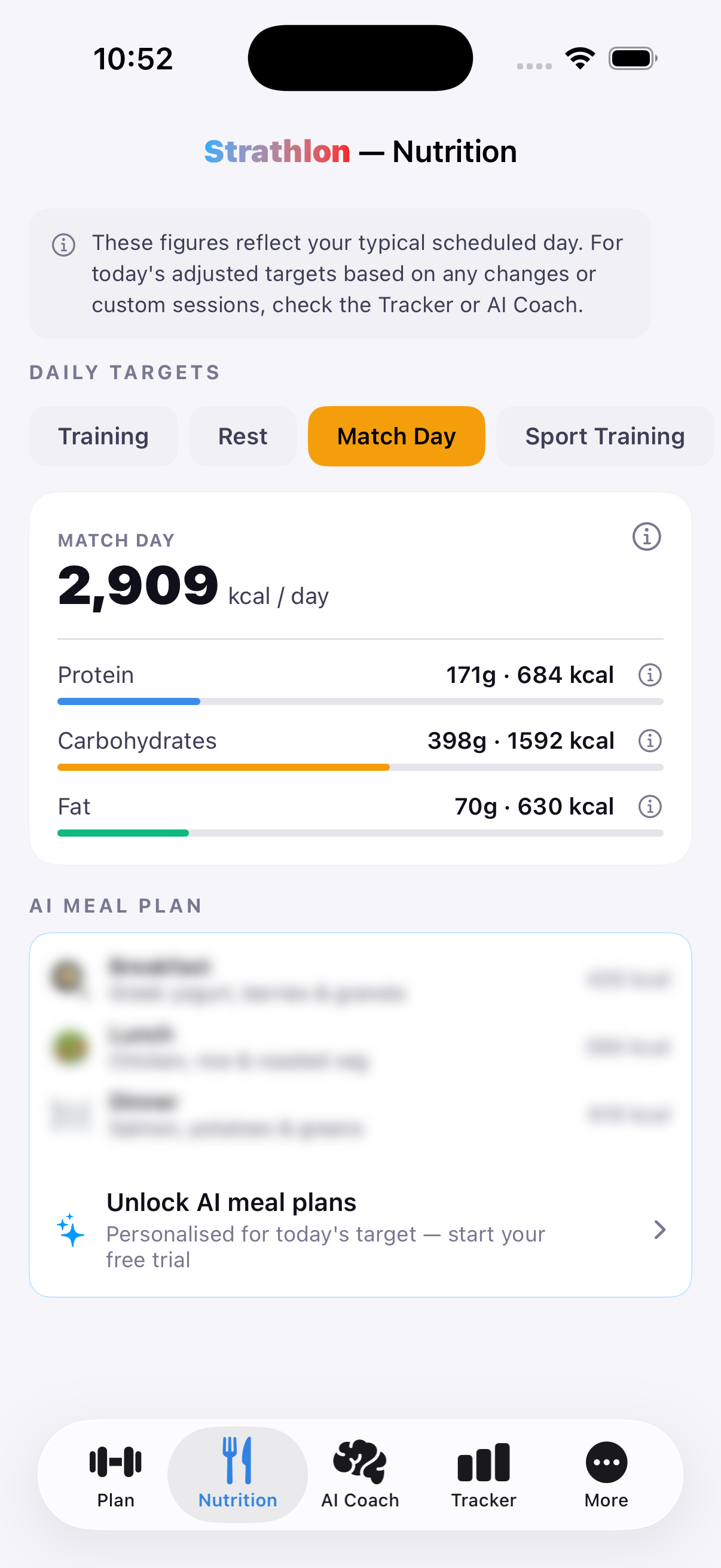
If you take one thing away, make it this: the player who is still sharp in the third set is usually the one who fuelled and drank early and steadily, before they needed to. Strathlon's role is to make that easier: lifting your sport-day targets when you log a match, and letting you see whether the fuel went in, so being ready for the next set, or the next match, is something you plan rather than hope for.
References
Numbered sources for the specific figures, effect sizes and named studies above. Where a claim reflects agreed guidance rather than a single trial, the citation is to the position stand or consensus statement of the body concerned, with the country or international remit named. Tennis is unusually well served: it has practical nutrition recommendations, governing-body guidance and in-match carbohydrate trials, and the figures below are cited to those.
- Ranchordas MK, Rogersion D, Ruddock A, Killer SC, Winter EM. Nutrition for tennis: practical recommendations. Journal of Sports Science & Medicine. 2013;12(2):211–24. Practical nutrition recommendations for tennis: the anchor source for this guide. PubMed 24149799 · PMC3761836 full text
- Vicente-Salar N, Crespo Celda M, Pluim BM, Fernández-Fernández J, Stroia K, Ellenbecker T, et al. International Tennis Federation (ITF), Women's Tennis Association (WTA), and Association of Tennis Professionals (ATP) Expert Group Statement on Nutrition in High-Performance Tennis. Current Evidence to Inform Practical Recommendations and Guide Future Research. International Journal of Sport Nutrition and Exercise Metabolism. 2025;35(6):557–594. Joint International Tennis Federation, WTA and ATP nutrition guidance, the governing-body position this guide follows. PubMed 40840558
- Gomes RV, Moreira A, Coutts AJ, Capitani CD, Aoki MS. Effect of carbohydrate supplementation on the physiological and perceptual responses to prolonged tennis match play. Journal of Strength and Conditioning Research. 2014;28(3):735–41. Randomised trial of carbohydrate supplementation on physiological and perceptual responses to prolonged tennis: the direct in-match carbohydrate evidence. PubMed 23860288
- Peltier SL, Leprêtre PM, Metz L, Ennequin G, Aubineau N, Lescuyer JF, et al. Effects of pre-exercise, endurance, and recovery designer sports drinks on performance during tennis tournament simulation. Journal of Strength and Conditioning Research. 2013;27(11):3076–83. Randomised trial of pre-exercise, endurance and recovery sports drinks during tennis tournament play, the second source for the same. PubMed 23439345
- Bergeron MF. Hydration and thermal strain during tennis in the heat. British Journal of Sports Medicine. 2014;48 Suppl 1(Suppl 1):i12–7. Study of hydration and thermal strain during tennis in the heat, the hydration case for a long outdoor match. PubMed 24668373 · PMC3995219 full text
- Bergeron MF. Heat cramps: fluid and electrolyte challenges during tennis in the heat. Journal of Science and Medicine in Sport. 2003;6(1):19–27. Study of heat cramps and fluid and electrolyte challenges during tennis in the heat, the sodium half of that case. PubMed 12801207
- Fleming JA, Naughton RJ, Harper LD. Investigating the Nutritional and Recovery Habits of Tennis Players. Nutrients. 2018;10(4). Study investigating the nutritional and recovery habits of tennis players, the source for the gap between guidance and practice. PubMed 29614035 · PMC5946228 full text
- Truax S, Fleming JA, Cross BL, Grosicki GJ. Nutritional habits of adolescent tennis players pre-, during, and post-match play. Minerva Pediatrics. 2022. Study of the nutritional habits of adolescent tennis players before, during and after match play, the youth picture. PubMed 35726766
- Reid M, Duffield R. The development of fatigue during match-play tennis. British Journal of Sports Medicine. 2014;48 Suppl 1(Suppl 1):i7–11. Study of the development of fatigue during match-play tennis, the demand this guide fuels against. PubMed 24668384 · PMC3995216 full text
- Thomas DT, Erdman KA, Burke LM. Position of the Academy of Nutrition and Dietetics, Dietitians of Canada, and the American College of Sports Medicine: Nutrition and Athletic Performance. Journal of the Academy of Nutrition and Dietetics. 2016;116(3):501–528. Joint position of the Academy of Nutrition and Dietetics, Dietitians of Canada and the American College of Sports Medicine: the umbrella source for the daily energy, carbohydrate and protein ranges used throughout. PubMed 26920240
- Burke LM, Hawley JA, Wong SH, Jeukendrup AE. Carbohydrates for training and competition. Journal of Sports Sciences. 2011;29 Suppl 1:S17–27. Burke and colleagues on carbohydrate for training and competition, the source for the g/kg/day carbohydrate targets matched to training load. PubMed 21660838
- Jeukendrup A. A step towards personalized sports nutrition: carbohydrate intake during exercise. Sports Medicine. 2014;44 Suppl 1(Suppl 1):S25–33. Jeukendrup on personalising carbohydrate intake during exercise: the source for the g/h feeding rates and the duration at which they start to matter. PubMed 24791914 · PMC4008807 full text
- Jäger R, Kerksick CM, Campbell BI, Cribb PJ, Wells SD, Skwiat TM, et al. International Society of Sports Nutrition Position Stand: protein and exercise. Journal of the International Society of Sports Nutrition. 2017;14:20. International Society of Sports Nutrition (ISSN, United States) position stand on protein and exercise, the source for the daily protein range and per-meal distribution. PubMed 28642676 · PMC5477153 full text
- Schoenfeld BJ, Aragon AA. How much protein can the body use in a single meal for muscle-building? Implications for daily protein distribution. Journal of the International Society of Sports Nutrition. 2018;15:10. Schoenfeld and Aragon on how much protein the body can use in a single meal, the basis for the per-feed figure quoted. PubMed 29497353 · PMC5828430 full text
- Burke LM, van Loon LJC, Hawley JA. Postexercise muscle glycogen resynthesis in humans. Journal of Applied Physiology. 2017;122(5):1055–1067. Review of post-exercise muscle glycogen resynthesis, the source for the refuelling rates and for when a fast refuel is actually needed. PubMed 27789774
- Sawka MN, Burke LM, Eichner ER, Maughan RJ, Montain SJ, Stachenfeld NS. American College of Sports Medicine position stand. Exercise and fluid replacement. Medicine and Science in Sports and Exercise. 2007;39(2):377–90. ACSM position stand on exercise and fluid replacement: the source for the under-2% body-mass-loss guideline and the sweat-rate method. PubMed 17277604
- Barnes KA, Anderson ML, Stofan JR, Dalrymple KJ, Reimel AJ, Roberts TJ, et al. Normative data for sweating rate, sweat sodium concentration, and sweat sodium loss in athletes: An update and analysis by sport. Journal of Sports Sciences. 2019;37(20):2356–2366. Normative data for sweating rate and sweat sodium concentration in athletes, the source for how widely fluid and sodium losses vary between individuals. PubMed 31230518
- Hew-Butler T, Rosner MH, Fowkes-Godek S, Dugas JP, Hoffman MD, Lewis DP, et al. Statement of the Third International Exercise-Associated Hyponatremia Consensus Development Conference, Carlsbad, California, 2015. Clinical Journal of Sport Medicine : Official Journal of the Canadian Academy of Sport Medicine. 2015;25(4):303–20. Third International Exercise-Associated Hyponatremia Consensus statement, the basis for the warning against drinking well beyond sweat losses. PubMed 26102445
- Guest NS, VanDusseldorp TA, Nelson MT, Grgic J, Schoenfeld BJ, Jenkins NDM, et al. International society of sports nutrition position stand: caffeine and exercise performance. Journal of the International Society of Sports Nutrition. 2021;18(1):1. ISSN position stand on caffeine and exercise performance, the source for the caffeine dose and timing guidance. PubMed 33388079 · PMC7777221 full text
- Kreider RB, Kalman DS, Antonio J, Ziegenfuss TN, Wildman R, Collins R, et al. International Society of Sports Nutrition position stand: safety and efficacy of creatine supplementation in exercise, sport, and medicine. Journal of the International Society of Sports Nutrition. 2017;14:18. ISSN position stand on the safety and efficacy of creatine supplementation, cited where creatine is relevant to the sport's demands. PubMed 28615996 · PMC5469049 full text
- Maughan RJ, Burke LM, Dvorak J, Larson-Meyer DE, Peeling P, Phillips SM, et al. IOC consensus statement: dietary supplements and the high-performance athlete. British Journal of Sports Medicine. 2018;52(7):439–455. IOC consensus statement on dietary supplements and the high-performance athlete: the framing for treating supplements as optional extras. PubMed 29540367 · PMC5867441 full text
- Mountjoy M, Ackerman KE, Bailey DM, Burke LM, Constantini N, Hackney AC, et al. 2023 International Olympic Committee's (IOC) consensus statement on Relative Energy Deficiency in Sport (REDs). British Journal of Sports Medicine. 2023;57(17):1073–1097. The 2023 IOC consensus statement on Relative Energy Deficiency in Sport, the source for the consequences of under-fuelling a training load. PubMed 37752011
- Aragon AA, Schoenfeld BJ. Nutrient timing revisited: is there a post-exercise anabolic window?. Journal of the International Society of Sports Nutrition. 2013;10(1):5. Aragon and Schoenfeld on the post-exercise anabolic window, the source for timing mattering far less than daily totals. PubMed 23360586 · PMC3577439 full text
- British Dietetic Association (BDA, United Kingdom). Sport and exercise nutrition: Food Fact Sheet. British Dietetic Association (BDA, United Kingdom) Food Fact Sheet on sport and exercise nutrition, the practical UK dietetic framing. BDA Food Fact Sheet
This is general educational information rather than medical, dietetic or coaching advice. The fuelling principles described here are well established in broad terms, but individual variation is large (in sweat rate, sweat sodium, tolerance and needs) and mechanisms and figures are framed as tendencies and general guides rather than certainties or promises. Anyone with a health condition, who is pregnant or postpartum, or who is planning competition nutrition around a medical issue, should consult a qualified professional such as a sports dietitian before making changes. See our Terms for more.
← All guides · Tennis training guide · Eating for results · Understanding your stats · Home