
Fuelling & performance nutrition for polo
An evidence-based guide to fuelling the polo player rather than the pony. Polo looks and feels athletic, and it is: you are balancing, bracing and swinging a mallet at speed, often in real heat. But the horse does the running, so the rider's true energy demand is moderate rather than endurance. That changes what fuelling should focus on. This covers why polo is a skill-and-heat sport rather than a glycogen sport, how to eat for steady energy across a match, the pre-match meal, modest between-chukka top-ups, and the real priorities: hydration, electrolytes and concentration. Practical, honest, and grounded in established sports-nutrition consensus.
Here's the short answer to "how should a polo player fuel?": fuel for steady energy and concentration. Build the day on regular balanced meals with a modest amount of carbohydrate, eat a familiar carbohydrate-focused meal roughly one to four hours before you play, and (the part that actually moves the needle) arrive well hydrated and keep drinking, with electrolytes when it's hot, using the breaks between chukkas to top up fluid and, on a long match, a little carbohydrate. Everything below is the detail behind that sentence: what the rider's body is really doing, the numbers that apply, and where they come from.
On this page
- Why polo is a skill-and-heat sport rather than an endurance one
- Daily fuelling: steady energy, modest carbohydrate
- Before you play: the pre-match meal
- Across the match: steady energy and top-ups
- Hydration, electrolytes, heat and kit
- Concentration: fuelling the brain along with the legs
- Recovery: rehydrate first, then eat
- Eating enough over a season
- Common questions
- Takeaways
- References
A framing note before the numbers. Sports nutrition is well studied, but people differ enormously: body size, how much you ride and train, the number of ponies you play, the weather, gut tolerance, sex and health status all shift what's right on the day. Equestrian sport in particular is under-researched compared with running or cycling, so much of the guidance here is adapted from broader sports-nutrition consensus and from the small but growing body of work on riders specifically. It's written as can, tends to and around, never as a guarantee, and every specific figure is a population-level guide rather than a personal prescription. It's general education rather than medical or dietary advice.
Pair this with the polo strength & conditioning guide for the training side: the core, grip and riding-specific work that this fuelling underpins.
Why polo is a skill-and-heat sport rather than an endurance one
Start with an honest picture of what the rider's body is doing. A polo match is played in chukkas, with a change to a fresh pony for each one. Under the rules of the Hurlingham Polo Association (the governing body for the United Kingdom and Ireland), a chukka runs to a maximum of seven and a half minutes, with a first bell at seven minutes signalling that up to thirty seconds remain. The standard game is six chukkas, though tournament committees vary that with the level of the polo, and the intervals between chukkas are three minutes, with five at half time.[1] That adds up to well under an hour of actual playing time, broken into short pieces: the first clue that polo is intermittent rather than a continuous grind.
The heart-rate numbers can look alarming and are worth understanding properly. A heart-rate analysis of elite players across two high-goal matches found a match average of 150 beats per minute, with the third of the five chukkas played the highest at 154.[2] A review of riders' physiology places polo among the disciplines in which high average heart rates of 150–185 bpm and near-maximal values of around 200 bpm are observed.[3] But heart rate overstates the true energy cost here. That same review notes that a dissociation between heart rate and the expected oxygen demand can occur in disciplines that hold a rider in two-point gaits and postures for long periods, because repeated isometric contractions raise blood pressure out of proportion to the metabolic demand.[3] It also reports that oxygen uptake during equestrian activity is lower than in comparable individual or team sports of similar duration: the pony, after all, is providing the locomotion.[3] In plain terms: your heart is working, but you are not burning glycogen like a marathoner.
That is why the fuelling emphasis for polo is different. Riding energy expenditure scales with gait: the same review puts a canter at 7.7 METs and a gallop at 9.4 METs, genuinely vigorous while it lasts[3], but a match spends much of its clock at lower efforts, in the breaks and on a fresh horse. The upshot is that a polo player is far less likely to empty their carbohydrate stores than a distance athlete. The things that do limit a rider late in a hot match are fluid loss, overheating and fading concentration, which is exactly where fuelling and hydration should be pointed.
Daily fuelling: steady energy, modest carbohydrate
Good match-day energy comes mostly from how you eat across the whole week. Nothing clever on the day makes up for it. Published guidance for riders scales daily carbohydrate to how much you actually ride and train: 3–5 g of carbohydrate per kilogram of body weight per day for recreational riding, low-energy yard tasks and off-horse training days, and 5–7 g/kg/day for one or more horses in light- to medium-ridden work.[3] The higher bands (7–10 g/kg/day and above) are set aside for riders with multiple horses in medium-to-heavy work or a full competitive load,[3] and most polo players sit comfortably below that. This is deliberately more modest than a distance runner's numbers, and that's correct: polo doesn't drain glycogen the way continuous endurance does.
The more useful habit than chasing a gram target is simply not running on empty. Riders are specifically discouraged from missing meals and snacks, because doing so tends to compromise both protein and fuel intake across the day[3], which matters when the day is a long one at the club. Around the carbohydrate, aim for roughly 1.2–2.2 g of protein per kilogram of body weight per day, spread across four to six servings of 0.25–0.4 g/kg, or 25–40 g, to support the muscle you use for bracing and control, and enough healthy fat (a minimum of around 20% of your dietary energy) for general health.[3] The eating-for-results guide covers this everyday picture in depth.
Before you play: the pre-match meal
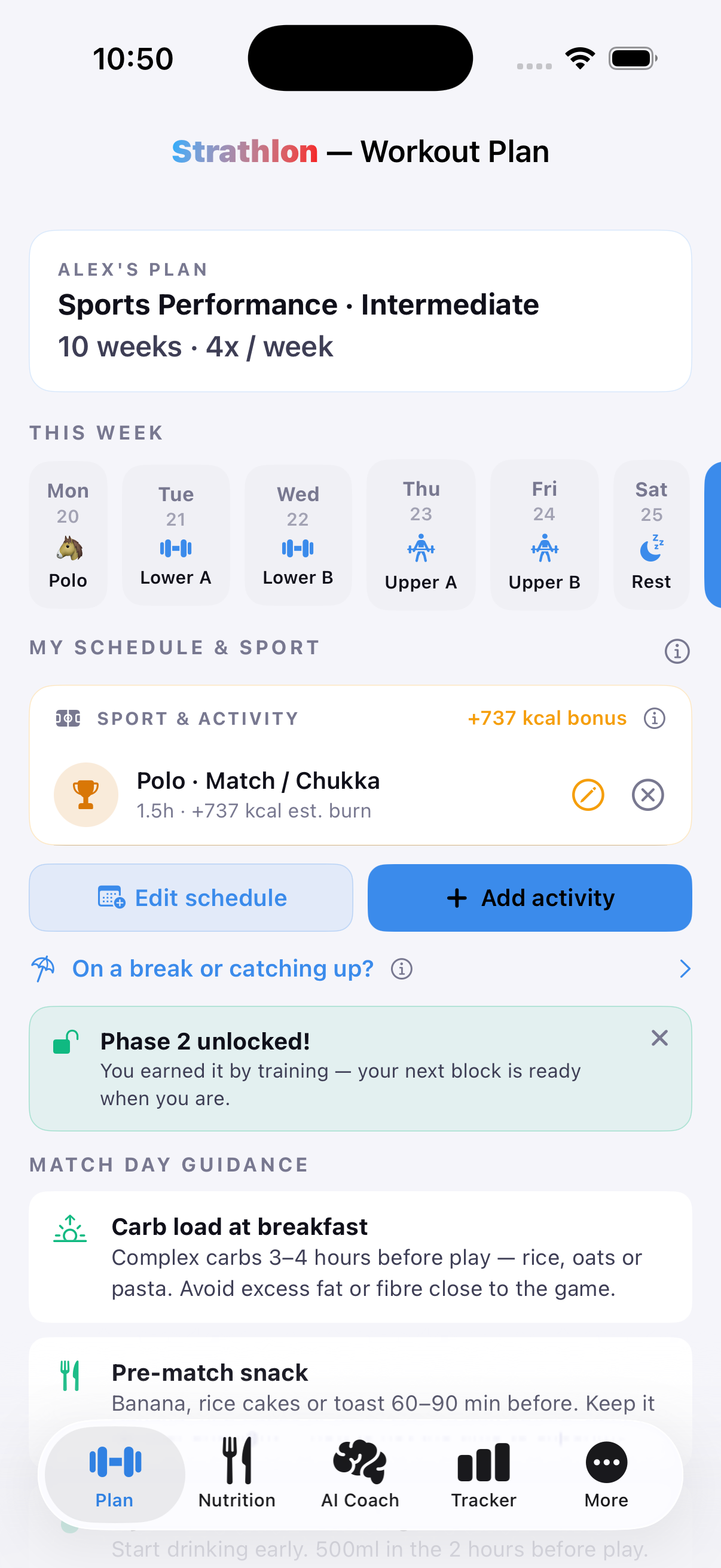
The pre-match meal has two jobs: top up energy without weighing you down, and start you well hydrated. The rider-specific guidance puts pre-event carbohydrate in a window of one to four hours before the start, with the stated aim of fuelling the event adequately while keeping the gut comfortable[3], larger and earlier when you have time to digest, smaller and closer to the start when you don't. For polo, err on the lighter, settled side: you want to feel athletic in the saddle, comfortably short of full.
In practice that means favouring familiar, lower-fibre and lower-fat carbohydrate you've eaten before a game before (porridge, toast, rice, a banana) since those are the easiest on the stomach while you're bracing and twisting. The golden rule on match day is to try nothing new. On hydration, aim to arrive with a pale urine colour: riders are advised to take in 5–10 ml of fluid per kilogram of body weight in the two to four hours before exercise[3], enough to be topped up without leaving you uncomfortable or making constant trips off the field.
Across the match: steady energy and top-ups
Because polo is intermittent and the rider's energy demand is moderate, you do not need the structured carbohydrate feeding of endurance racing, where athletes take in tens of grams of carbohydrate every hour to hold off glycogen depletion. For a normal match your pre-match meal and everyday stores have you covered. What the breaks between chukkas are really for is fluid, and, on a long or very hot match, a small amount of easy carbohydrate to keep energy and focus level.
When a session does run long (a full six-chukka match, a tournament day with matches stacked up, or serious heat), general guidance is useful as a ceiling to work within: 30–60 g of carbohydrate per hour for moderate-to-high-intensity exercise lasting one to two and a half hours,[4] conveniently delivered by a sports drink that carries fluid and sodium at the same time. Most polo players will sit at the lower end of that, or below it, taking a few mouthfuls of a carbohydrate-electrolyte drink or a small snack in the breaks rather than forcing anything down. One option late in a match is a carbohydrate mouth rinse: in roughly hour-long cycling time trials, rinsing with a carbohydrate solution and spitting it out improved finishing times by about 2–3% against an artificially sweetened placebo, and brain imaging in the same study showed carbohydrate in the mouth activating reward and motor-control regions.[5] Transient carbohydrate exposure of this kind (rinses, gums, gels) is recommended for riders at competition.[3] It has not been tested in polo, and it is a small performance effect rather than a jolt of alertness, but it is handy when your stomach has had enough.
Hydration, electrolytes, heat and kit
This is where polo fuelling genuinely matters. The season peaks in summer, matches are often played in the afternoon heat, and the kit adds to the problem: equestrian competition clothing carries a thermal cost of its own, reducing evaporative and convective cooling and increasing heat storage.[3] Sweating is how you cool down, so you're always losing fluid and sodium, sometimes a lot, and letting that loss run away is what turns a sharp player into a flat, error-prone one late in a match.
Performance is consistently reduced once fluid loss reaches or exceeds about 2% of body mass, and heart rate rises by roughly three to five beats per minute for every 1% of body mass lost.[6] Rather than a rigid drinking schedule, the guidance is to take in enough to approximate your own sweat losses, avoiding both heavy deficits and over-drinking.[6] There's no universal millilitre figure, because sweat rates vary enormously with the person, the heat, the humidity and the workload, but as an illustration, the German Nutrition Society cites 0.4–0.8 litres per hour as optimal for intense endurance activity.[7] Around 200 ml every 15 to 20 minutes is a reasonable pattern where the sport allows it, though that timing is acknowledged to be difficult in sports with long playing periods between breaks[6] (polo exactly). The reliable way to find your number is to weigh yourself before and after a hot match: sweat loss in litres is simply your body mass before minus after in kilograms, adjusted for what you drank,[6] which tells you how much you under-replaced and how much to aim for next time. In practice, take fluid in the breaks between chukkas, when you're off or changing ponies, rather than trying to drink while you play.
Sodium alongside fluid helps you hold onto what you drink: sodium in a drink at 500–700 mg per litre supports the absorption of water in the intestine, and the best absorption comes from slightly hypotonic or isotonic drinks carrying 4–8% carbohydrate and 400–1,100 mg of sodium per litre.[7] Conveniently, the same carbohydrate-electrolyte drinks that give a little energy usually carry sodium too, so fuelling and hydrating overlap. Riders who lose unusually salty sweat (above about 60 mEq per litre) and sweat at very high rates are the ones most likely to benefit from deliberately adding sodium.[6] In hot conditions, an ice slurry taken shortly before you play is another option: a scoping review of highly trained athletes found a dose of 7–14 g per kilogram of body mass about 30 minutes beforehand had a beneficial effect on thermoregulation and performance, though the underlying studies were mixed, with six reporting a benefit and five no difference.[8]
Concentration: fuelling the brain along with the legs
Polo is a skill and reaction sport. Timing a shot off a moving pony, reading the line of the ball and the play, and making quick decisions all depend on a brain that's hydrated and evenly fuelled. Two nutrition levers point straight at that. First, hydration: a meta-analysis of 33 studies found that dehydration significantly impairs attention, executive function and motor coordination, and that the impairment is larger once losses pass 2% of body mass[9], precisely the faculties a polo player can least afford to lose in the fourth chukka. Second, steady blood sugar: regular meals and, where useful, small carbohydrate top-ups keep energy level, so you avoid the foggy, irritable flatness that comes with running low.
There's a neat quirk worth knowing here. Carbohydrate in the mouth is sensed by the brain as well as used as fuel by muscle: rinsing with glucose or maltodextrin and spitting it out lit up reward-related regions including the anterior cingulate cortex and striatum, and the effect appears to be independent of sweetness.[5] What that buys you is a small performance gain rather than a measured lift in alertness. The study tested cycling time trials. Concentration itself was never on the table. It's a minor tool that works alongside eating and drinking properly, and it can be worth a try in the closing stages of a long, hot match when your appetite has shut down.
Recovery: rehydrate first, then eat
Because the rider's energy cost is moderate, recovery from polo is refreshingly simple, and hydration leads. The first job is to replace the fluid and sodium you lost: use your before-and-after weigh-in as the guide, and drink somewhat beyond the plain deficit, up to about 150% of the estimated deficit if you need to be right again within four hours.[6] Take it in smaller sips over a longer period, with electrolytes alongside, rather than gulping plain water.[7]
The eating side is unremarkable and that's the point. A normal balanced meal covers it: some carbohydrate to restock energy (riders are advised to take 1–2 g per kilogram of body weight within the three hours after exercise, sooner being better[3]), plus roughly 0.25–0.4 g of protein per kilogram, most effective when taken within one to three hours afterwards,[3] to support repair of the muscle you used for bracing and control. If your next match is a day or more away, there's no need to rush any of it. Just hit your normal daily targets across ordinary meals. There's rarely a reason to over-eat after polo, and treating a match like a marathon on the plate is a common way riders gain weight they didn't intend to.
Eating enough over a season
One last point, kept in proportion. Polo's rider demand is moderate, so chronic under-fuelling is a smaller risk here than in leanness-focused endurance sports, but it's not zero: the rider-nutrition review explicitly flags the potential for equestrians to under-fuel and develop REDs and disordered eating.[3] Consistently eating too little relative to what you burn in training is what sports scientists call low energy availability, and the International Olympic Committee describes the syndrome that follows (Relative Energy Deficiency in Sport) as a set of harmful health and performance outcomes affecting female and male athletes alike, with mental health now recognised as part of the picture.[10] The signs (persistent fatigue, frequent illness, poor sleep, nagging injuries, and in women disrupted or absent periods) are worth heeding rather than pushing through. The fix is usually to eat more rather than train harder, and if it's a persistent worry, to get help from a sports physician or registered dietitian. For the everyday player, though, the headline is simpler and happier: eat regular, balanced meals, stay well hydrated, and polo asks little more of your plate than that.
Common questions
How should a polo player fuel for a match?
Fuel for steady energy and concentration rather than for endurance, because the pony does the running and the rider's own energy demand is moderate. Build the day on regular, balanced meals with a modest amount of carbohydrate, eat a familiar carbohydrate-focused meal roughly one to four hours before you play, and (the real priority) arrive well hydrated and keep drinking, with some electrolytes if it is hot. For a long match, small carbohydrate and fluid top-ups between chukkas can help, but you do not need the gels-per-hour approach of a marathon. Keep it modest, familiar and rehearsed.
Do polo players need to carb-load like endurance athletes?
No. Carbohydrate loading is aimed at prolonged continuous efforts that steadily drain muscle glycogen, such as a marathon. Polo is intermittent, and oxygen uptake during equestrian activity is lower than in comparable individual or team sports of similar duration,[3] so your normal glycogen stores from everyday eating are plenty. A sensible carbohydrate-containing meal the day before and on the morning of a match is all that is useful. A deliberate load would mostly leave you heavy.
How much should I drink during polo, especially in the heat?
There is no single number, because sweat rates vary widely with the person, the heat and the kit. Performance is consistently reduced once fluid loss reaches about 2% of body mass, so the guidance is to take in enough to approximate your own sweat losses rather than follow a fixed schedule, avoiding both a big deficit and over-drinking.[6] As an illustration, 0.4 to 0.8 litres per hour is the range the German Nutrition Society cites as optimal for intense endurance activity.[7] Weigh yourself before and after a hot match to learn your losses, and take fluid in the breaks between chukkas rather than trying to gulp it while playing.
What should I eat before a match?
A familiar, mostly carbohydrate meal eaten roughly one to four hours before you mount, larger and earlier, or smaller and closer to the start, depending on what your stomach tolerates. Favour lower-fibre, lower-fat options you have tested before, such as porridge, toast, rice or a banana, so you feel light and settled in the saddle rather than heavy. Drink to a pale urine colour beforehand: riders are advised to take in 5 to 10 ml of fluid per kilogram of body weight in the two to four hours before exercise.[3] Do not try anything new on match day.
Does what I eat and drink affect my concentration and skill on the ball?
It can. Polo is a skill and reaction sport, and dehydration measurably impairs attention, executive function and motor coordination, more so once losses pass 2% of body mass[9], exactly what you cannot afford when timing a shot at speed. Staying hydrated is the single biggest lever. Keeping blood sugar steady with regular meals is the second. A carbohydrate mouth rinse between chukkas is a smaller, more marginal tool: rinsing and spitting improved hour-long cycling time trials by a couple of per cent and activated reward-related brain regions,[5] but that is a performance effect rather than a proven lift in alertness, and it has not been tested in polo.
How should I recover after a polo match?
Rehydrate first: replace the fluid and sodium you lost, using the before-and-after weigh-in as your guide and drinking beyond the plain deficit, up to about 150% of it if you need to be right again within four hours.[6] Then eat a normal balanced meal: some carbohydrate to restock energy, 1 to 2 g per kilogram of body weight within the three hours after riding, sooner being better, plus roughly 0.25 to 0.4 g of protein per kilogram within one to three hours to support repair.[3] Because the rider's energy demand is moderate, there is rarely any need to rush or to over-eat after polo. A good meal and good hydration cover it.
Takeaways
- The pony does the running. Polo is intermittent, and oxygen uptake in equestrian activity is lower than in comparable sports of similar duration: high heart rates partly reflect postural bracing rather than aerobic work.[3]
- Fuel modestly and steadily. Match everyday carbohydrate to how much you ride (3–5 g/kg/day on recreational loads, 5–7 g/kg/day for light-to-medium ridden work) and don't skip meals across long days at the club.[3]
- Eat light before you play. Pre-event carbohydrate belongs in the one-to-four-hour window, with gut comfort as the goal.[3] Nothing new, nothing heavy or fatty on match day.
- Skip the endurance playbook. No carb-loading, no gels-per-hour. On a long or hot match, small carbohydrate-electrolyte sips in the breaks (30–60 g/h for one-to-two-and-a-half-hour efforts is a ceiling rather than a target[4]) are plenty.
- Hydration is the real lever. Performance falls off once you lose about 2% of body mass.[6] 0.4–0.8 l/h is a cited illustration for intense endurance work.[7] Weigh before and after to learn your sweat rate, and drink in the breaks, well away from the ball.
- Salt when it's hot. Sodium at 500–700 mg per litre supports water absorption in the gut.[7] An ice slurry beforehand may help in heat.[8] And remember that riding kit adds a thermal cost of its own.[3]
- Protect your concentration. Dehydration impairs attention, executive function and motor coordination, more so past 2% body-mass loss.[9]
- Recover simply. Rehydrate first, then a normal meal: 1–2 g/kg carbohydrate within three hours, plus 0.25–0.4 g/kg protein within one to three hours.[3] No need to over-eat.
If you remember one thing, make it this: polo is won and lost on skill, balance and focus held under heat. How many carbohydrates you can cram in barely enters into it. Fuel steadily, keep the pre-match meal light and familiar, and put most of your effort into hydration and electrolytes when it's hot. Strathlon's job is to keep that base honest by adjusting your day's targets around the matches you actually log, so the everyday fuelling underneath your polo is one less thing to guess at.
References
Sources for the specific figures on this page. Where a number reflects established consensus rather than a single trial, the citation is to the relevant expert body's position stand, with the country or region that body belongs to named: guidance is written by national and regional organisations, and no one country's advice is universal. Where a source is produced or funded by a commercial interest, that is noted too.
- Hurlingham Polo Association. HPA Rules & Regulations for Polo 2019. Part 1, Rule 9 (Duration of the Game) and Rule 11 (Duration of Chukkas). Rules of the Hurlingham Polo Association, the governing body for polo in the United Kingdom and Ireland. https://www.hpa-polo.co.uk/wp-content/uploads/rules/BB19_Rules_Online_FINAL.pdf
- Wright LR, Peters MD. A heart rate analysis of the cardiovascular demands of elite level competitive polo. International Journal of Performance Analysis in Sport. 2008;8(2):76–81. https://doi.org/10.1080/24748668.2008.11868437
- Best R, Williams JM, Pearce J. The physiological requirements of and nutritional recommendations for equestrian riders. Nutrients. 2023;15(23):4977. https://pmc.ncbi.nlm.nih.gov/articles/PMC10708571/
- Kerksick CM, et al. International Society of Sports Nutrition position stand: nutrient timing. Journal of the International Society of Sports Nutrition. 2017;14:33. Position stand of the International Society of Sports Nutrition (ISSN, United States). https://doi.org/10.1186/s12970-017-0189-4
- Chambers ES, Bridge MW, Jones DA. Carbohydrate sensing in the human mouth: effects on exercise performance and brain activity. The Journal of Physiology. 2009;587(8):1779–1794. https://pmc.ncbi.nlm.nih.gov/articles/PMC2683964/
- McDermott BP, Anderson SA, Armstrong LE, Casa DJ, Cheuvront SN, Cooper L, Kenney WL, O'Connor FG, Roberts WO. National Athletic Trainers' Association position statement: fluid replacement for the physically active. Journal of Athletic Training. 2017;52(9):877–895. Position statement of the National Athletic Trainers' Association (NATA, United States). https://pmc.ncbi.nlm.nih.gov/articles/PMC5634236/
- Mosler S, Braun H, Carlsohn A, et al. Position of the working group sports nutrition of the German Nutrition Society (DGE): fluid replacement in sports. Deutsche Zeitschrift für Sportmedizin. 2020;71:178–184. Position of the German Nutrition Society (Deutsche Gesellschaft für Ernährung, Germany). https://doi.org/10.5960/dzsm.2020.453
- Gopathi P, Tiwari KH, Kalpana K. The effects of pre-exercise ice-slurry ingestion on thermoregulation and exercise performance of highly trained athletes: a scoping review. International Journal of Exercise Science. 2023;16(2):1398–1412. https://pmc.ncbi.nlm.nih.gov/articles/PMC10824289/
- Wittbrodt MT, Millard-Stafford M. Dehydration impairs cognitive performance: a meta-analysis. Medicine & Science in Sports & Exercise. 2018;50(11):2360–2368. https://pubmed.ncbi.nlm.nih.gov/29933347/
- Mountjoy M, Ackerman KE, Bailey DM, et al. 2023 International Olympic Committee's (IOC) consensus statement on Relative Energy Deficiency in Sport (REDs). British Journal of Sports Medicine. 2023;57(17):1073–1097. Consensus statement of the International Olympic Committee (IOC, international). https://pubmed.ncbi.nlm.nih.gov/37752011/
This is general educational information rather than medical, dietary or coaching advice. The sports-nutrition figures here are drawn from established consensus and from the limited research on riders specifically, and are framed as population-level guides: individual needs vary widely with body size, riding and training load, conditions, gut tolerance and health, and are best personalised with a qualified professional. Anyone with a health condition, a history of disordered eating, or who is pregnant or postpartum, or who suspects under-fuelling or low energy availability, should consult a sports physician or registered dietitian before making changes. See our Terms for more.
← All guides · Polo strength & conditioning · Eating for results · Understanding your stats · Home