
Fuelling & performance nutrition for ice hockey
An evidence-based guide to fuelling the hockey player's body. Ice hockey is a shift-based power sport: short, near-maximal bursts of skating separated by bench recovery, repeated for three periods. That pattern (explosive work, brief rest, over and over) shapes everything about how you fuel it. This covers daily carbohydrate for repeated shifts, the pre-game meal, fuelling on the bench, the genuinely surprising amount of sweat and salt you lose under the gear despite the cold rink, recovery between games, and how goalies differ from skaters. Practical, honest, and grounded in established sports-nutrition consensus.
Here's the short answer to "how should an ice hockey player fuel?": arrive with muscle glycogen topped up from a carbohydrate-rich couple of days and a pre-game meal, sip a carbohydrate-electrolyte drink on the bench and between periods (roughly 30–60 g of carbs plus steady fluid per hour), replace the surprising amount of sweat and salt you lose under the gear, and refuel fast afterwards, hardest of all when you play again within a day or two. Everything below is the detail behind that sentence: the numbers, where they come from, and how to make them work for your body and your schedule.
On this page
- Why hockey is a shift-based power sport
- Daily carbohydrate: the base for repeated shifts
- Before the game: the pre-game meal
- On the bench: fuelling during the game
- The cold-rink paradox: sweat, fluid and sodium
- Recovery, and the tournament problem
- Goalies vs skaters
- Eating enough overall
- Common questions
- Takeaways
Pair this with the ice hockey strength and conditioning guide: the shift-based power and groin-prehab training this fuelling plan is built to support.
A framing note before the numbers. Sports nutrition is well studied, but people differ enormously: body size, position, ice time, how hard the game is, gut tolerance, sex and health status all shift what's right on the day. So this is written as can, tends to and around, never as a guarantee, and every specific figure is a population-level guide drawn from published research rather than a personal prescription. It's general education rather than medical or dietary advice, and it isn't a personalised plan.
Why hockey is a shift-based power sport
A hockey shift is short and violent. Players are typically on the ice for around 30–60 seconds of high-intensity skating, then sit for roughly four to five minutes of bench recovery before going again: a work-to-rest ratio of about 1:2 to 1:3 that tightens toward 1:1 on a penalty kill or a long shift. Repeat that through three periods and the game leans on all three energy systems at once: the immediate phosphagen (ATP-PC) system for the first few seconds of each burst, the glycolytic system for the harder ten-second-to-two-minute efforts, and the aerobic system working hard in the background to recharge between shifts. Average on-ice heart rates sit near 85% of maximum, with players spending a good chunk of the game, on the order of fifteen minutes or more, up above 90% of their max.
Two of those three systems run on carbohydrate. Glycolysis burns it directly, and the aerobic recovery between shifts leans on it too when the pace is high. Carbohydrate is stored as glycogen in the muscles, and those stores are finite. In a classic study of elite Swedish players, muscle glycogen fell by roughly half over the course of a single game, and the individual muscle fibres doing the sprinting were depleted the hardest. That matters because when glycogen in the fast-twitch fibres runs low, the very thing hockey is built on, repeated explosive acceleration, is the first casualty. Your legs feel heavy in the third period because their fast fuel is running down. Your muscles themselves aren't the problem.
Daily carbohydrate: the base for repeated shifts
Game-day fuelling only works if you turn up with the tank reasonably full, and that comes from your everyday carbohydrate intake, matched to your training. The joint position on nutrition and athletic performance from the Academy of Nutrition and Dietetics, Dietitians of Canada and the American College of Sports Medicine scales daily carbohydrate to training load: around 5–7 g of carbohydrate per kilogram of body weight per day for lighter days, rising to roughly 6–10 g/kg/day for the moderate-to-high loads of a full practice-and-game schedule (about one to three hours a day). Hockey-specific guidance echoes this, suggesting players sit above 5 g/kg most days and push toward 8–10 g/kg on heavy training and competition days.
The practical point is that these dials should move with your week. A double-session day, or a day with a game on top of practice, warrants more carbohydrate than a rest day. Chronically eating at the low end while skating hard is one of the most common ways players end up flat and heavy-legged by the third period: the base is too empty for whatever you do on top to matter.
Before the game: the pre-game meal
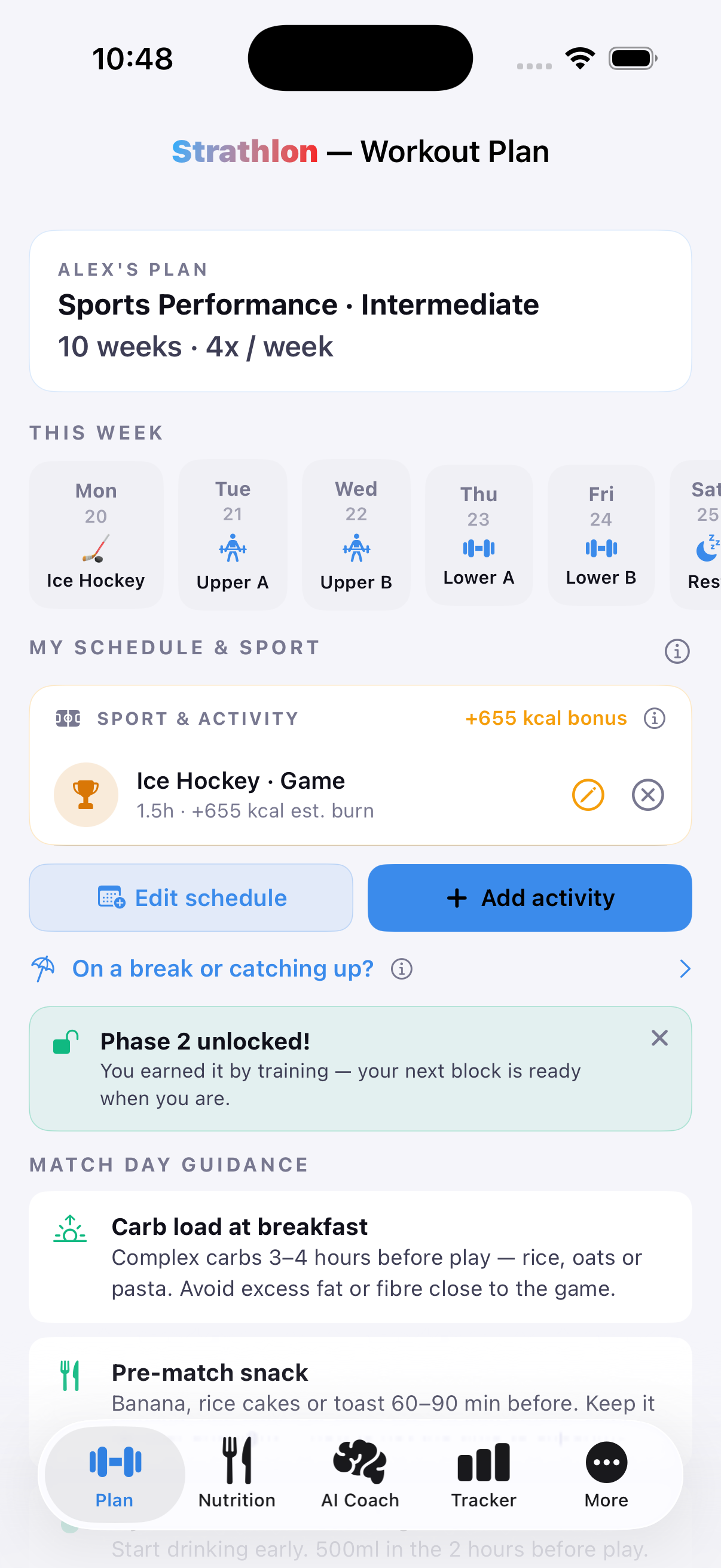
Before a game, and before a hard practice, a carbohydrate-focused top-up helps make sure liver and muscle glycogen are high at the opening face-off. Position stands describe a pre-exercise meal or snack of roughly 1–4 g of carbohydrate per kilogram of body weight, eaten around one to four hours beforehand: the larger amounts earlier when you have time to digest, smaller amounts closer to warm-up. A familiar three-to-four-hours-out meal (rice or pasta with lean protein, oats, a bagel and banana) followed by a lighter carbohydrate snack in the last hour is a reliable pattern.
Getting the grams right is half of it; getting them to sit well is the rest. Favour familiar, lower-fibre and lower-fat carbohydrate you've rehearsed: the equipment already presses on your stomach, and a heavy, greasy or very high-fibre pre-game meal that sits undigested is a recipe for feeling sick on the bench. The golden rule before a game that matters is to try nothing new: the meal, the timing and the pre-game drink should all be things your gut has already met before an ordinary practice.
On the bench: fuelling during the game
Here's the piece most players leave on the table. A game runs well over an hour of elapsed time, and taking in carbohydrate during it helps maintain blood glucose and spares glycogen for the shifts that matter most. For intermittent team sports lasting more than an hour, the consensus that grew out of the IOC's sports nutrition work recommends taking in around 30–60 g of carbohydrate per hour, most easily as a 6–8% carbohydrate-electrolyte drink sipped on the bench and at intermissions. The benefit shows up where it counts: late in the game, when fatigue and dropping blood sugar would otherwise start to blunt skating speed and decision-making.
| When | Carbohydrate | Fluid | Why |
|---|---|---|---|
| 3–4 h before | ~1–4 g/kg meal | Drink to comfort | Tops up liver & muscle glycogen. Start hydrated. |
| Last ~60 min | Light carb snack | ~400–600 ml | Tops up without sitting heavy under the gear. |
| During game | ~30–60 g/h | Sip every bench/intermission | Holds blood glucose. Helps most in the third period. |
| After | Carb + protein | Replace 1.25–1.5× loss | Refill glycogen, repair muscle, rehydrate. |
The honest caveat is that this is a ceiling to aim toward, rather than a rule most players hit, and for a single, relatively short game you won't fully empty your tank anyway. Studies that measured what hockey players actually take in during on-ice sessions found intakes of only about 14–20 g per hour, with a large share, up to 40% of players in one professional group, taking in no carbohydrate at all. So for most players the message isn't "force down gels," it's "you almost certainly have room to fuel and drink more deliberately," and the payoff grows with long games, extra time, tournaments and back-to-back fixtures.
The cold-rink paradox: sweat, fluid and sodium
The rink is cold, so surely you barely sweat? It's one of the most persistent, and costly, myths in the sport. Under full equipment, with almost no way to shed heat, hockey players sweat heavily. Measured on-ice sweat rates run to around 1.6–2.0 litres per hour in junior through professional players. In one study of elite junior players, a single game produced roughly 3.2 litres of sweat against only about 2.1 litres taken in, a net loss of over a kilogram, and enough that some players finished having lost up to 4% of their body mass.
Why care? Because losing more than roughly 2% of body mass as sweat is associated with slower skating, poorer decision-making and reduced performance, and hockey studies find a meaningful share of players cross that line during hard sessions. Worse, research repeatedly finds that a large proportion of players, in some samples over half, turn up to the rink already mildly dehydrated, so the deficit starts before the first shift. The fix is unglamorous: drink to comfort before you play, and use the bench and intermissions to sip, rather than waiting for thirst.
Sweat also carries sodium, and hockey players lose a lot of it, on the order of 3 grams of sodium (roughly 8 grams of salt) across a game in elite juniors, far more than most take in. Replacing some sodium alongside fluid helps you hold onto what you drink and can blunt cramping, which is exactly why a carbohydrate-electrolyte drink does two useful jobs at once: fuel and salt in the same bottle.
Recovery, and the tournament problem
After a game, two jobs matter: refill glycogen and repair muscle. How urgently you chase the first depends entirely on when you next play or train hard.
- Fast turnaround (another game or hard session within about four hours, a tournament, a doubleheader). Here speed matters. Research on rapid recovery describes taking in carbohydrate at around 1.0–1.2 g per kilogram of body weight per hour in the first few hours, favouring higher-glycaemic sources, to refill glycogen as quickly as possible. Add some protein (roughly 0.3 g/kg, or about 20 g) to support repair, and rehydrate deliberately to replace the fluid and sodium the last game cost you.
- Normal turnaround (a full day or more until the next game). There's no need to rush. Simply hitting your usual daily carbohydrate and protein targets across normal meals refills stores comfortably before you're back on the ice. The "eat within 30 minutes or lose your gains" urgency is real only when the recovery window is genuinely short.
- References
Over the whole day, players are generally advised to eat around 1.2–2.0 g of protein per kilogram of body weight, more than a sedentary person, because hard skating and contact damage muscle and protein supports repair and adaptation, spread across meals rather than piled into one. Because ice hockey draws so heavily on glycogen, incomplete refuelling between games is one of the clearest reasons performance fades across a tournament weekend: each game starts a little emptier than the last. The eating-for-results guide covers the broader nutrition picture in depth.
Goalies vs skaters
The principles are the same for goaltenders, with a shift of emphasis. Goalies do far less high-speed skating than out-field players, so their moment-to-moment glycogen turnover tends to be lower: they don't spend the game repeatedly sprinting to exhaustion, so aggressive carbohydrate loading is less critical for them. But two things absolutely still apply. They wear the heaviest gear of anyone on the ice and sweat heavily under it. Their job is built on fine concentration and reaction speed sustained for a full sixty minutes, which stable blood sugar and good hydration protect.
The evidence backs this up. Research on goaltenders found they routinely lose 2% or more of body mass to sweat during play, and that when they drank to stay hydrated they improved save percentage and movement speed while lowering heart rate, core temperature and perceived effort. So the goalie's fuelling priorities read a little differently from a forward's: worry slightly less about maximal carbohydrate stores, and slightly more about steady hydration, electrolytes and stable blood sugar to keep the reactions sharp deep into the third.
Eating enough overall
One quieter risk deserves a mention. Because hockey players do a lot of high-intensity work, often on top of gym training and, for younger players, growth, it's easy to under-eat relative to the energy the sport demands, especially through a heavy schedule. Chronically not eating enough to cover training, called low energy availability, is associated with a cascade of problems the sports world groups under Relative Energy Deficiency in Sport (RED-S): it can impair bone health, hormones, immunity, recovery, mood and, the point every competitor should note, performance itself.
The warning signs are worth knowing: stalled or declining performance despite hard training, frequent illness, recurrent stress injuries, poor sleep, low mood, and (in women) disrupted or missing periods. None of these are things to push through. If they appear, the answer is usually to eat more rather than train harder, and to seek help from a sports physician or registered dietitian. Fuelling isn't only about game day: eating enough, day after day, is what lets you keep showing up with legs that work.
Common questions
How should an ice hockey player fuel on game day?
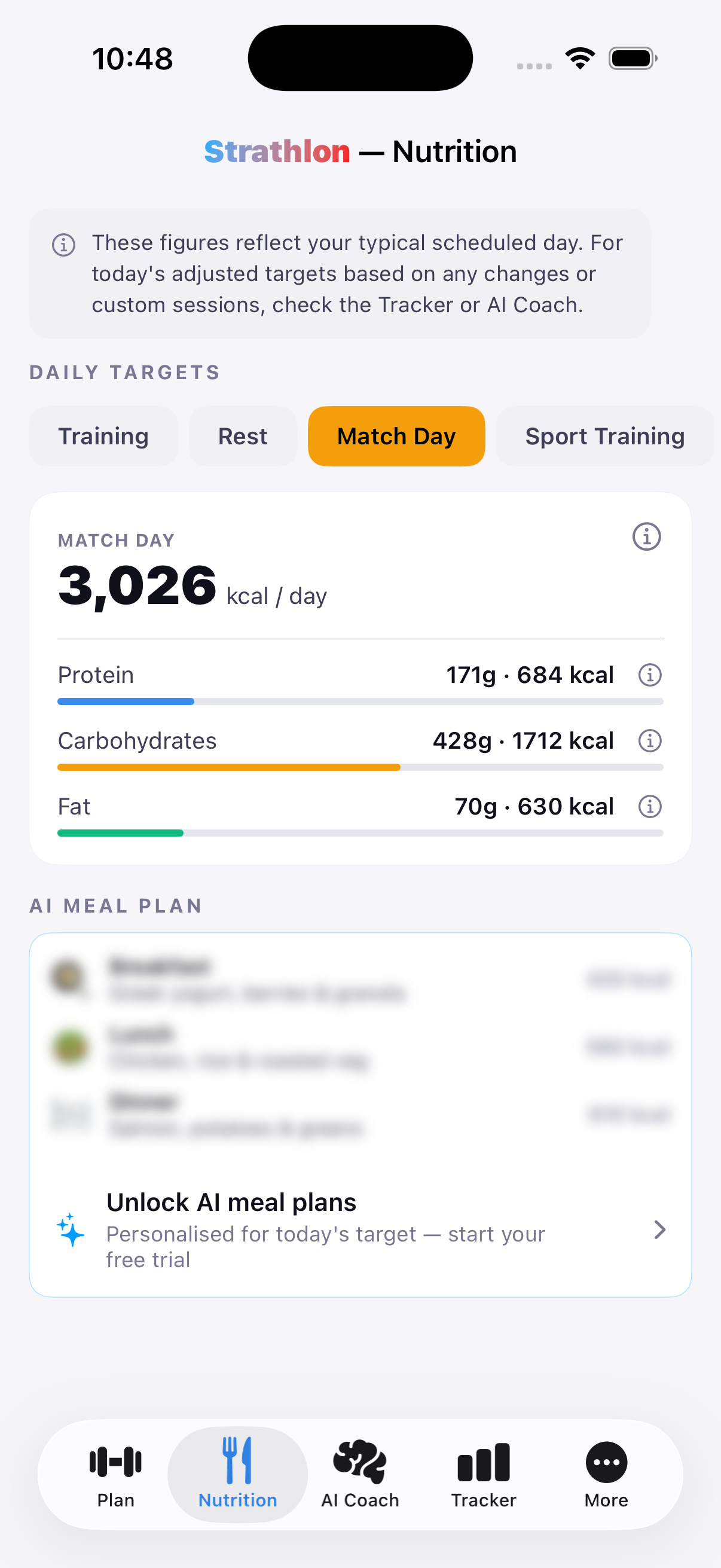
Think of it as topping up a tank you spend in bursts. Eat a carbohydrate-based meal roughly three to four hours before the puck drops (around 1–4 g of carbohydrate per kilogram of body weight), keep sipping a carbohydrate-electrolyte drink on the bench and between periods, and refuel and rehydrate hard afterwards, especially if you play again within a day or two. Ice hockey depletes muscle glycogen substantially (roughly half over a game in one study of elite players), and you sweat heavily under the gear even though the rink is cold, so both fuel and fluid matter more than the temperature suggests.
Do hockey players really need to worry about hydration in a cold rink?
Yes, more than most players expect. The cold air is misleading: under full equipment, players sweat a lot. Measured on-ice sweat rates run to around 1.6–2.0 litres per hour, and in one study of elite junior players a single game produced about 3.2 litres of sweat against roughly 2.1 litres of fluid taken in, a net loss of over a kilogram. Losing more than about 2% of body mass as sweat is associated with slower skating, poorer decisions and reduced performance, and studies find many players arrive at the rink already mildly dehydrated. Drinking on the bench and replacing sodium both matter.
How much carbohydrate should I take in during a game?
For intermittent team sports lasting over an hour, sports-nutrition consensus suggests taking in around 30–60 g of carbohydrate per hour, usually as a roughly 6–8% carbohydrate-electrolyte drink sipped on the bench and at intermissions. This helps maintain blood glucose and tends to help most in the closing stages, when fatigue would otherwise bite. In practice, studies find many hockey players take in far less than this, often only 14–20 g per hour, with a large share taking none, so there is usually room to fuel more deliberately, especially in long games, tournaments or back-to-back fixtures.
What should I eat between back-to-back games or during a tournament?
When another game or hard session is less than about four hours away, prioritise fast carbohydrate: research on rapid recovery describes intakes of around 1.0–1.2 g per kilogram of body weight per hour, favouring higher-glycaemic carbohydrate, plus some protein (roughly 0.3 g per kilogram, or about 20 g) to support repair. Rehydrate to replace the fluid and sodium lost in the previous game. Because ice hockey draws heavily on muscle glycogen, incomplete refuelling between games in a tournament is one of the clearest ways performance fades across a weekend.
Do goaltenders need to fuel differently from skaters?
Broadly the principles are the same, with a shift of emphasis. Goalies do far less high-speed skating than out-field players, so their moment-to-moment glycogen turnover tends to be lower, but they still wear the heaviest gear, sweat heavily and rely on sharp concentration and reaction speed for a full game. Research on goaltenders found they routinely lose 2% or more of body mass to sweat, and that drinking to stay hydrated improved save percentage and movement speed while lowering heart rate and perceived effort. So goalies can worry a little less about aggressive carbohydrate loading and a little more about steady hydration and stable blood sugar for focus.
Takeaways
- Hockey is a shift-based power sport. Short near-maximal shifts (~30–60 s) with bench recovery, repeated over three periods, lean heavily on carbohydrate: muscle glycogen can fall by about half over a game.
- Build the base daily. Match everyday carbohydrate to load (roughly 5–7 g/kg on lighter days, 6–10 g/kg, up to ~8–10, on training and game days) and move the dial with your week.
- Top up before the game. A familiar, carb-focused meal of about 1–4 g/kg, one to four hours before, plus a light snack near warm-up. Nothing new on a day that matters.
- Fuel on the bench. Aim for ~30–60 g of carbs per hour from a carbohydrate-electrolyte drink. Most players take far less than they could, and the payoff shows late in the game.
- Respect the cold-rink paradox. Under the gear you sweat ~1.6–2.0 L/h. Keep body-mass loss under ~2%, don't start already dehydrated, and replace sodium as well as fluid.
- Recover fast only when you must. Between tournament games (<~4 h) chase carbs at ~1.0–1.2 g/kg/h plus ~0.3 g/kg protein. With a day or more, normal meals suffice. Aim ~1.2–2.0 g/kg/day protein overall.
- Goalies tilt toward hydration and focus. Lower skating volume means less need for maximal carb loading, but heavy sweat and reaction-speed demands make steady fluid, electrolytes and blood sugar the priority.
- Eat enough, always. Chronic under-fuelling (low energy availability, RED-S) harms bone, hormones, health and performance. When in doubt, eat more rather than less.
If you remember one thing, make it this: the players who fade least in the third period and across a tournament aren't the ones with the fanciest supplements. They're the ones who show up with a full tank, drink and fuel on the bench instead of waiting for thirst, and refuel fast between games. Strathlon's job is to keep that base honest by adjusting your targets around the games and practices you actually log, so the everyday fuelling that underpins every shift is one less thing to guess at.
References
Numbered sources for the specific figures, effect sizes and named studies above. Where a claim reflects agreed guidance rather than a single trial, the citation is to the position stand or consensus statement of the body concerned, with the country or international remit named. Ice hockey now has an evidence-based nutrition recommendation paper of its own, and the intake figures below are cited to it and to hockey dietary-intake studies.
- Nordstrøm A. Nutrition for Elite Male Ice Hockey: Evidence-Based Recommendations. International Journal of Sport Nutrition and Exercise Metabolism. 2026:1–13. Evidence-based nutrition recommendations for elite male ice hockey: the anchor source for this guide. PubMed 42362109
- Stanzione JR, Dardarian N, Volpe SL. Body Composition Changes after One Year in Professional Male Ice Hockey Players. International Journal of Sports Medicine. 2020;41(14):1056–1060. Study of body composition changes across a year in professional male ice hockey players, the basis for the season-long energy discussion. PubMed 32693429
- Vermeulen TF, Boyd LA, Spriet LL. Dietary Macronutrient and Micronutrient Intake over a 7-Day Period in Female Varsity Ice Hockey Players. Nutrients. 2021;13(7). Study of dietary macronutrient and micronutrient intake over seven days in female varsity ice hockey players, the sport-specific intake benchmark. PubMed 34208963 · PMC8308293 full text
- Jiménez-Casquet MJ, Conde-Pipo J, Valenzuela-Barranco I, Rienda-Contreras R, Olea-Serrano F, Monserrat-Mesquida M, et al. Cross-Sectional Study of the Anthropometric Profile and Nutrient Status of Elite Female Ice Hockey Players: Differences by Play Position. Nutrients. 2024;16(4). Cross-sectional study of the anthropometric profile and nutrient status of elite female ice hockey players, cited so the guidance is not male-only. PubMed 38398795 · PMC10891979 full text
- Sommer Jeppesen J, Vigh-Larsen JF, Oxfeldt MS, Laustsen NM, Mohr M, Bangsbo J, et al. Four Weeks of Intensified Training Enhances On-Ice Intermittent Exercise Performance and Increases Maximal Oxygen Consumption of Youth National-Team Ice Hockey Players. International Journal of Sports Physiology and Performance. 2022;17(10):1507–1515. Trial of four weeks of intensified training on on-ice intermittent exercise performance, the demand this guide fuels for. PubMed 35894877
- Williams C, Rollo I. Carbohydrate Nutrition and Team Sport Performance. Sports Medicine. 2015;45 Suppl 1(Suppl 1):S13–22. Review of carbohydrate nutrition and team-sport performance, the source for the carbohydrate case in a shift-based sport. PubMed 26553494 · PMC4672015 full text
- Baker LB, Rollo I, Stein KW, Jeukendrup AE. Acute Effects of Carbohydrate Supplementation on Intermittent Sports Performance. Nutrients. 2015;7(7):5733–63. Review of the acute effects of carbohydrate supplementation on intermittent sports performance, the in-game evidence. PubMed 26184303 · PMC4517026 full text
- Nuccio RP, Barnes KA, Carter JM, Baker LB. Fluid Balance in Team Sport Athletes and the Effect of Hypohydration on Cognitive, Technical, and Physical Performance. Sports Medicine. 2017;47(10):1951–1982. Review of fluid balance in team-sport athletes and the effect of hypohydration on performance: cited because a cold rink masks a real sweat rate. PubMed 28508338 · PMC5603646 full text
- Thomas DT, Erdman KA, Burke LM. Position of the Academy of Nutrition and Dietetics, Dietitians of Canada, and the American College of Sports Medicine: Nutrition and Athletic Performance. Journal of the Academy of Nutrition and Dietetics. 2016;116(3):501–528. Joint position of the Academy of Nutrition and Dietetics, Dietitians of Canada and the American College of Sports Medicine: the umbrella source for the daily energy, carbohydrate and protein ranges used throughout. PubMed 26920240
- Burke LM, Hawley JA, Wong SH, Jeukendrup AE. Carbohydrates for training and competition. Journal of Sports Sciences. 2011;29 Suppl 1:S17–27. Burke and colleagues on carbohydrate for training and competition, the source for the g/kg/day carbohydrate targets matched to training load. PubMed 21660838
- Jeukendrup A. A step towards personalized sports nutrition: carbohydrate intake during exercise. Sports Medicine. 2014;44 Suppl 1(Suppl 1):S25–33. Jeukendrup on personalising carbohydrate intake during exercise: the source for the g/h feeding rates and the duration at which they start to matter. PubMed 24791914 · PMC4008807 full text
- Jäger R, Kerksick CM, Campbell BI, Cribb PJ, Wells SD, Skwiat TM, et al. International Society of Sports Nutrition Position Stand: protein and exercise. Journal of the International Society of Sports Nutrition. 2017;14:20. International Society of Sports Nutrition (ISSN, United States) position stand on protein and exercise, the source for the daily protein range and per-meal distribution. PubMed 28642676 · PMC5477153 full text
- Schoenfeld BJ, Aragon AA. How much protein can the body use in a single meal for muscle-building? Implications for daily protein distribution. Journal of the International Society of Sports Nutrition. 2018;15:10. Schoenfeld and Aragon on how much protein the body can use in a single meal, the basis for the per-feed figure quoted. PubMed 29497353 · PMC5828430 full text
- Burke LM, van Loon LJC, Hawley JA. Postexercise muscle glycogen resynthesis in humans. Journal of Applied Physiology. 2017;122(5):1055–1067. Review of post-exercise muscle glycogen resynthesis, the source for the refuelling rates and for when a fast refuel is actually needed. PubMed 27789774
- Sawka MN, Burke LM, Eichner ER, Maughan RJ, Montain SJ, Stachenfeld NS. American College of Sports Medicine position stand. Exercise and fluid replacement. Medicine and Science in Sports and Exercise. 2007;39(2):377–90. ACSM position stand on exercise and fluid replacement: the source for the under-2% body-mass-loss guideline and the sweat-rate method. PubMed 17277604
- Barnes KA, Anderson ML, Stofan JR, Dalrymple KJ, Reimel AJ, Roberts TJ, et al. Normative data for sweating rate, sweat sodium concentration, and sweat sodium loss in athletes: An update and analysis by sport. Journal of Sports Sciences. 2019;37(20):2356–2366. Normative data for sweating rate and sweat sodium concentration in athletes, the source for how widely fluid and sodium losses vary between individuals. PubMed 31230518
- Hew-Butler T, Rosner MH, Fowkes-Godek S, Dugas JP, Hoffman MD, Lewis DP, et al. Statement of the Third International Exercise-Associated Hyponatremia Consensus Development Conference, Carlsbad, California, 2015. Clinical Journal of Sport Medicine : Official Journal of the Canadian Academy of Sport Medicine. 2015;25(4):303–20. Third International Exercise-Associated Hyponatremia Consensus statement, the basis for the warning against drinking well beyond sweat losses. PubMed 26102445
- Guest NS, VanDusseldorp TA, Nelson MT, Grgic J, Schoenfeld BJ, Jenkins NDM, et al. International society of sports nutrition position stand: caffeine and exercise performance. Journal of the International Society of Sports Nutrition. 2021;18(1):1. ISSN position stand on caffeine and exercise performance, the source for the caffeine dose and timing guidance. PubMed 33388079 · PMC7777221 full text
- Kreider RB, Kalman DS, Antonio J, Ziegenfuss TN, Wildman R, Collins R, et al. International Society of Sports Nutrition position stand: safety and efficacy of creatine supplementation in exercise, sport, and medicine. Journal of the International Society of Sports Nutrition. 2017;14:18. ISSN position stand on the safety and efficacy of creatine supplementation, cited where creatine is relevant to the sport's demands. PubMed 28615996 · PMC5469049 full text
- Maughan RJ, Burke LM, Dvorak J, Larson-Meyer DE, Peeling P, Phillips SM, et al. IOC consensus statement: dietary supplements and the high-performance athlete. British Journal of Sports Medicine. 2018;52(7):439–455. IOC consensus statement on dietary supplements and the high-performance athlete: the framing for treating supplements as optional extras. PubMed 29540367 · PMC5867441 full text
- Mountjoy M, Ackerman KE, Bailey DM, Burke LM, Constantini N, Hackney AC, et al. 2023 International Olympic Committee's (IOC) consensus statement on Relative Energy Deficiency in Sport (REDs). British Journal of Sports Medicine. 2023;57(17):1073–1097. The 2023 IOC consensus statement on Relative Energy Deficiency in Sport, the source for the consequences of under-fuelling a training load. PubMed 37752011
- Aragon AA, Schoenfeld BJ. Nutrient timing revisited: is there a post-exercise anabolic window?. Journal of the International Society of Sports Nutrition. 2013;10(1):5. Aragon and Schoenfeld on the post-exercise anabolic window, the source for timing mattering far less than daily totals. PubMed 23360586 · PMC3577439 full text
- British Dietetic Association (BDA, United Kingdom). Sport and exercise nutrition: Food Fact Sheet. British Dietetic Association (BDA, United Kingdom) Food Fact Sheet on sport and exercise nutrition, the practical UK dietetic framing. BDA Food Fact Sheet
This is general educational information rather than medical, dietary or coaching advice. The sports-nutrition figures here are drawn from established consensus and published research, and are framed as population-level guides: individual needs vary widely with body size, position, ice time, conditions, gut tolerance and health, and are best personalised with a qualified professional. Anyone with a health condition, a history of disordered eating, or who is pregnant or postpartum, or who suspects under-fuelling, stress injuries, menstrual disruption or RED-S, should consult a sports physician or registered dietitian before making changes. See our Terms for more.
← All guides · Ice hockey strength & conditioning guide · Eating for results · Understanding your stats · Home