
Fuelling & performance nutrition for gym & home workouts
A practical, evidence-based guide to fuelling general gym and home training: resistance work plus cardio. Unlike a marathon, an hour in the gym is not a race against an emptying fuel tank, so this guide is honest about what actually matters: enough protein and energy over the whole day, protein spread sensibly across meals, a little carbohydrate for energy, and sensible hydration. Timing and supplements come last. For the deeper science, it points you to two companion guides rather than repeating them.
Here's the short answer to "how should I fuel my gym workouts?": eat enough protein across the day (roughly 1.6–2.2 g per kilogram of body weight), spread over a few meals of about 0.25–0.4 g/kg each; eat enough total energy for your goal; have some carbohydrate in the hours before harder sessions for energy; and drink to thirst. For most gym-goers, the daily totals matter far more than the exact timing of any meal or shake. Everything below is the detail, and, just as importantly, what you can stop worrying about.
On this page
- Why gym fuelling isn't like endurance fuelling
- Daily protein: the number that matters most
- Spreading protein across the day
- Before a session: carbohydrate for energy
- The "anabolic window": does timing matter?
- Fluid and hydration
- Around the session, recovery and energy balance
- Common questions
- Takeaways
Pair this with the gym workout strength and conditioning guide, how to structure the squats, hinges, pushes and pulls this eating plan is built to fuel and recover from.
A framing note before the numbers. Sports nutrition is well studied, but people differ enormously: body size, training style and intensity, goals, gut tolerance, sex and health status all shift what's right for you. So this is written as can, tends to and around, never as a guarantee, and every specific figure is a population-level guide drawn from published consensus rather than a personal prescription. It's general education rather than medical or dietary advice, and it isn't a personalised plan. This guide is deliberately a practical overview: for how muscle grows see how muscle actually grows, and for the full nutrition picture see eating for results.
Why gym fuelling isn't like endurance fuelling
If you've read about marathon fuelling (gels every 30 minutes, carbohydrate loading, litres of sports drink), it's easy to assume a gym workout needs the same choreography. It doesn't. A marathon is a continuous, hours-long effort that steadily drains a small carbohydrate store. The entire fuelling strategy exists to keep from running the tank dry. A typical gym or home session is different in shape: 45–75 minutes, broken into sets with rest between them, mixing resistance work and some cardio. It uses carbohydrate (resistance training does draw on muscle glycogen), but the total demand of one session is modest compared with the roughly 300–400 g of glycogen stored in muscle (plus another 80–100 g in the liver). You are very unlikely to "bonk" mid-workout the way a marathoner can at 30 km.
That changes the priorities completely. For endurance racing, during-session fuelling and precise timing genuinely move performance. For general gym training, the levers that actually decide your results are much more boring and much more powerful: are you eating enough protein over the day, and enough total energy for your goal? Get those right and you've done the vast majority of the job. The rest (the pre-workout snack, the post-workout shake, the exact minute you eat) is fine-tuning that helps a little at the margins. It isn't the main event.
Daily protein: the number that matters most
If you take one number from this page, make it this one. To build or keep muscle, the total protein you eat across the day is the single biggest nutritional lever, and it's the one most gym-goers under-hit. The International Society of Sports Nutrition's position stand on protein concludes that a daily intake of roughly 1.4–2.0 g of protein per kilogram of body weight is sufficient for most exercising people to build and maintain muscle. The largest meta-analysis of resistance training and protein, pooling 49 studies and over 1,800 people, found that muscle gains kept improving as protein rose up to about 1.6 g/kg/day and then flattened, with the study's upper estimate reaching roughly 2.2 g/kg/day.
Put together, a sensible working target for someone training for muscle or strength is around 1.6–2.2 g/kg/day. For a 70 kg person that's roughly 112–154 g of protein a day. There's no meaningful benefit to going far beyond it for muscle purposes, and the lower half of the range is enough for many people, especially if the goal is maintaining rather than maximising. If you're dieting to lose fat, protein needs actually rise a little: position stands suggest up to about 2.3–3.1 g/kg/day of fat-free mass can help protect muscle while you're in a calorie deficit, because there's less energy around to spare muscle.
Spreading protein across the day
Once your daily total is sorted, distribution is the modest next-order tweak. Muscle protein synthesis responds to a serving of protein and then returns toward baseline over a few hours, so eating protein at several points in the day keeps the building signal topped up more consistently than one large dose. Position stands and reviews converge on a per-meal serving of roughly 0.25–0.4 g/kg of body weight (about 20–40 g for most people), repeated every three to four hours across the day. To reach the top of the daily range, analysis suggests aiming near the upper end (about 0.4 g/kg per meal across at least four meals).
In plain terms: for a typical person, three or four meals each containing a decent portion of protein (a palm or two of meat, fish, eggs, dairy, beans or tofu) comfortably reaches 1.6–2.2 g/kg/day. Whole foods and protein powder both count. A shake is simply a convenient way to add a serving when whole food is awkward, with no magic to it beyond that. This is the level of "timing" worth caring about (spreading protein through the day), and it's far more useful than obsessing over the minutes right after a workout.
Before a session: carbohydrate for energy
Carbohydrate's job around a gym session isn't to stave off a marathon-style bonk. It's to make sure you feel energetic and focused so you can train hard. Resistance training and cardio both burn glycogen, and turning up with reasonably full stores (from eating normally across the day) tends to mean better-quality sessions than training on empty. For most people who've eaten during the day, no special pre-workout meal is needed.
Before longer, harder, or early-morning fasted sessions, a carbohydrate-containing meal or snack beforehand can help. Sports-nutrition consensus describes roughly 1–4 g of carbohydrate per kilogram of body weight in the one to four hours before exercise, but that band spans everything from a light gym session to endurance racing, and for a normal gym workout the low end is plenty. A banana, some oats, toast, a bit of rice or a yoghurt an hour or two before is the right order of magnitude. You don't need to eat like you're about to race. Favour familiar foods that sit well in your stomach, and leave more time after a bigger or higher-fibre meal.
Over the whole day, your carbohydrate needs scale with how much you train. The joint position stand from the Academy of Nutrition and Dietetics, Dietitians of Canada and the American College of Sports Medicine puts light or skill-based activity at about 3–5 g/kg/day, moderate training of around an hour a day at 5–7 g/kg/day, and higher volumes (one to three hours a day) at 6–10 g/kg/day. Most gym-goers sit comfortably in the lower bands: you don't need an endurance athlete's carbohydrate intake to lift weights three or four times a week.
The "anabolic window": does timing matter?
Few ideas in gym culture are as sticky as the anabolic window: the belief that you must get protein in within 30–60 minutes of finishing or you'll "lose your gains." The evidence doesn't support the panic. A meta-analysis of protein-timing studies found that the apparent benefit of eating protein close to training largely disappeared once total daily protein was equated between groups. The ISSN concludes plainly that when recommended amounts of protein are consumed across the day, the effect of exact timing appears to be, at best, minimal.
The useful post-workout interval is several hours wide, nothing like a slamming door, and it stretches further still if you ate a protein-containing meal beforehand, because that food is still being digested and feeding your muscles during and after the session. So there's no need to sprint to the blender the moment you finish. Have a normal protein-containing meal in the hours around your workout, hit your daily total, and the "window" takes care of itself. As one leading researcher puts it, timing is a pebble next to the big rock of total daily protein.
Fluid and hydration
Hydration for gym training is refreshingly simple: for most indoor sessions, water is enough, and your thirst is a reasonable guide. The sports-medicine principle is to keep fluid losses from pushing body-mass loss beyond roughly 2% during exercise, since larger deficits are associated with rising perceived effort and, in the heat, falling performance. In a typical air-conditioned gym over an hour, few people get anywhere near that, but a long, hot, or heavily sweaty session (think a sweaty home HIIT workout in summer, or a long conditioning block) is where fluid starts to matter.
Two practical habits cover it. First, start hydrated: the ACSM position on fluid replacement describes drinking around 500 ml a couple of hours before exercise, which also leaves time to pass any excess. Second, drink to thirst during and after, sipping through the session rather than following a rigid schedule. If you sweat heavily or train long in heat, replacing some sodium (electrolytes) alongside fluid helps you hold onto what you drink. If you want to know your own sweat rate, weigh yourself before and after a hard session: each kilogram lost is roughly a litre of sweat.
Around the session, recovery and energy balance
Because a single gym workout doesn't deeply deplete glycogen, aggressive post-workout refuelling is usually unnecessary. The rapid-recovery protocols you'll see quoted (taking in carbohydrate at around 0.6–1.0 g/kg soon after exercise, or up to 1.0–1.2 g/kg per hour to refill glycogen fast) exist for endurance athletes training twice a day or racing back-to-back. Someone lifting a few times a week needs none of that. For general training, simply eating your normal daily meals, with protein spread across them, restocks everything you used comfortably before the next session.
What does matter is the whole-day picture, and it comes down to energy balance matched to your goal. To gain muscle, you generally want your total energy intake at or slightly above what you burn, with protein high. To lose fat, a modest energy deficit with protein kept high protects muscle while the fat comes off. A training day genuinely costs more energy than a rest day, so eating a little more on hard days (more carbohydrate for energy, and enough protein) is sensible. This is the practical overview. The full mechanics of calories, macronutrients and building a sustainable way of eating live in eating for results, and how the training itself drives muscle growth is covered in how muscle actually grows.
Common questions
How much protein do I need to build or keep muscle from gym workouts?
For building or maintaining muscle, position stands describe a daily protein intake of roughly 1.4–2.0 g per kilogram of body weight, and the largest meta-analysis of resistance training found benefits leveling off around 1.6 g/kg/day, with an upper estimate near 2.2 g/kg. A practical target of about 1.6–2.2 g/kg/day covers most gym-goers. It helps to spread that across the day in servings of roughly 0.25–0.4 g/kg (about 20–40 g) every few hours, but the single most important number is the daily total: hit that and the details matter much less.
Do I need to eat carbs before a gym or home workout?
Not always. A typical 45–75 minute resistance or cardio session uses only a modest share of your stored carbohydrate (glycogen), so if you've eaten normally through the day you usually have enough on board. Before longer, harder or fasted-morning sessions, a carbohydrate-containing meal or snack an hour or few beforehand can help you train with more energy and focus: position stands describe roughly 1–4 g of carbohydrate per kilogram of body weight in the hours before exercise, and for a gym session the lower end is plenty. Training fasted is fine for easy or short sessions if you prefer it.
Is there an anabolic window, and do I have to eat protein right after training?
The narrow post-workout anabolic window is largely a myth. When total daily protein is adequate, meta-analysis found the timing of protein around the session has, at best, a minimal independent effect on muscle and strength. The useful interval for protein is several hours wide, well beyond a matter of minutes, especially if you ate protein beforehand. So there's no need to rush a shake the moment you rack the weights: just make sure the day as a whole hits your protein target, with a protein-containing meal in the hours around training.
What should I drink around a gym workout?
For most indoor sessions, water is enough. Sports-medicine guidance is to keep fluid losses from pushing body-mass loss beyond roughly 2% during exercise, and to drink largely to thirst rather than to a rigid schedule. Starting a session already hydrated helps: the ACSM position describes drinking around 500 ml a couple of hours beforehand. For long, hot or heavily sweaty sessions, replacing some sodium (electrolytes) alongside fluid helps. Drinking far more than you sweat is not safer and can, rarely, be dangerous.
Do I need protein powder or a pre-workout supplement?
No. Whole foods (meat, fish, eggs, dairy, beans, tofu) reach the same daily protein targets, and a protein shake is just a convenient way to add a serving when whole food is awkward. Pre-workout supplements are optional. Caffeine has reasonable evidence for a small performance boost, but the fundamentals (enough total protein, enough energy, sensible carbohydrate and fluid) do far more for your results than any supplement. Powders and pre-workouts are tools of convenience, nothing more.
Should I eat more or less on days I train?
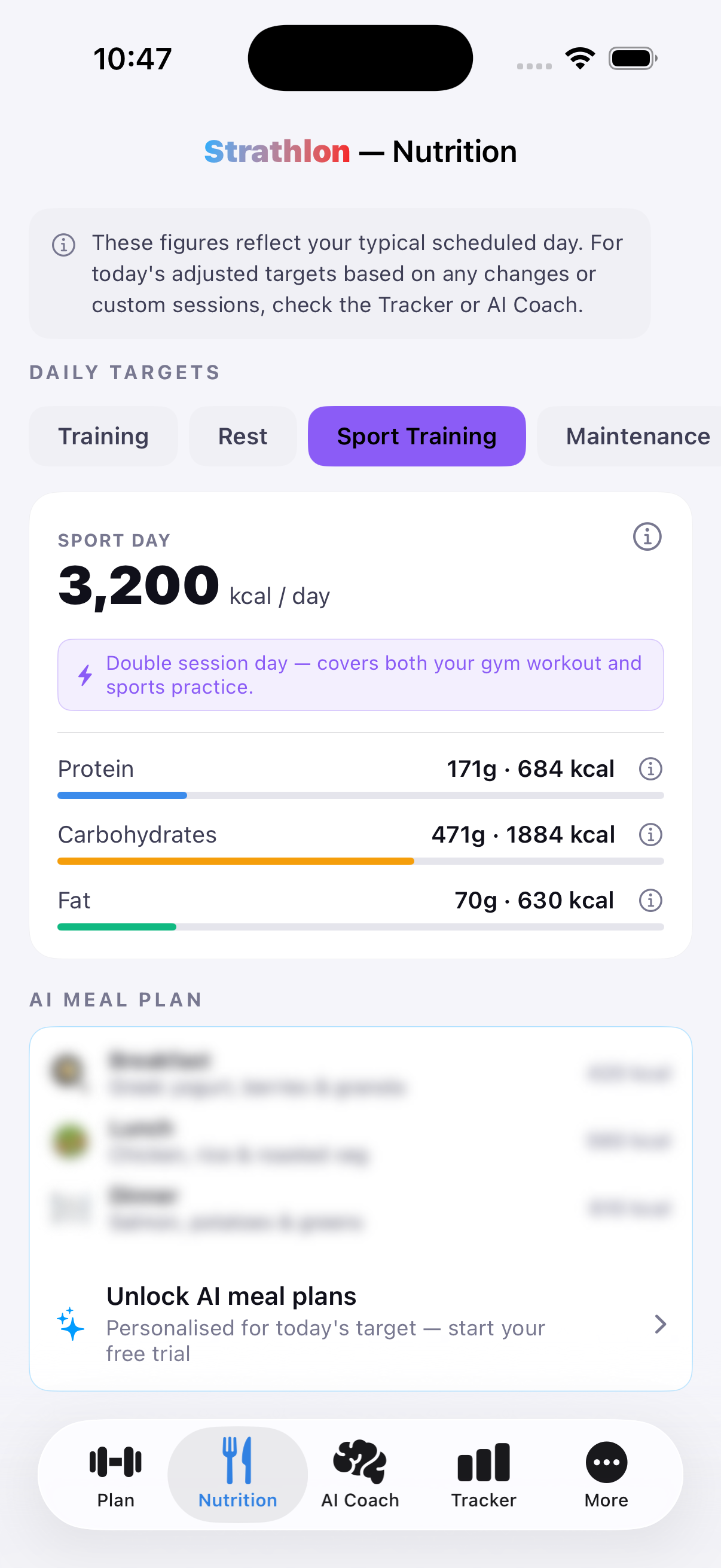
It depends on your goal, but a training day genuinely costs more energy than a rest day, so eating a little more (especially carbohydrate and protein) on hard days is sensible. If your goal is gaining muscle, you'll want a small overall energy surplus. If it's losing fat, a modest deficit while keeping protein high (position stands suggest up to about 2.3–3.1 g/kg/day when dieting) helps protect muscle. Apps like Strathlon nudge the day's calorie and carb targets up when you log a workout, so a training day is met with more food than a rest day.
Takeaways
- Daily protein is the big rock. Aim for roughly 1.6–2.2 g/kg/day to build or keep muscle. It's the number most gym-goers under-hit and the one that matters most.
- Spread it out. Servings of about 0.25–0.4 g/kg (roughly 20–40 g) every three to four hours are a slightly more effective way to reach a high daily total than one big dose.
- Carbs are for energy. One session won't empty your glycogen. A light carb-containing snack before harder or fasted sessions helps you train well. The lower end of 1–4 g/kg is plenty.
- Match daily carbs to your training. Most gym-goers sit around 3–7 g/kg/day. You don't need an endurance athlete's intake to lift.
- Forget the anabolic window. When daily protein is adequate, exact timing has, at best, a minimal effect: the useful window is hours wide.
- Hydrate simply. Water and thirst cover most sessions. Aim to keep body-mass loss under ~2%, start hydrated, and add electrolytes only for long, hot or sweaty work. Don't over-drink.
- Eat for your goal. Slight energy surplus to gain muscle, modest deficit (protein kept high, up to ~2.3–3.1 g/kg/day) to lose fat. Eat a bit more on training days.
- Supplements are optional. Whole food hits every target. Powders and pre-workouts are convenience, nothing more.
- References
If you remember one thing, make it this: eating enough protein and enough food, consistently, day after day, with a bit of carbohydrate for energy and sensible hydration around it, matters far more than elaborate timing or the right shake at the right second. Strathlon's job is to keep those daily targets honest by adjusting them around the workouts you actually log. For the science underneath, how muscle grows and how to build a way of eating that lasts, see how muscle actually grows and eating for results.
References
Numbered sources for the specific figures, effect sizes and named studies above. Where a claim reflects agreed guidance rather than a single trial, the citation is to the position stand or consensus statement of the body concerned, with the country or international remit named. A general gym session is the case most of the resistance-training nutrition literature was built on, so this page is cited to primary evidence rather than to sport-specific work.
- Henselmans M, Bjørnsen T, Hedderman R, Vårvik FT. The Effect of Carbohydrate Intake on Strength and Resistance Training Performance: A Systematic Review. Nutrients. 2022;14(4). Systematic review of the effect of carbohydrate intake on strength and resistance-training performance, the source for fuelling a lifting session. PubMed 35215506 · PMC8878406 full text
- Morton RW, Murphy KT, McKellar SR, Schoenfeld BJ, Henselmans M, Helms E, et al. A systematic review, meta-analysis and meta-regression of the effect of protein supplementation on resistance training-induced gains in muscle mass and strength in healthy adults. British Journal of Sports Medicine. 2018;52(6):376–384. Morton and colleagues' meta-analysis of protein supplementation and resistance-training gains, the source for the protein target. PubMed 28698222 · PMC5867436 full text
- Mamerow MM, Mettler JA, English KL, Casperson SL, Arentson-Lantz E, Sheffield-Moore M, et al. Dietary protein distribution positively influences 24-h muscle protein synthesis in healthy adults. The Journal of Nutrition. 2014;144(6):876–80. Mamerow and colleagues on protein distribution and 24-hour muscle protein synthesis, the basis for spreading protein across the day. PubMed 24477298 · PMC4018950 full text
- Mazzulla M, Abou Sawan S, Williamson E, Hannaian SJ, Volterman KA, West DWD, et al. Protein Intake to Maximize Whole-Body Anabolism during Postexercise Recovery in Resistance-Trained Men with High Habitual Intakes is Severalfold Greater than the Current Recommended Dietary Allowance. The Journal of Nutrition. 2020;150(3):505–511. Study of the protein intake needed to maximise whole-body anabolism after exercise in trained men, the upper end of the per-meal range. PubMed 31618421
- Bird SP, Nienhuis M, Biagioli B, De Pauw K, Meeusen R. Supplementation Strategies for Strength and Power Athletes: Carbohydrate, Protein, and Amino Acid Ingestion. Nutrients. 2024;16(12). Review of carbohydrate, protein and amino-acid supplementation strategies for strength and power athletes, the practical summary. PubMed 38931241 · PMC11206787 full text
- Lim C, Nunes EA, Currier BS, McLeod JC, Thomas ACQ, Phillips SM. An Evidence-Based Narrative Review of Mechanisms of Resistance Exercise-Induced Human Skeletal Muscle Hypertrophy. Medicine and Science in Sports and Exercise. 2022;54(9):1546–1559. Narrative review of the mechanisms of resistance-exercise-induced hypertrophy, the physiology the nutrition supports. PubMed 35389932 · PMC9390238 full text
- Longland TM, Oikawa SY, Mitchell CJ, Devries MC, Phillips SM. Higher compared with lower dietary protein during an energy deficit combined with intense exercise promotes greater lean mass gain and fat mass loss: a randomized trial. The American Journal of Clinical Nutrition. 2016;103(3):738–46. Longland and colleagues' trial of higher versus lower protein in a deficit with intense exercise, cited where the goal is to lift while losing fat. PubMed 26817506
- National Health Service (NHS, United Kingdom). Physical activity guidelines for adults aged 19 to 64. NHS physical activity guidance for adults, the weekly training volume this fuelling advice is scaled to. NHS physical activity guidelines
- Thomas DT, Erdman KA, Burke LM. Position of the Academy of Nutrition and Dietetics, Dietitians of Canada, and the American College of Sports Medicine: Nutrition and Athletic Performance. Journal of the Academy of Nutrition and Dietetics. 2016;116(3):501–528. Joint position of the Academy of Nutrition and Dietetics, Dietitians of Canada and the American College of Sports Medicine, the umbrella source for the daily energy, carbohydrate and protein ranges used throughout. PubMed 26920240
- Burke LM, Hawley JA, Wong SH, Jeukendrup AE. Carbohydrates for training and competition. Journal of Sports Sciences. 2011;29 Suppl 1:S17–27. Burke and colleagues on carbohydrate for training and competition, the source for the g/kg/day carbohydrate targets matched to training load. PubMed 21660838
- Jeukendrup A. A step towards personalized sports nutrition: carbohydrate intake during exercise. Sports Medicine. 2014;44 Suppl 1(Suppl 1):S25–33. Jeukendrup on personalising carbohydrate intake during exercise, the source for the g/h feeding rates and the duration at which they start to matter. PubMed 24791914 · PMC4008807 full text
- Jäger R, Kerksick CM, Campbell BI, Cribb PJ, Wells SD, Skwiat TM, et al. International Society of Sports Nutrition Position Stand: protein and exercise. Journal of the International Society of Sports Nutrition. 2017;14:20. International Society of Sports Nutrition (ISSN, United States) position stand on protein and exercise, the source for the daily protein range and per-meal distribution. PubMed 28642676 · PMC5477153 full text
- Schoenfeld BJ, Aragon AA. How much protein can the body use in a single meal for muscle-building? Implications for daily protein distribution. Journal of the International Society of Sports Nutrition. 2018;15:10. Schoenfeld and Aragon on how much protein the body can use in a single meal, the basis for the per-feed figure quoted. PubMed 29497353 · PMC5828430 full text
- Burke LM, van Loon LJC, Hawley JA. Postexercise muscle glycogen resynthesis in humans. Journal of Applied Physiology. 2017;122(5):1055–1067. Review of post-exercise muscle glycogen resynthesis, the source for the refuelling rates and for when a fast refuel is actually needed. PubMed 27789774
- Sawka MN, Burke LM, Eichner ER, Maughan RJ, Montain SJ, Stachenfeld NS. American College of Sports Medicine position stand. Exercise and fluid replacement. Medicine and Science in Sports and Exercise. 2007;39(2):377–90. ACSM position stand on exercise and fluid replacement, the source for the under-2% body-mass-loss guideline and the sweat-rate method. PubMed 17277604
- Barnes KA, Anderson ML, Stofan JR, Dalrymple KJ, Reimel AJ, Roberts TJ, et al. Normative data for sweating rate, sweat sodium concentration, and sweat sodium loss in athletes: An update and analysis by sport. Journal of Sports Sciences. 2019;37(20):2356–2366. Normative data for sweating rate and sweat sodium concentration in athletes, the source for how widely fluid and sodium losses vary between individuals. PubMed 31230518
- Hew-Butler T, Rosner MH, Fowkes-Godek S, Dugas JP, Hoffman MD, Lewis DP, et al. Statement of the Third International Exercise-Associated Hyponatremia Consensus Development Conference, Carlsbad, California, 2015. Clinical Journal of Sport Medicine : Official Journal of the Canadian Academy of Sport Medicine. 2015;25(4):303–20. Third International Exercise-Associated Hyponatremia Consensus statement, the basis for the warning against drinking well beyond sweat losses. PubMed 26102445
- Guest NS, VanDusseldorp TA, Nelson MT, Grgic J, Schoenfeld BJ, Jenkins NDM, et al. International society of sports nutrition position stand: caffeine and exercise performance. Journal of the International Society of Sports Nutrition. 2021;18(1):1. ISSN position stand on caffeine and exercise performance, the source for the caffeine dose and timing guidance. PubMed 33388079 · PMC7777221 full text
- Kreider RB, Kalman DS, Antonio J, Ziegenfuss TN, Wildman R, Collins R, et al. International Society of Sports Nutrition position stand: safety and efficacy of creatine supplementation in exercise, sport, and medicine. Journal of the International Society of Sports Nutrition. 2017;14:18. ISSN position stand on the safety and efficacy of creatine supplementation, cited where creatine is relevant to the sport's demands. PubMed 28615996 · PMC5469049 full text
- Maughan RJ, Burke LM, Dvorak J, Larson-Meyer DE, Peeling P, Phillips SM, et al. IOC consensus statement: dietary supplements and the high-performance athlete. British Journal of Sports Medicine. 2018;52(7):439–455. IOC consensus statement on dietary supplements and the high-performance athlete, the framing for treating supplements as optional extras. PubMed 29540367 · PMC5867441 full text
- Mountjoy M, Ackerman KE, Bailey DM, Burke LM, Constantini N, Hackney AC, et al. 2023 International Olympic Committee's (IOC) consensus statement on Relative Energy Deficiency in Sport (REDs). British Journal of Sports Medicine. 2023;57(17):1073–1097. The 2023 IOC consensus statement on Relative Energy Deficiency in Sport, the source for the consequences of under-fuelling a training load. PubMed 37752011
- Aragon AA, Schoenfeld BJ. Nutrient timing revisited: is there a post-exercise anabolic window?. Journal of the International Society of Sports Nutrition. 2013;10(1):5. Aragon and Schoenfeld on the post-exercise anabolic window, the source for timing mattering far less than daily totals. PubMed 23360586 · PMC3577439 full text
- British Dietetic Association (BDA, United Kingdom). Sport and exercise nutrition: Food Fact Sheet. British Dietetic Association (BDA, United Kingdom) Food Fact Sheet on sport and exercise nutrition, the practical UK dietetic framing. BDA Food Fact Sheet
This is general educational information rather than medical, dietary or coaching advice. The sports-nutrition figures here are drawn from established consensus and are framed as population-level guides. Individual needs vary widely with body size, training, goals, gut tolerance and health, and are best personalised with a qualified professional. Anyone with a health condition, a history of disordered eating, or who is pregnant or postpartum, or who is unsure how much to eat, should consult a physician or registered dietitian before making changes. See our Terms for more.
← All guides · Gym workout strength & conditioning guide · How muscle actually grows · Eating for results · Understanding your stats · Home