
Fuelling & performance nutrition for CrossFit
An evidence-based guide to fuelling for CrossFit and high-intensity functional training. This is a sport that mixes weightlifting, gymnastics and metabolic conditioning, trained often and hard, which makes it hungry for carbohydrate to power glycolytic WODs, protein to build and repair strength, and fluid to replace heavy sweat. This covers daily carbohydrate, protein, fuelling around and between sessions, hydration for sweaty boxes, recovery when you train most days, and the quietly serious risk of under-eating in a sport that prizes leanness. Practical, honest, and grounded in established sports-nutrition consensus.
Here's the short answer to "how should a CrossFit athlete fuel?": eat enough carbohydrate every training day to keep muscle glycogen topped up for hard WODs (very roughly 5–7 g per kilogram of body weight on lighter days and up to about 6–10 g/kg when you're training one to three hours or twice a day), pair it with plenty of protein (around 1.6–2.2 g/kg/day) for strength and recovery, drink to your own sweat rate, and above all avoid chronically under-eating to stay lean. Everything below is the detail behind that sentence: the numbers, where they come from, and how to make them work for your training rather than someone else's.
Pair this with the CrossFit strength and conditioning guide for the training side: building maximal strength, Olympic-lift power and the conditioning engine that WODs demand.
On this page
A framing note before the numbers. Sports nutrition is well studied, but CrossFit itself is younger and less researched than, say, marathon running, and people differ enormously: body size, the mix of lifting versus conditioning in your week, fitness, the heat of the box, sex and health status all shift what's right on the day. So this is written as can, tends to and around, never as a guarantee, and every specific figure is a population-level guide drawn from published consensus. None of it is a personal prescription. It's general education rather than medical or dietary advice, and it isn't a personalised plan.
Why CrossFit leans on glycogen
CrossFit is deliberately mixed: an Olympic lift, a set of pull-ups and a breathless metcon can all live in one hour. But the workouts that define the sport, the fast, high-rep, "constantly varied, high-intensity" conditioning pieces, draw heavily on anaerobic glycolysis, the energy system that burns carbohydrate to produce power quickly. Carbohydrate is stored as glycogen in your muscles and liver, and it's the fuel that lets you keep moving when a workout is genuinely hard. Fat burns too slowly to keep up with a thruster sprint or a round of wall balls.
This kind of training measurably empties the tank. A single resistance-training session can reduce muscle glycogen by roughly a quarter to 40%, and higher-repetition schemes (the 8-to-15-rep range that dominates hypertrophy work and metcons) tend to deplete more glycogen per set than heavy low-rep lifting. Type II ("fast-twitch") fibres, the ones you recruit for explosive and repeated efforts, are hit hardest. The practical consequence is simple: starting a WOD with low glycogen accelerates fatigue, saps power and force, and hurts the sessions that come after. Fuelling CrossFit is mostly about showing up with a full tank, day after day.
Daily carbohydrate: the base
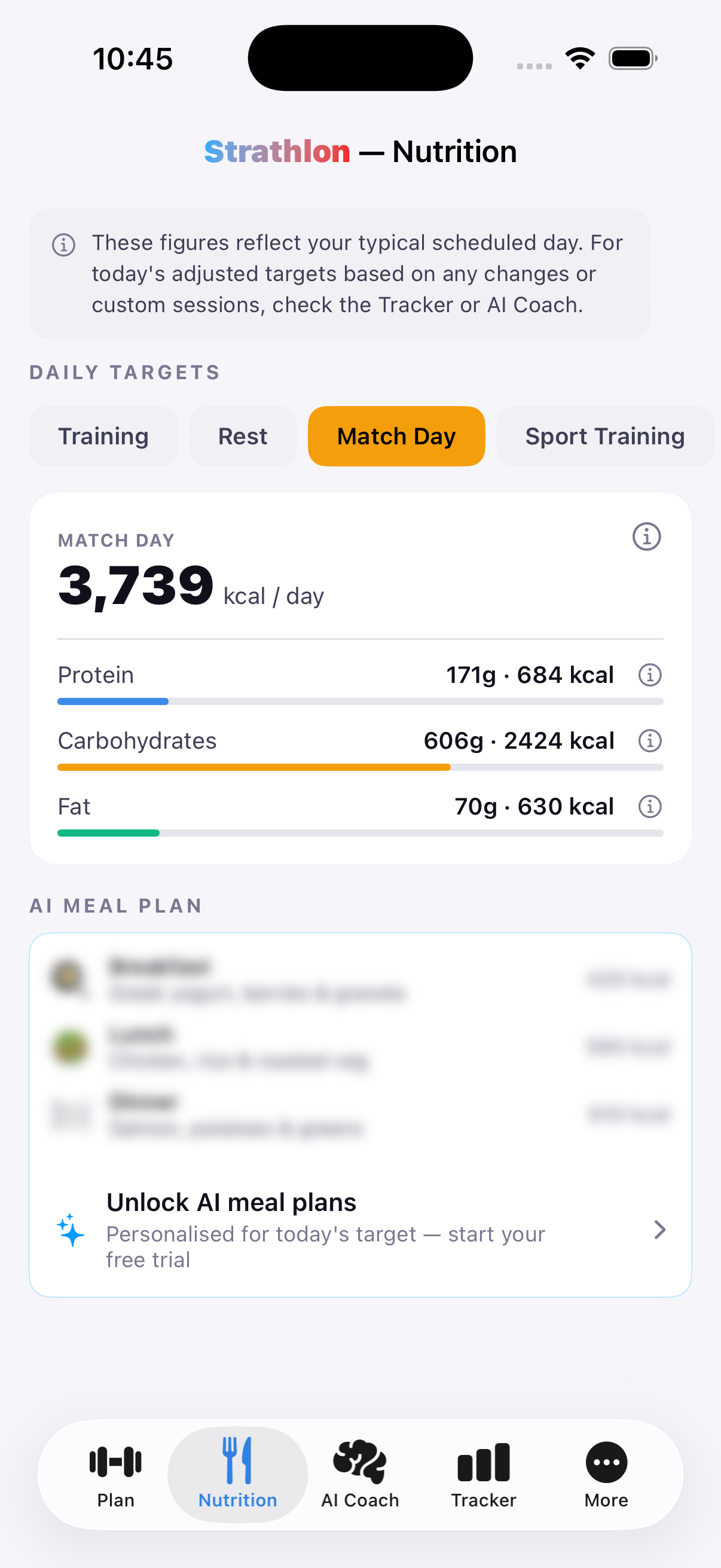
Since most CrossFit sessions are too short to fuel during, the carbohydrate that matters is what you eat across the day, matched to your training. The joint position on nutrition and athletic performance from the Academy of Nutrition and Dietetics, Dietitians of Canada and the American College of Sports Medicine sets daily carbohydrate targets scaled to load: around 5–7 g of carbohydrate per kilogram of body weight per day for a general or moderate program (about an hour a day), and roughly 6–10 g/kg/day for the moderate-to-high volumes of someone training one to three hours a day or doing two sessions. The International Society of Sports Nutrition frames physically active people at about 5–8 g/kg/day. Where you sit in those bands depends on how much hard conditioning your week actually contains.
Here's the honest gap. When researchers have measured what CrossFit athletes actually eat, carbohydrate intake often comes in well under target: one descriptive study found women averaging about 3.9 g/kg and men about 3.3 g/kg of body mass per day, which the authors judged too low relative to recommendations. If your workouts fade in the back half of a metcon, or your lifts feel heavy on a day they shouldn't, under-eating carbohydrate is the first suspect. It usually isn't a lack of "mental toughness."
| Training that day / week | Carbohydrate per day | Why |
|---|---|---|
| Rest or light day | ~3–5 g/kg | Little glycogen spent. The base can be lower. |
| One class / ~1 hour | ~5–7 g/kg | Refills what a hard WOD and lifting empties. |
| 1–3 hours or two sessions | ~6–10 g/kg | Higher volume means more glycogen to replace. |
The point is that these dials should move with your week. A day with a heavy squat session plus a long conditioning piece warrants more carbohydrate than a rest day or a skills day. Chronically eating at the low end while training hard is one of the most common ways CrossFitters end up flat, under-recovered and stuck.
Protein: the strength and recovery demand
CrossFit is as much a strength sport as a conditioning one, and building and repairing muscle takes protein. The International Society of Sports Nutrition position stand puts the useful daily range for exercising people at about 1.4–2.0 g of protein per kilogram of body weight, and given how much heavy lifting CrossFit involves, many athletes aim at the higher part of that band: around 1.6–2.2 g/kg/day is commonly cited for maximising muscle growth and strength. If you're dieting to get leaner, protein needs go up not down, toward roughly 2.3–3.1 g/kg/day, to protect the muscle you've built while in a calorie deficit.
How you spread it matters too. The evidence favours dividing protein across the day rather than piling it into one meal: doses of about 0.25 g per kilogram of body weight, or 20–40 g at a time, appear to make the most of each feeding for muscle repair, ideally including something in the hours around training. Reassuringly, protein is the one macronutrient CrossFit athletes tend to hit (measured intakes often land near 1.6 g/kg), so for many people the bigger fix is carbohydrate. More protein powder usually isn't it. The eating-for-results guide covers the broader nutrition picture in depth.
Around the workout: before, during and between
Before. For an early class you can often train on what you ate yesterday, but before a harder or later session a carbohydrate-focused top-up helps ensure glycogen is high at the start. Position stands describe a pre-exercise meal or snack of roughly 1–4 g of carbohydrate per kilogram of body weight, eaten around one to four hours beforehand: larger and earlier when you have time to digest, smaller and closer to the start otherwise. Favour familiar, lower-fibre, lower-fat foods you've tested, because a WOD full of burpees is unkind to a heavy stomach.
During. Here's where CrossFit differs sharply from marathon running: a typical WOD lasts a few to twenty-odd minutes, which is far too short to need fuel taken mid-workout. Your stored glycogen covers it. A recent randomized trial gave trained CrossFitters carbohydrate during a session and did not find a clear performance benefit, consistent with the general principle that intra-exercise carbohydrate earns its keep mainly in efforts beyond about an hour. So skip the mid-WOD gels. The fix for a session that fades is a better-stocked tank going in. Sugar taken during the session rarely helps.
Between. The exception is the long day: a competition with several events, or a self-inflicted "two-a-day" where hard sessions sit only a few hours apart. Then topping up carbohydrate between pieces, a mix of carbohydrate with a little protein and fluid, helps you refill glycogen and turn up recovered for the next one. That's the situation where between-session fuelling genuinely matters. It doesn't apply to the daily class.
Fluid, sweat rate and hydration
CrossFit boxes run hot and workouts spike your heart rate fast, so sweat losses can be high. Field measurements during CrossFit training put the average sweat rate at around 1.5 litres per hour, with bigger athletes and warmer rooms losing considerably more (men in one study averaged well over 1.6 L/h, women closer to 0.9 L/h). Losing more than roughly 2% of body mass as sweat is associated with rising perceived effort and, past a point, falling performance and impaired motor control, which matters when a barbell is overhead.
The good news is that you probably don't need a rigid drinking schedule. The long-standing guidance from the American College of Sports Medicine is to drink enough to keep body-mass loss under about 2% over a session, and studies of CrossFitters suggest that most people drinking to thirst around class stay adequately hydrated on their own. The most reliable way to know your own number is to weigh yourself before and after a tough session in typical conditions: each kilogram lost is roughly a litre of sweat you under-replaced. For longer or especially sweaty workouts, add some sodium alongside fluid: sweat sodium averages roughly 800–1,000 mg per litre (about 35–40 mmol/L) but varies widely between people (around 230–2,000 mg/L), so a personal sweat test is the only way to know your own, and replacing some helps you hold onto what you drink.
Recovery when you train most days
CrossFit's defining challenge is frequency: many people train five or six days a week, sometimes twice a day, so recovery is where fuelling either compounds or unravels. Two jobs matter after a hard session, refilling glycogen and repairing muscle, and how urgently you chase the first depends on when you next train hard.
- Fast turnaround (another hard session within a day, or two-a-days). Speed matters here. Research on rapid recovery describes taking in carbohydrate at around 1.0–1.2 g per kilogram of body weight per hour in the first few hours after training to refill glycogen quickly: muscle is most receptive to restocking soon after you stop. Add some protein (roughly 0.25–0.3 g/kg) to support repair.
- Normal turnaround (a rest day or an easy day before the next hard one). There's no need to rush. Simply hitting your usual daily carbohydrate and protein targets across normal meals refills stores comfortably. The "eat within 30 minutes or lose your gains" urgency is real only when the next hard session is genuinely close.
- References
Because most CrossFitters train several days a week, the everyday base (enough total carbohydrate, enough protein, enough overall energy) does more for your recovery than any single post-WOD shake. Get the daily picture right and the day-to-day recovery mostly looks after itself.
Under-fuelling, leanness and RED-S
The most serious nutrition mistake in CrossFit isn't a missed post-workout shake: it's chronically eating too little to support the training, often in pursuit of a leaner, more "aesthetic" physique. High training volume plus a culture that admires visible abs is exactly the combination that pushes athletes into low energy availability: not leaving enough energy, once exercise is paid for, to run the body's basic functions.
Sports scientists quantify this as energy availability: roughly, energy eaten minus energy burned in training, expressed per kilogram of fat-free (lean) mass. Research associates falling below about 30 kcal per kg of fat-free mass per day with a cascade of problems, while something nearer 45 kcal/kg FFM/day is considered healthy for an exercising body. Sustained low energy availability is the root cause of what the International Olympic Committee calls Relative Energy Deficiency in Sport (RED-S): a syndrome affecting both men and women that can impair bone health, hormones and menstrual function, immunity, metabolism, mood and, ironically, performance itself. This isn't hypothetical for the sport: a study of recreational female CrossFit athletes flagged around half (49%) at risk of low energy availability on a validated questionnaire, and about 30% measured below that 30 kcal/kg threshold.
The warning signs are worth knowing: stalled or declining performance despite hard training, nagging or recurrent stress fractures, frequent illness, poor sleep, low mood and drive, and (in women) missing or irregular periods. None are things to push through. If they appear, the answer is usually to eat more instead of training harder, and to seek help from a sports physician or registered dietitian. In a sport that rewards intensity, eating enough is not the soft option: it's the one that keeps you training.
Common questions
How much carbohydrate do I need for CrossFit?
Because CrossFit leans heavily on carbohydrate-burning energy systems, your daily intake matters more than anything you eat mid-workout. Sports-nutrition guidance scales carbohydrate to training load: roughly 5–7 g per kilogram of body weight per day for about an hour of training, and around 6–10 g/kg/day when you're training one to three hours a day or doing two sessions. Surveys of CrossFit athletes often find real-world intakes well under this, around 3–4 g/kg/day, which tends to leave the glycogen tank that fuels hard WODs half-empty. If your sessions feel flat late in a metcon, eating more carbohydrate on training days is usually the first thing to fix.
Do I need to eat carbs or gels during a WOD?
Usually not. Most CrossFit sessions (a class with a WOD of a few to twenty-odd minutes) are far too short to need fuel taken during them. Your existing muscle glycogen covers the effort, so the job is to arrive with it well stocked. Taking carbohydrate during a single short session hasn't been shown to reliably improve CrossFit performance. Intra-session and between-session fuelling only really matters on long competition days or when you train multiple hard sessions close together, where topping up carbohydrate between events helps you recover for the next one.
How much protein should a CrossFit athlete eat?
CrossFit combines heavy lifting with high volume, so protein needs sit at the athletic end. The International Society of Sports Nutrition position stand puts the useful daily range at about 1.4–2.0 g per kilogram of body weight, with roughly 1.6–2.2 g/kg often cited for maximising muscle growth and strength, and higher still (around 2.3–3.1 g/kg) to protect lean mass while dieting. Spreading it across meals in doses of about 0.25 g/kg, or 20–40 g at a time, appears to make the most of each feeding for muscle repair.
How much should I drink during CrossFit?
CrossFit is a high-sweat sport: measured sweat rates during training average around 1.5 litres per hour, and higher in bigger athletes and hot boxes. The long-standing sports-medicine aim is to keep body-mass loss under about 2% across a session rather than to drink on a fixed schedule. Encouragingly, studies suggest most CrossFitters drinking to thirst around class stay adequately hydrated, so you don't need to force fluids. Learn your own sweat rate by weighing yourself before and after a tough session, and for longer or very sweaty workouts include some sodium: sweat sodium averages roughly 800–1,000 mg per litre (about 35–40 mmol/L) but varies widely between people (around 230–2,000 mg/L), so a personal sweat test is the only way to know your own.
Should I do CrossFit on a low-carb or keto diet to stay lean?
You can, but it tends to work against the kind of training CrossFit is. High-intensity, glycolytic efforts (sprints, high-rep barbell cycling, repeated metcons) depend on carbohydrate, and starting them with low glycogen accelerates fatigue and can blunt power and work capacity. Carbohydrate is not what makes people gain fat. Overall energy balance is. For most people the leaner, stronger path is fuelling the work with enough carbohydrate and protein rather than cutting the fuel your hardest sessions run on.
Can under-eating hurt my CrossFit performance?
Yes, and it's one of the most common mistakes in a leanness-focused sport. Chronically eating too little to cover hard, frequent training causes low energy availability, the driver of Relative Energy Deficiency in Sport (RED-S). Research links falling below about 30 kcal per kilogram of fat-free mass per day with disrupted hormones, bone, immunity and, ironically, performance itself, in both men and women. Surveys of recreational female CrossFit athletes have flagged around half at risk of low energy availability. Warning signs include stalled progress, frequent illness, stress fractures and, in women, disrupted periods. The answer is usually to eat more rather than train harder.
Takeaways
- CrossFit runs on glycogen. Its glycolytic WODs and high-rep lifting empty muscle glycogen fast, so fuelling is mostly about starting each session with a full tank.
- Build the base daily. Match everyday carbohydrate to training (roughly 5–7 g/kg on a one-hour day, up to 6–10 g/kg on heavier or twice-a-day ones) and move the dial with your week. Most CrossFitters under-eat carbs.
- Prioritise protein. Around 1.6–2.2 g/kg/day for strength and recovery (more, ~2.3–3.1 g/kg, when dieting to stay lean), spread across meals in ~0.25 g/kg or 20–40 g doses.
- Skip mid-WOD gels. Sessions are too short to fuel during. Between-session carbs only matter on long competition days or two-a-days.
- Hydrate to your own sweat rate. Sweat losses average ~1.5 L/h. Aim to keep body-mass loss under ~2%, drink largely to thirst, weigh yourself to learn your number, and add sodium for sweaty sessions.
- Recover with carbs and protein. Rush refuelling (~1.0–1.2 g/kg/h carbs plus ~0.25–0.3 g/kg protein) only when the next hard session is soon. Otherwise normal meals suffice.
- Eat enough, always. Chronic under-fuelling to stay lean (low energy availability, RED-S) harms bone, hormones, health and performance in both sexes. When in doubt, lean toward eating more.
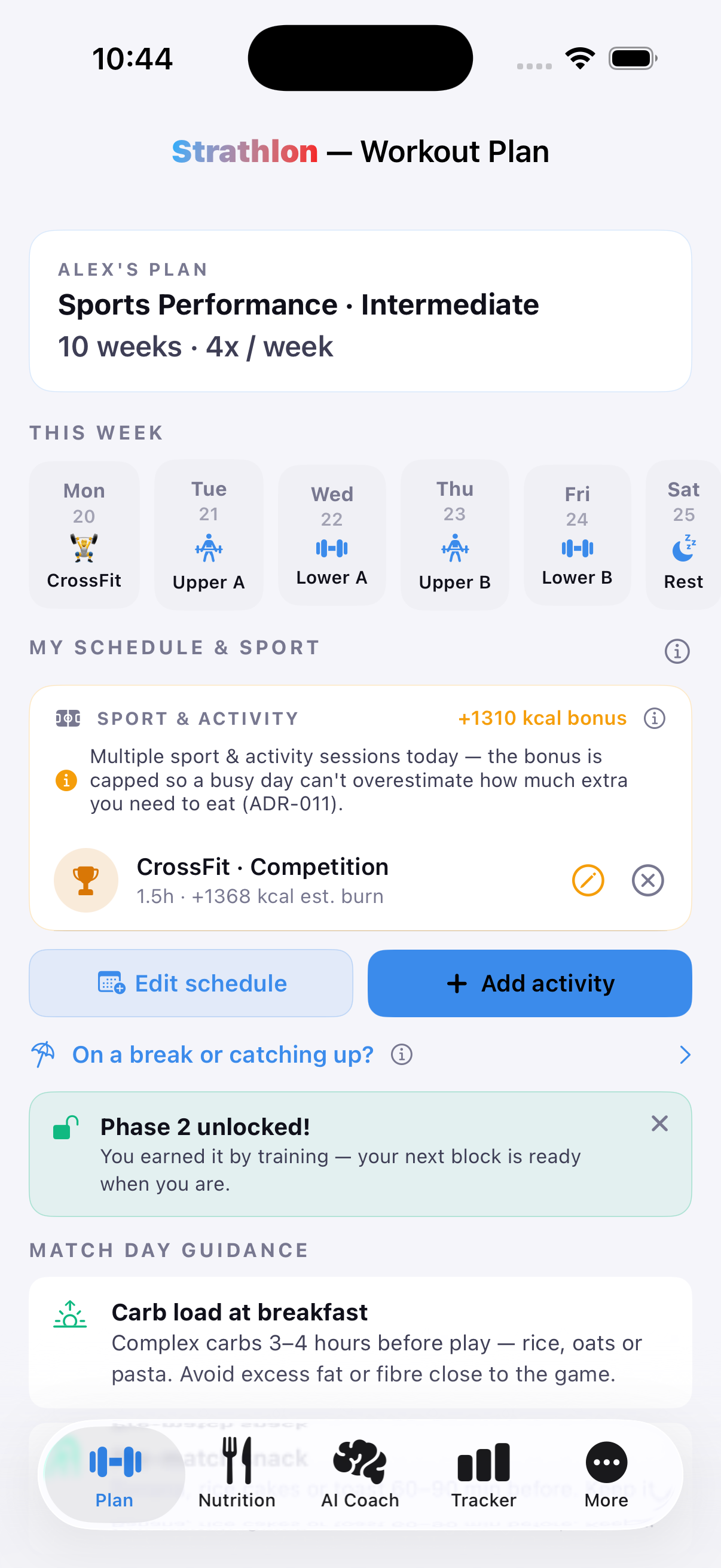
If you remember one thing, make it this: the CrossFitters who fuel well aren't the ones on the strictest diet. They're the ones who show up with a full tank, eat enough protein to rebuild, drink to their own sweat, and refuse to starve their training in the name of leanness. Strathlon's job is to keep that base honest by adjusting your targets around the sessions you actually log, so the everyday fuelling that underpins every WOD is one less thing to guess at.
References
Numbered sources for the specific figures, effect sizes and named studies above. Where a claim reflects agreed guidance rather than a single trial, the citation is to the position stand or consensus statement of the body concerned, with the country or international remit named. CrossFit now has its own nutrition literature, including a scoping review, and the sport-specific sources below are cited directly rather than generalised from weightlifting or endurance work.
- Martinho DV, Rebelo A, Clemente FM, Costa R, Gouveia ÉR, Field A, et al. Nutrition in CrossFit® - scientific evidence and practical perspectives: a systematic scoping review. Journal of the International Society of Sports Nutrition. 2025;22(1):2509674. Scoping review of nutrition in CrossFit covering the scientific evidence and its practical application: the anchor source for this guide. PubMed 40471841 · PMC12143013 full text
- de Souza RAS, da Silva AG, de Souza MF, Souza LKF, Roschel H, da Silva SF, et al. A Systematic Review of CrossFit® Workouts and Dietary and Supplementation Interventions to Guide Nutritional Strategies and Future Research in CrossFit®. International Journal of Sport Nutrition and Exercise Metabolism. 2021;31(2):187–205. Systematic review of CrossFit workouts and dietary and supplementation interventions, the source for the fuelling strategies described. PubMed 33513565
- Meier N, Schlie J, Schmidt A. Physiological effects of regular CrossFit(®) training and the impact of the COVID-19 pandemic-A systematic review. Frontiers in Physiology. 2023;14:1146718. Systematic review of the physiological effects of regular CrossFit training, the basis for the mixed-energy-system fuelling case. PubMed 37089417 · PMC10113564 full text
- McDougle JM, Mangine GT, Townsend JR, Jajtner AR, Feito Y. Acute physiological outcomes of high-intensity functional training: a scoping review. PeerJ. 2023;11:e14493. Scoping review of the acute physiological outcomes of high-intensity functional training, the demand this guide fuels for. PubMed 36620744 · PMC9817969 full text
- Williams C, Rollo I. Carbohydrate Nutrition and Team Sport Performance. Sports Medicine. 2015;45 Suppl 1(Suppl 1):S13–22. Review of carbohydrate nutrition and team-sport performance, applied to the repeated high-intensity efforts of a metcon. PubMed 26553494 · PMC4672015 full text
- Henselmans M, Bjørnsen T, Hedderman R, Vårvik FT. The Effect of Carbohydrate Intake on Strength and Resistance Training Performance: A Systematic Review. Nutrients. 2022;14(4). Systematic review of carbohydrate intake and strength and resistance-training performance, the source for fuelling the lifting half. PubMed 35215506 · PMC8878406 full text
- Leite CDFC, Zovico PVC, Rica RL, Barros BM, Machado AF, Evangelista AL, et al. Exercise-Induced Muscle Damage after a High-Intensity Interval Exercise Session: Systematic Review. International Journal of Environmental Research and Public Health. 2023;20(22). Systematic review of exercise-induced muscle damage after high-intensity interval sessions, the basis for the recovery-nutrition emphasis. PubMed 37998313 · PMC10671292 full text
- Durkalec-Michalski K, Domagalski A, Główka N, Kamińska J, Szymczak D, Podgórski T. Effect of a Four-Week Vegan Diet on Performance, Training Efficiency and Blood Biochemical Indices in CrossFit-Trained Participants. Nutrients. 2022;14(4). Randomised trial of a four-week vegan diet on performance and training efficiency in CrossFit athletes, cited in the dietary-pattern discussion. PubMed 35215544 · PMC8878731 full text
- Thomas DT, Erdman KA, Burke LM. Position of the Academy of Nutrition and Dietetics, Dietitians of Canada, and the American College of Sports Medicine: Nutrition and Athletic Performance. Journal of the Academy of Nutrition and Dietetics. 2016;116(3):501–528. Joint position of the Academy of Nutrition and Dietetics, Dietitians of Canada and the American College of Sports Medicine: the umbrella source for the daily energy, carbohydrate and protein ranges used throughout. PubMed 26920240
- Burke LM, Hawley JA, Wong SH, Jeukendrup AE. Carbohydrates for training and competition. Journal of Sports Sciences. 2011;29 Suppl 1:S17–27. Burke and colleagues on carbohydrate for training and competition, the source for the g/kg/day carbohydrate targets matched to training load. PubMed 21660838
- Jeukendrup A. A step towards personalized sports nutrition: carbohydrate intake during exercise. Sports Medicine. 2014;44 Suppl 1(Suppl 1):S25–33. Jeukendrup on personalising carbohydrate intake during exercise: the source for the g/h feeding rates and the duration at which they start to matter. PubMed 24791914 · PMC4008807 full text
- Jäger R, Kerksick CM, Campbell BI, Cribb PJ, Wells SD, Skwiat TM, et al. International Society of Sports Nutrition Position Stand: protein and exercise. Journal of the International Society of Sports Nutrition. 2017;14:20. International Society of Sports Nutrition (ISSN, United States) position stand on protein and exercise, the source for the daily protein range and per-meal distribution. PubMed 28642676 · PMC5477153 full text
- Schoenfeld BJ, Aragon AA. How much protein can the body use in a single meal for muscle-building? Implications for daily protein distribution. Journal of the International Society of Sports Nutrition. 2018;15:10. Schoenfeld and Aragon on how much protein the body can use in a single meal, the basis for the per-feed figure quoted. PubMed 29497353 · PMC5828430 full text
- Burke LM, van Loon LJC, Hawley JA. Postexercise muscle glycogen resynthesis in humans. Journal of Applied Physiology. 2017;122(5):1055–1067. Review of post-exercise muscle glycogen resynthesis, the source for the refuelling rates and for when a fast refuel is actually needed. PubMed 27789774
- Sawka MN, Burke LM, Eichner ER, Maughan RJ, Montain SJ, Stachenfeld NS. American College of Sports Medicine position stand. Exercise and fluid replacement. Medicine and Science in Sports and Exercise. 2007;39(2):377–90. ACSM position stand on exercise and fluid replacement, the source for the under-2% body-mass-loss guideline and the sweat-rate method. PubMed 17277604
- Barnes KA, Anderson ML, Stofan JR, Dalrymple KJ, Reimel AJ, Roberts TJ, et al. Normative data for sweating rate, sweat sodium concentration, and sweat sodium loss in athletes: An update and analysis by sport. Journal of Sports Sciences. 2019;37(20):2356–2366. Normative data for sweating rate and sweat sodium concentration in athletes, the source for how widely fluid and sodium losses vary between individuals. PubMed 31230518
- Hew-Butler T, Rosner MH, Fowkes-Godek S, Dugas JP, Hoffman MD, Lewis DP, et al. Statement of the Third International Exercise-Associated Hyponatremia Consensus Development Conference, Carlsbad, California, 2015. Clinical Journal of Sport Medicine : Official Journal of the Canadian Academy of Sport Medicine. 2015;25(4):303–20. Third International Exercise-Associated Hyponatremia Consensus statement, the basis for the warning against drinking well beyond sweat losses. PubMed 26102445
- Guest NS, VanDusseldorp TA, Nelson MT, Grgic J, Schoenfeld BJ, Jenkins NDM, et al. International society of sports nutrition position stand: caffeine and exercise performance. Journal of the International Society of Sports Nutrition. 2021;18(1):1. ISSN position stand on caffeine and exercise performance, the source for the caffeine dose and timing guidance. PubMed 33388079 · PMC7777221 full text
- Kreider RB, Kalman DS, Antonio J, Ziegenfuss TN, Wildman R, Collins R, et al. International Society of Sports Nutrition position stand: safety and efficacy of creatine supplementation in exercise, sport, and medicine. Journal of the International Society of Sports Nutrition. 2017;14:18. ISSN position stand on the safety and efficacy of creatine supplementation, cited where creatine is relevant to the sport's demands. PubMed 28615996 · PMC5469049 full text
- Maughan RJ, Burke LM, Dvorak J, Larson-Meyer DE, Peeling P, Phillips SM, et al. IOC consensus statement: dietary supplements and the high-performance athlete. British Journal of Sports Medicine. 2018;52(7):439–455. IOC consensus statement on dietary supplements and the high-performance athlete, the framing for treating supplements as optional extras. PubMed 29540367 · PMC5867441 full text
- Mountjoy M, Ackerman KE, Bailey DM, Burke LM, Constantini N, Hackney AC, et al. 2023 International Olympic Committee's (IOC) consensus statement on Relative Energy Deficiency in Sport (REDs). British Journal of Sports Medicine. 2023;57(17):1073–1097. The 2023 IOC consensus statement on Relative Energy Deficiency in Sport, the source for the consequences of under-fuelling a training load. PubMed 37752011
- Aragon AA, Schoenfeld BJ. Nutrient timing revisited: is there a post-exercise anabolic window?. Journal of the International Society of Sports Nutrition. 2013;10(1):5. Aragon and Schoenfeld on the post-exercise anabolic window, the source for timing mattering far less than daily totals. PubMed 23360586 · PMC3577439 full text
- British Dietetic Association (BDA, United Kingdom). Sport and exercise nutrition: Food Fact Sheet. British Dietetic Association (BDA, United Kingdom) Food Fact Sheet on sport and exercise nutrition, the practical UK dietetic framing. BDA Food Fact Sheet
This is general educational information rather than medical, dietary or coaching advice. The sports-nutrition figures here are drawn from established consensus and are framed as population-level guides. Individual needs vary widely with body size, training mix, conditions, gut tolerance and health, and are best personalised with a qualified professional. Anyone with a health condition, a history of disordered eating, or who is pregnant or postpartum, or who suspects under-fuelling, stress fractures, menstrual disruption or RED-S, should consult a sports physician or registered dietitian before making changes. See our Terms for more.
← All guides · CrossFit strength & conditioning · Eating for results · Understanding your stats · Home