
Fuelling & performance nutrition for archery
An honest, evidence-based guide to eating and drinking for archery. Let's be upfront from the first line: archery is barely a "fuelling" sport in the way running or cycling are. The energy cost of drawing a bow is small, so there is very little to top up for performance. What actually decides how you feel on the shooting line over a long day is something quieter: steady blood sugar, good hydration and unbroken concentration, hour after hour, plus one specific caution about caffeine and a steady hand. This covers all of it, grounded in archery-specific research and established sports-nutrition consensus. Pair this with the archery strength & conditioning guide for the gym side: the shoulder, back and grip work behind the steady hold this fuelling supports.
Here's the short answer to "how should an archer fuel?": eat and drink for steadiness. Power isn't the point. Arrive with a familiar slow-release meal and good hydration, sip fluid and graze on small, familiar snacks across the day to keep blood sugar level, and be genuinely careful with caffeine, because it can worsen tremor and body sway and unsettle the calm hold archery depends on. There is no carbohydrate loading and no "carbs per hour" race plan here. The whole game is holding a stable internal state over many hours.
On this page
- Why archery is barely a fuelling sport
- Steady blood sugar over a long day
- Before the shoot: the pre-competition meal
- During the day: snacks and steady topping-up
- Hydration, focus and a steady hand
- Caffeine: the one big caution
- Between days and recovery
- Eating enough over a tournament
- Common questions
- Takeaways
- References
A framing note before any numbers. Sports nutrition is well studied, but people differ: body size, the weather, how nerves hit your stomach, gut tolerance, sex and health all shift what's right on the day. So this is written as can, tends to and around, never as a guarantee, and every specific figure is a population-level guide drawn from published research rather than a personal prescription. It is general education rather than medical or dietary advice, and it isn't a personalised plan.
Why archery is barely a fuelling sport
Start with a dose of honesty that a lot of "sports nutrition for archery" content skips: archery places a very low metabolic demand on the body. A shot is a brief, mostly static effort: draw, anchor, aim, release, repeated with rest in between. There is no sustained high heart rate, no burning through glycogen, no "wall" to hit. The classic sport that fuelling advice is written for (a marathon, a long bike race) is a story about not running out of carbohydrate. Archery is not that story at all.
What the research actually shows fits that picture. In a study of six world-class male archers from the Turkish national team across a four-day European tournament, daily energy intake ranged from roughly 2,563 to 3,986 kcal, and (tellingly) the higher figures came on the days with more shooting and more walking around the field, a sign of time on their feet rather than any intense fuel burn.[1] Across those days the archers shot between 38 and 180 arrows, spent between about half an hour and five and a half hours on the competition, and walked roughly 1.3 to 4.2 km between the shooting line and the target.[1] So the calories reflect a long, active day on your feet far more than a high-intensity engine. Their carbohydrate intake sat at roughly 4 to 7 g per kilogram of body weight per day[1]: squarely in normal, moderately active athlete territory, nowhere near the 8–12 g/kg a day that position stands reserve for an extreme training commitment, or the 10–12 g/kg a day used to carbohydrate-load before an event lasting over 90 minutes.[2]
Steady blood sugar over a long day
If there is a single nutrition idea that matters for archery, it's this one: keep your blood sugar level. A competition day is long (in the world-class archers who have been measured, a single day of competition ran anywhere from about half an hour to five and a half hours[1]) and the enemy isn't running out of fuel, it's the swings. Phoebe Pine, a Paralympic champion archer writing for Archery GB, the sport's national governing body in the United Kingdom, describes the mechanism plainly: the body converts sugar into fast-acting energy but then produces insulin to counteract it, so if a big sugar hit isn't kept up it ends in a crash: "a sudden loss of energy caused by hypoglycaemia".[3] That is an experienced athlete's account rather than a research finding, so take it as practical wisdom rather than proof, but a dip like that tends to show up as wandering attention and a less certain hold exactly when you need to be calm.
The fix is unglamorous and effective: base your eating on slow-release carbohydrate (wholegrain toast, porridge, oats, wholemeal bread, rice, fruit) and top up with small, regular snacks rather than occasional big hits. Pine makes exactly this point, describing a slow-release breakfast such as brown toast or Weetabix with fruit, grazing on fruit, nuts and cereal or oat bars through the day, and treating the odd jelly baby or bite of chocolate as an occasional, small "fast" option rather than the foundation.[3] During competition, the eight world-class archers measured across a four-day tournament took in between about 14 g of carbohydrate an hour on the quietest day and about 43 to 44 g an hour on the two busiest[4], straddling, and on the lighter days falling well below, the 30 to 60 g an hour that position stands suggest for endurance and stop-start sport[2]. A light, steady trickle beats a fuelling assault.
Before the shoot: the pre-competition meal
Aim to arrive with stable blood sugar and a comfortable, un-heavy stomach. A familiar, carbohydrate-based meal a few hours beforehand does the job: think porridge with fruit, wholegrain toast, or cereal, with a little protein such as eggs or bacon if you have time, which is close to the routine Pine describes in her Archery GB piece.[3] The joint position stand of the Academy of Nutrition and Dietetics (United States), Dietitians of Canada (Canada) and the American College of Sports Medicine (ACSM, United States) describes a pre-event meal of roughly 1 to 4 g of carbohydrate per kilogram of body weight, eaten one to four hours before exercise lasting over an hour[2]: for a low-intensity sport like archery you're comfortably at the lower, lighter end of that range, and it's more about timing and tolerance than hitting a gram target.
Two practical rules matter more than the numbers. First, favour lower-fat, lower-fibre, familiar foods that won't sit heavily or send you looking for a toilet mid-round. Second (the golden rule of any competition), try nothing new on the day. The meal, the timing, and especially any coffee should all be things your body has already met at practice. Competition morning is not the time to experiment.
During the day: snacks and steady topping-up
Across a long shooting day the aim is simply to not let the tank drift low and not let blood sugar swing. That means grazing on small, familiar snacks between ends and during breaks rather than eating one big meal and hoping it lasts. Good choices are the boring, reliable ones: a banana, an apple, a handful of nuts, oatcakes, a cereal or oat bar, half a sandwich. Eating a little as you go also keeps hunger from becoming a distraction: a real factor when a competition day runs for hours.
Keep the quantities modest and the foods low-fuss. You are not trying to fuel an engine. You're trying to hold a steady internal state so your hands, eyes and attention stay reliable from the first end to the last. If you do want a small sugary lift late in a long day, keep it small and pair it with something slower so it doesn't spike and crash.
Hydration, focus and a steady hand
Hydration is where archery nutrition quietly earns its money, because the brain is more sensitive to fluid loss than the drawing arm is. A fluid deficit of more than 2% of body weight can compromise cognitive function, particularly in hot weather[2], and a meta-analysis of 33 studies found the impairment was greater above 2% body-mass loss than below it, hitting attention, executive function and motor coordination hardest.[5] In a sport decided by millimetres of aim and a repeatable release, dulled attention is exactly the failure mode you can't afford. Pine puts it bluntly in her Archery GB piece: "your rule should always be: 'If you're thirsty, it's too late'".[3]
Worth an honest caveat, though: the international consensus statement on exercise-associated hyponatraemia argues the opposite way round: that "drink ahead of thirst" advice was written for high-sweat-rate situations and has encouraged inadvertent over-drinking, and that drinking palatable fluid when thirsty is the safest individual strategy for most people.[6] For a long, hot shooting day the sensible reading of both is the same: don't ignore thirst, don't let yourself get badly behind, and don't force fluid far beyond what you're losing.
There's no universal millilitres-per-hour figure, because sweat rate varies with the person, the heat and how much you're walking the field. As real-world anchors: the world-class archers measured in competition drank an average of 0.66 litres per hour[4], and in the earlier study of the male squad, urine measurements showed them euhydrated before and after competition and before bed, with only mild hypohydration on waking.[1] Pine, writing for Archery GB, describes her own routine as at least half a pint before leaving on the morning of a shoot and at least a litre and a half of water or squash across the day, while stressing that "everyone has different levels of water required for optimal hydration so this is just what I do".[3] That is one archer's habit. It isn't an Archery GB prescription, so treat it as a sanity check rather than a target. The archers' measured sweat sodium sat at about 45 mmol/L, roughly 416 mg of sodium lost per hour of sweating[4], so on a hot, long day an electrolyte tablet or a lightly salted snack can help you hold onto the fluid you drink, but for a normal day plain water and food are usually plenty. Sip little and often. Don't try to catch up with one big bottle.
Caffeine: the one big caution
This is the most sport-specific point in the whole guide, so it gets its own section. In most endurance sports caffeine is a well-evidenced performance aid. In precision shooting it can be the opposite. An article published by the International Shooting Sport Federation (ISSF, the international governing body for rifle, pistol and shotgun shooting) and written by a doctor on its medical committee relays the results of one study in professional shooters: arm trembling reported after a single cup of coffee containing 300 to 600 mg of caffeine, and 300 mg producing a marked increase in body sway 40 minutes after ingestion compared with placebo.[7] Those are second-hand reports of someone else's data rather than the ISSF's own measurements, but tremor and sway are the two things a precision archer spends years trying to eliminate from the hold and release.
The clearest single trial comes from the closely related sport of rifle shooting. In a randomised, double-blind, placebo-controlled crossover study of 20 trained shooters (Norwegian biathletes), a 300 mg dose of caffeine (3.7 to 5.7 mg per kilogram for that group) worsened total shooting score by 11.8 points, almost all of it from an 11.3-point drop in the standing position, with no significant change prone (a 0.6-point decrease). The authors suggest the standing-only effect may be down to the increased postural sway that follows caffeine ingestion, degrading stability of hold.[8] The ISSF article reaches a matching conclusion for shooting athletes generally: caffeine "may be of little performance enhancing benefit to shooting sport athletes", and it advises shooters look for other ways of improving before considering caffeine products.[7]
Now the honest other side, because it matters. Archery isn't rifle shooting, and this specific research was done in shooters rather than archers, so treat it as related evidence rather than proof. The same ISSF article also mentions a study finding no effect of caffeine on shooting accuracy or reaction time in the recurve bow discipline (the one directly archery-specific result it cites, and one that cannot be traced, because that citation is missing from the article's own reference) list.[7] And the world-class archers measured during competition were themselves taking caffeine beforehand, averaging 3.2 mg per kilogram of body weight.[4] So the fair summary is: the mechanism (fine-motor steadiness, a stable hold, a clean release) is exactly what archery is built on, and the risk is real enough to respect, but nobody has shown a caffeine penalty in archery itself. The practical takeaway: if you drink coffee, keep it modest and take it early so the jittery, shaky peak has passed well before you're on the line, and avoid loading up on strong coffee, pre-workout or energy drinks before or during competition. If you're sensitive to caffeine, consider cutting it right back on competition days. This really is a sport where less can be more.
Between days and recovery
Because archery does so little muscle damage and burns so little fuel compared with endurance or strength sport, recovery nutrition is refreshingly simple. There's no urgent glycogen window to chase and no need to rush carbohydrate in the moment you finish. What helps over a multi-day tournament is just normal, balanced eating: replace the day's energy with regular meals, include some protein at each to support the shoulder, back and core muscles that hold your form, and rehydrate steadily through the evening.
The Academy of Nutrition and Dietetics / Dietitians of Canada / ACSM position stand puts daily protein for athletes at 1.2 to 2.0 g per kilogram of body weight, spread across the day[2], and notably, the world-class archers in the research ate 2.2 to 3.6 g/kg without trying, comfortably above that range, simply by eating balanced meals.[1] One evening caution from Pine's Archery GB piece: snacking close to bedtime risks being kept awake, or woken in the night, by an active digestive system.[3] The broader picture of everyday eating (protein, balance, overall energy) is covered in the eating-for-results guide.
Eating enough over a tournament
One last honest note in the other direction. The low energy cost of archery, plus competition nerves that kill appetite, plus long days away from a normal kitchen, can quietly add up to under-eating across a multi-day event: arriving at the last round flat, foggy and low on concentration because you barely ate rather than because you burned so much. The signs are simple: fading focus, irritability, low energy and poor decisions late in a long day.
The remedy is the theme of this whole guide: eat regular, modest, familiar meals and snacks, drink steadily, and don't let nerves talk you out of fuelling your brain. You don't need much food for archery, but you do need enough, spread evenly, to keep the steady internal state that good shooting is built on. As with any sport, anyone who chronically under-eats, has a history of disordered eating, or notices persistent fatigue, poor recovery or (in women) menstrual disruption should treat that seriously and seek qualified help.
Common questions
How should an archer fuel for a competition day?
Think steady rather than big. Archery has a very low energy cost, so there is little to 'fuel' in the endurance sense: the real job is keeping blood sugar level, staying hydrated and holding concentration across a long day. Start with a familiar slow-release carbohydrate meal a few hours before, sip fluid steadily rather than gulping it, and graze on small, low-fuss snacks like fruit, oatcakes or a cereal bar between ends to avoid an energy dip. In a study of world-class male archers, daily intake ranged from roughly 2,600 to 4,000 kcal across four competition days and carbohydrate sat around 4 to 7 g per kilogram of body weight: ordinary athlete territory, well short of the carbohydrate loading an endurance racer needs.
Should I drink coffee or an energy drink before shooting?
Be cautious with caffeine before you shoot. Caffeine is a stimulant that can increase hand tremor and body sway and sharpen the fight-or-flight response: exactly the opposite of the calm, steady hold archery rewards. Evidence from precision shooting is telling: in a placebo-controlled trial in 20 trained rifle shooters, a 300 mg dose worsened standing shooting scores by about 11 points while leaving prone shooting essentially unchanged, and an article published by the International Shooting Sport Federation (the international governing body for rifle, pistol and shotgun shooting) concludes caffeine may be of little performance-enhancing benefit to shooting athletes. Be fair to the evidence, though: no equivalent trial has been run in archery, and that same ISSF article mentions a study finding no effect on accuracy or reaction time in the recurve discipline. So if you rely on a morning coffee, keep it modest and take it early so the jittery peak has passed, and avoid loading up on strong coffee or energy drinks right before or during competition. This is one sport where more caffeine is unlikely to help and might hurt.
How much should I drink during a day of archery?
Enough not to fall behind, because a fluid deficit above about 2% of body weight can compromise cognitive function: attention and motor coordination especially. There is no universal number, since sweat rate varies with heat and the person, but world-class archers drank an average of about 0.66 litres per hour during competition, and a Paralympic champion archer writing for Archery GB describes her own routine as at least half a pint in the morning and at least a litre and a half of water or squash across a shooting day, more in the heat: her habit rather than a governing-body target. Sip little and often rather than downing a bottle at once, and do not force far more than you lose: the international consensus on exercise-associated hyponatraemia is that drinking more fluid than you lose in sweat and urine is the main cause of dangerously low blood sodium, and constant bathroom breaks interrupt your rhythm too.
Do archers need to carb-load?
No. Carbohydrate loading is a protocol for events involving more than 90 minutes of sustained or intermittent exercise, like a half marathon (a demand archery simply does not place on the body). Drawing a bow is brief and intermittent, so your normal glycogen stores are never the limiting factor. What matters instead is steady availability of energy across a long, low-intensity day, which comes from regular balanced meals and small snacks, rather than from a giant pasta dinner the night before. Eating normally and sensibly beats any special loading protocol here.
What should I eat between ends during a long shooting day?
Small, familiar, low-fuss foods that release energy gradually and will not upset your stomach or spike then crash your blood sugar. Good options are fruit, nuts, oatcakes, a banana, a cereal or oat bar, or half a sandwich: the kind of snacks elite archers actually graze on. Keep any sugary treats (sweets, chocolate) small and occasional: a big sugar hit can give a short lift followed by a slump, which is the last thing you want mid-competition. During competition, the eight world-class archers measured across a four-day tournament took in about 14 g of carbohydrate an hour on the quietest day and about 43 to 44 g an hour on the two busiest, straddling, and on lighter days falling well below, the 30 to 60 g an hour position stands suggest for endurance and stop-start sport, and easy to hit with ordinary food.
Can nerves affect what I should eat before competing?
Yes, and it is worth planning for. Competition nerves can blunt appetite and unsettle the gut, so this is not the day to force a large or unfamiliar meal. Favour foods you have eaten before training and that sit lightly (lower in fat and fibre, moderate in size) and lean on easy snacks and fluids if a full meal feels like too much. The goal is simply to arrive with stable blood sugar and good hydration. There's no set amount to eat. Never trial a new food, supplement or big coffee on competition morning.
Takeaways
- Archery is barely a fuelling sport. Six world-class male archers ate 2,563–3,986 kcal a day at a four-day tournament on 4–7 g/kg of carbohydrate: ordinary active-athlete territory, driven by hours on their feet rather than a hard fuel burn.[1]
- Keep blood sugar steady. Base eating on slow-release carbohydrate and small, regular snacks. A Paralympic champion archer writing for Archery GB warns that a big sugar hit you don't keep topping up ends in a hypoglycaemic crash.[3]
- Eat lightly and familiarly before you shoot. Position stands put the pre-event meal at 1–4 g/kg of carbohydrate, one to four hours out[2]: archery sits at the lighter end. Nothing new on the day.
- Graze across the day. Fruit, nuts, cereal or oat bars, half a sandwich: the archers measured took in ~14 g of carbohydrate an hour on the quietest competition day and ~43–44 g on the busiest.[4]
- Stay ahead of a deficit. Don't obsess over every sip. Losing more than ~2% of body weight can compromise cognition[2][5]. Archers averaged ~0.66 L/h in competition[4] and one elite archer describes drinking at least 1.5 L across a shooting day[3], but drinking more than you lose in sweat and urine is the main cause of hyponatraemia.[6]
- Be careful with caffeine. 300 mg cost trained rifle shooters ~11 points standing[8], and an article published by shooting's international federation concludes it may be of little benefit to shooting athletes, though the same article notes a study finding no effect in recurve archery, and no archery trial has been run.[7]
- Skip carb-loading. The protocol targets events over 90 minutes of sustained or intermittent exercise[2], which archery is not. Normal balanced eating is enough.
- Recover simply, but eat enough. Position stands put athlete protein at 1.2–2.0 g/kg/day[2]. The archers measured cleared that easily at 2.2–3.6 g/kg without trying.[1]
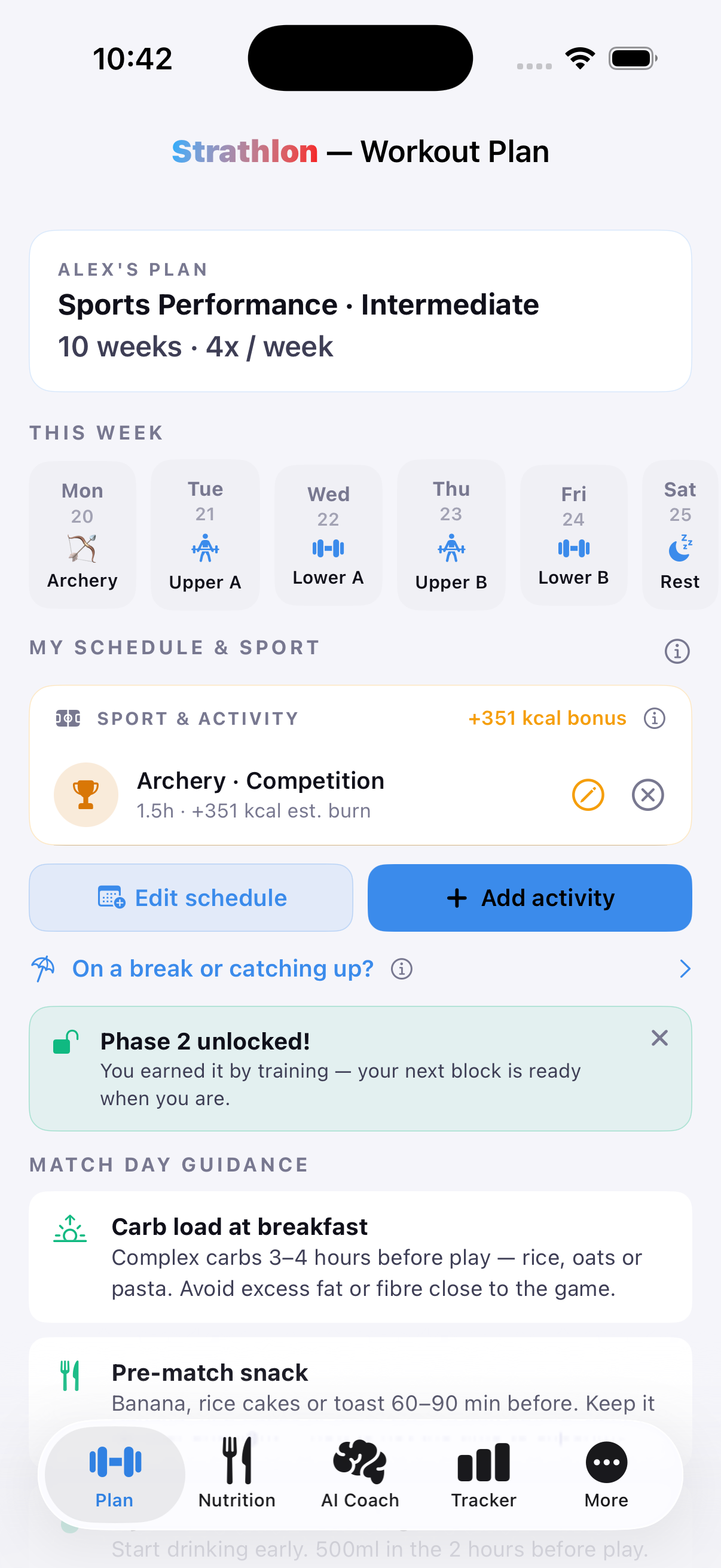
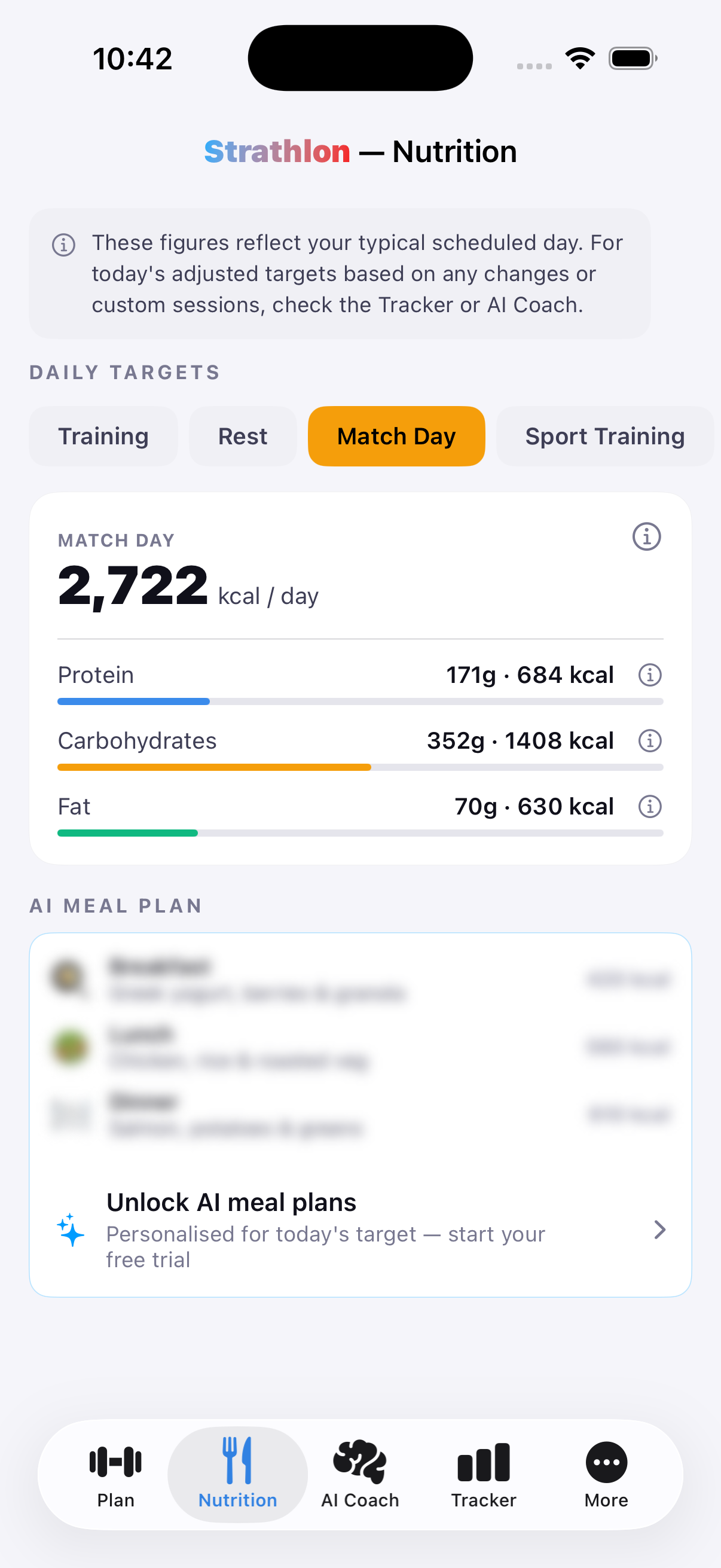
If you remember one thing, make it this: archery nutrition isn't about power, it's about staying the same: steady blood sugar, steady hydration, a steady hand, from the first arrow to the last, with caffeine kept firmly in check. Strathlon's job is to keep that base honest by adjusting your everyday targets around the shooting you actually log, so the quiet fundamentals that underpin a good shooting day are one less thing to think about on the line.
References
Sources for the specific figures on this page. Where a number reflects established consensus rather than a single trial, the citation is to the relevant expert body’s position stand, with the country or region that body belongs to named: guidance is written by national and regional organisations, and no one country’s advice is universal. Two caveats worth reading before the list. First, the archery-specific measurements come from UK-led research on a single squad (the Turkish national archery team) studied at European events: six male archers in the 2024 paper and eight male and female archers in the 2025 paper. Those two very small studies are essentially the whole published evidence base on archery nutrition, so treat every archery figure here as an illustration of what elite archers did rather than a target. Second, the practical shooting-day advice comes from a first-person account by a Paralympic champion archer published on the Archery GB website: that is one athlete describing her own routine rather than a formal recommendation from Archery GB, the national governing body in the United Kingdom. The general fuelling numbers come from a joint United States and Canadian position stand; the caffeine material comes from a Norwegian rifle-shooting trial and an article published by the international shooting federation. No source cited here is produced or funded by a food or drink company.
- Esen O, Walshe I, Goodall S. Energy intake, hydration status, and sleep of world-class male archers during competition. Journal of the International Society of Sports Nutrition. 2024;21(1):2345358: Six elite male archers from the Turkish National Archery Team, measured across a four-day European Grand Prix; research conducted by Northumbria University, United Kingdom. https://pmc.ncbi.nlm.nih.gov/articles/PMC11075653/
- Thomas DT, Erdman KA, Burke LM. Position of the Academy of Nutrition and Dietetics, Dietitians of Canada, and the American College of Sports Medicine: nutrition and athletic performance. Journal of the Academy of Nutrition and Dietetics. 2016;116(3):501–528: Joint position stand of the Academy of Nutrition and Dietetics (United States), Dietitians of Canada (Canada) and the American College of Sports Medicine (ACSM, United States). Source of the 1–4 g/kg pre-event meal, 1.2–2.0 g/kg/day protein, 8–12 g/kg/day very-high-load carbohydrate, the 10–12 g/kg carbohydrate-loading protocol for events over 90 minutes, the 30–60 g/h during-exercise range, and the >2% body-weight dehydration and over-drinking statements. https://pubmed.ncbi.nlm.nih.gov/26920240/
- Pine P. Improve your game — how to stay hydrated and fuelled while shooting. Archery GB. 12 October 2020: A first-person article by Phoebe Pine, Paralympic champion archer, published on the website of Archery GB, the national governing body for archery in the United Kingdom. It describes her own rules and routine (“this is just what I do”) rather than a formal Archery GB recommendation, and it is not a peer-reviewed study. https://archerygb.org/news/improve-your-game-how-to-stay-hydrated-and-fuelled-while-shooting
- Esen O, Goodall S. Sex differences in energy intake, sweat rate, and electrolyte loss among world-class archers during competition. Journal of the International Society of Sports Nutrition. 2025;22(1):2528532: Eight elite archers (four female, four male) from the Turkish National Archery Team; research conducted by Northumbria University, United Kingdom. Source of the 0.66 L/h fluid intake, the ~45 mmol/L (~416 mg/h) sweat sodium loss, the 3.2 mg/kg pre-competition caffeine intake, and the in-competition carbohydrate intake reported by day in its Table 2 (43.0, 27.3, 44.2 and 13.8 g/h on days 1–4). https://pmc.ncbi.nlm.nih.gov/articles/PMC12231323/
- Wittbrodt MT, Millard-Stafford M. Dehydration impairs cognitive performance: a meta-analysis. Medicine & Science in Sports & Exercise. 2018;50(11):2360–2368: 33 studies, 413 participants; impairment of attention, executive function and motor coordination was greater above 2% body-mass loss than below it. https://pubmed.ncbi.nlm.nih.gov/29933347/
- Hew-Butler T, Rosner MH, Fowkes-Godek S, et al. Statement of the Third International Exercise-Associated Hyponatremia Consensus Development Conference, Carlsbad, California, 2015. Clinical Journal of Sport Medicine. 2015;25(4):303–320: International expert consensus statement; concludes over-consumption of hypotonic fluid is the primary cause of exercise-associated hyponatraemia and of all known fatalities, and that drinking when thirsty is the safest individual strategy. https://pubmed.ncbi.nlm.nih.gov/26102445/
- Nozari N. Is caffeine consumption recommended for shooting sport athletes? International Shooting Sport Federation (ISSF) Medical Committee. 28 May 2018: An article published on the website of the International Shooting Sport Federation, the international governing body for rifle, pistol and shotgun shooting, and written by a doctor who is a member of its medical committee. It is not a peer-reviewed paper and it reports other researchers’ findings second-hand; its published reference list stops at six entries, so the numbered citations it makes for the recurve-archery, military and comparison-score results cannot be traced. https://www.issf-sports.org/news/3065
- Nygaard H, Riksaasen S, Hjelmevoll LM, Wold E. Effect of caffeine ingestion on competitive rifle shooting performance. PLOS ONE. 2019;14(10):e0224596: Randomised, double-blind, placebo-controlled crossover trial in 20 trained Norwegian biathletes; rifle shooting rather than archery. https://pmc.ncbi.nlm.nih.gov/articles/PMC6822722/
This is general educational information rather than medical, dietary or coaching advice. The figures here are drawn from archery-specific research and established sports-nutrition consensus and are framed as population-level guides: individual needs vary widely with body size, conditions, gut tolerance, caffeine sensitivity and health, and are best personalised with a qualified professional. Anyone with a health condition, a history of disordered eating, or who is pregnant or postpartum, or who suspects under-fuelling or menstrual disruption, should consult a physician or registered dietitian before making changes. See our Terms for more.
← All guides · Archery strength & conditioning guide · Eating for results · Understanding your stats · Home