
Fuelling & performance nutrition for American football
An evidence-based guide to fuelling the American footballer's body. Football is a collision, stop-start power sport: short explosive plays, long rests, big bodies, and hours in pads under a hot sun. That mix makes its fuelling unlike an endurance sport's: the priorities are enough energy and protein to build and hold serious mass, enough carbohydrate to power repeated bouts, and (above almost everything else) enough fluid to survive the heat safely. This covers all of it: daily energy, carbohydrate, protein, gaining mass the sensible way, pre-game fuelling, in-game top-ups, the heat-illness danger, and recovery. Practical, honest, and grounded in established sports-nutrition consensus. Pair this with the American football strength & conditioning guide, the gym work that builds the mass, power and durability this fuelling is meant to support.
Here's the short answer to "how should an American football player fuel?": eat enough overall to fuel a big, hard-training body, keep daily carbohydrate solid (roughly 5–7 g per kg of body weight) to power repeated explosive plays, take in around 1.6–2.2 g of protein per kg to build and repair muscle, top up carbohydrate and fluid before and during games, and treat hydration and heat as the number-one safety priority, drinking to your own measured sweat rate rather than a fixed amount. Everything below is the detail behind that sentence: the numbers, where they come from, and how to apply them to your body and position.
On this page
- What kind of sport football is to fuel
- Daily energy: eating big enough
- Carbohydrate: fuel for repeated plays
- Protein: building and repairing
- Gaining mass the safe way
- Before the game: pre-game fuelling
- During a long game day
- Hydration, sweat and the heat-illness danger
- Recovery: rehydrate, refuel, repair
- Common questions
- Takeaways
- References
A framing note before the numbers. Sports nutrition is well studied, but people differ enormously: body size, position, playing time, the weather, gut tolerance, sex and health status all shift what's right on the day, and few sports span as wide a range of body types as football, from a 150 kg lineman to a lean cornerback. So this is written as can, tends to and around, never as a guarantee, and every specific figure is a population-level guide drawn from published consensus rather than a personal prescription. It's general education rather than medical or dietary advice, and it isn't a personalised plan.
What kind of sport football is to fuel
American football is a collision, stop-start power sport. Video analysis of the 12 matches at the 2019 Under-19 European championship (youth international football rather than the NFL) put the average play at roughly five to six seconds (an all-out sprint, a block, a tackle), with team averages of about 43 to 56 seconds of huddle and rest between plays.[1] Over a game those brief maximal efforts add up to a few genuinely intense minutes scattered across several hours on your feet. That pattern matters for fuelling. An effort of about five seconds is powered almost entirely by stored ATP and phosphocreatine, the phosphagen system, which can only supply energy at that rate for around ten seconds. Once efforts stretch past that, anaerobic glycolysis burns muscle glycogen (the muscle's stored carbohydrate) to keep going.[2] The gaps between plays are too short to fully restock phosphocreatine, so performance across a game leans on a mix of the phosphagen and aerobic systems, rather than the steady fat-burning that powers a distance runner.[1]
This has an honest consequence: football is not an endurance sport, and its carbohydrate demand during a single game is far more modest than a marathon's. You are not continuously draining glycogen for two hours straight. But repeated sprints, over a long practice or a full game, do run glycogen down. The closest direct evidence comes from association football: in a single biopsy study of 31 Danish fourth-division players, muscle glycogen fell over a match and 47% of muscle fibres ended up completely or almost empty of it, while sprint times lengthened by 2.8% by the end of the game. The authors offer glycogen-empty fibres as a possible explanation (the slowing "may be explained by low glycogen levels in individual muscle fibers", they write), but it is a hypothesis rather than a demonstrated cause, because the drop in sprint performance was not correlated with total muscle glycogen content.[3] So carbohydrate still matters: as a well-stocked base that keeps you as explosive on the last drive as the first. It isn't about sipping a river of gels mid-race. The two things football fuelling is really about are quite different from a runner's: building and fuelling a big, powerful body, and getting through hours of heat and collisions safely.
Daily energy: eating big enough
Before any macro split, football's first nutrition problem is simply eating enough. Players are large and train hard (heavy lifting, field practice, conditioning and skills, often on the same day), so total energy needs run high. The reason sports-nutrition guidance states energy and macronutrient targets per kilogram of body weight is precisely so they scale across the enormous spread of athlete body sizes, and gaining fat-free mass is itself listed as a factor that pushes energy needs up.[2] Few sports stretch that spread further than football, where a lineman and a cornerback can be tens of kilograms apart, so a per-kilogram target lands on very different absolute numbers by position. We'd be overstating the evidence to put a firm calorie figure on any one position, so treat body size and your own logged training load as the guide rather than a position stereotype.
Two practical implications follow. First, many younger or smaller players who want to add size simply under-eat (appetite, school or work schedules and a small stomach get in the way), and no amount of lifting builds mass on an energy deficit. Second, the target isn't fixed: energy requirements move with the periodised training and competition cycle, varying day to day with training volume and intensity, so a two-a-day pre-season block should be met with far more food than an off-season week rather than one number held all year.[2]
Carbohydrate: fuel for repeated plays
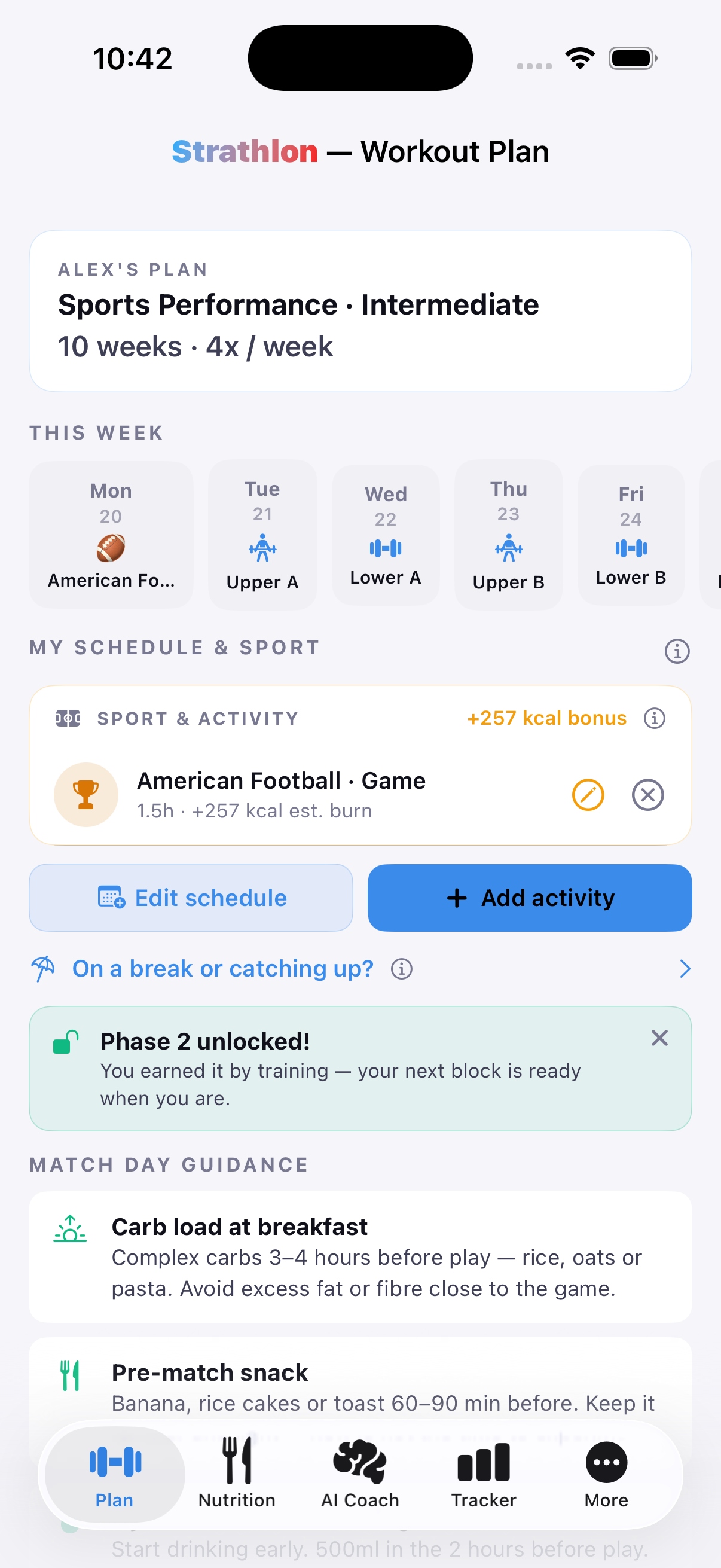
Carbohydrate keeps muscle and liver glycogen topped up so you can repeat explosive efforts without power draining away. The joint position on nutrition and athletic performance from the Academy of Nutrition and Dietetics (United States), Dietitians of Canada (Canada) and the American College of Sports Medicine (ACSM, United States) frames daily carbohydrate on a sliding scale tied to training load: 3–5 g/kg/day for light, low-intensity or skill-based activity, 5–7 g/kg/day for a moderate programme of about an hour a day, 6–10 g/kg/day for the one-to-three-hour days of moderate-to-high-intensity training, and 8–12 g/kg/day only for the extreme commitment of four or five hours a day.[2]
Most footballers live in the middle of that scale: a daily intake around 5–7 g of carbohydrate per kilogram of body weight, dialling up toward the high band during the heaviest pre-season or double-session phases.[2] That is the sensible base for football: solidly fuelled, but deliberately below the 8–12 g/kg reserved for very high endurance loads, because football's glycogen demand, while real, is intermittent rather than continuous. The everyday point is to keep carbohydrate genuinely present at meals (rice, potatoes, pasta, bread, fruit, oats) so the tank is never chronically low going into practice.
Protein: building and repairing
If carbohydrate fuels the plays, protein builds the player. Every collision causes muscle breakdown, and protein supplies the raw material to repair and, with training, grow. It's worth being precise about where the popular numbers come from, because they get muddled. The position stand of the International Society of Sports Nutrition (ISSN, United States) states that 1.4–2.0 g of protein per kilogram of body weight per day is sufficient for most exercising individuals to build and maintain muscle.[4] The joint Academy/Dietitians of Canada/ACSM stand puts the range at 1.2–2.0 g/kg/day, noting that higher intakes may be warranted for short periods during intensified training or while cutting energy intake, which is the honest basis for eating more protein when a player is trimming down and trying to hold muscle.[2] The familiar 1.6–2.2 g/kg figure comes from somewhere else again: the largest meta-analysis of protein supplementation and resistance training found that gains in fat-free mass stopped improving beyond about 1.62 g/kg/day, with the 95% confidence interval running up to 2.20 g/kg/day.[5] Practically the three agree: somewhere between about 1.6 and 2.0 g/kg covers a hard-training footballer, and there is no good evidence that piling on more builds more.
How you spread protein matters as much as the daily total. The joint position stand recommends hitting the daily target as roughly 0.3 g/kg after key training sessions and again every three to five hours across the day, with about 0.25–0.3 g/kg (15–25 g for typical athlete body sizes) enough to maximally stimulate muscle protein synthesis in the two hours after exercise.[2] A widely cited review argues for a slightly more generous 0.4 g/kg per meal across at least four meals as the safer way to guarantee the daily total is reached: for a 90–130 kg player that's roughly 35–50 g a sitting.[6] Doses above about 40 g have not been shown to stimulate muscle protein synthesis further, though the position stand allows that they may be prudent for the very largest athletes, which, in football, is a real caveat rather than a footnote.[2] A protein feed before sleep is genuinely digested and absorbed overnight and raises muscle protein synthesis during post-exercise recovery, so it earns its place in the rhythm.[7] For a collision sport, hitting protein consistently, day after day, is one of the highest-value habits there is.
Gaining mass the safe way
Many players (linemen especially) need to add mass, and how you do it decides whether the new weight helps or hurts. The best-developed evidence on lean gaining comes from off-season bodybuilding practice rather than from football, and it points to a modest energy surplus of around 10–20% above maintenance paired with a target rate of roughly 0.25–0.5% of body weight gained per week for novice and intermediate lifters, with the more advanced advised to stay at the conservative end.[8] Go faster than that and a growing share of the gain is fat rather than muscle. Underpinning it all is resistance training: the surplus and the protein only translate into muscle if the training is there to signal for it.
The safe-mass-gain framing matters more in football than in most sports, because the "get huge at any cost" culture around the line has a real downside. In a study of 90 Division 1 college players, linemen averaged 25.6% body fat against roughly 12–14% in the other position groups, and every single case of metabolic syndrome in the squad was a lineman.[9] Among 69 current, active players from a single NFL team, screened before the 2008 pre-season camp, cardiometabolic syndrome was found in 22% of linemen and none of the non-linemen. Every lineman had a BMI of 30 or above, against 32% of non-linemen, and 95% had a waist-to-height ratio over 0.5, against 36%.[10] A "see-food" dirty bulk on fast food adds weight quickly, but much of it is the kind of mass those figures describe: load without power. Leading with protein, resistance training and mostly nutritious calories, and letting the scale climb gradually, builds usable size while protecting long-term health.
Before the game: pre-game fuelling
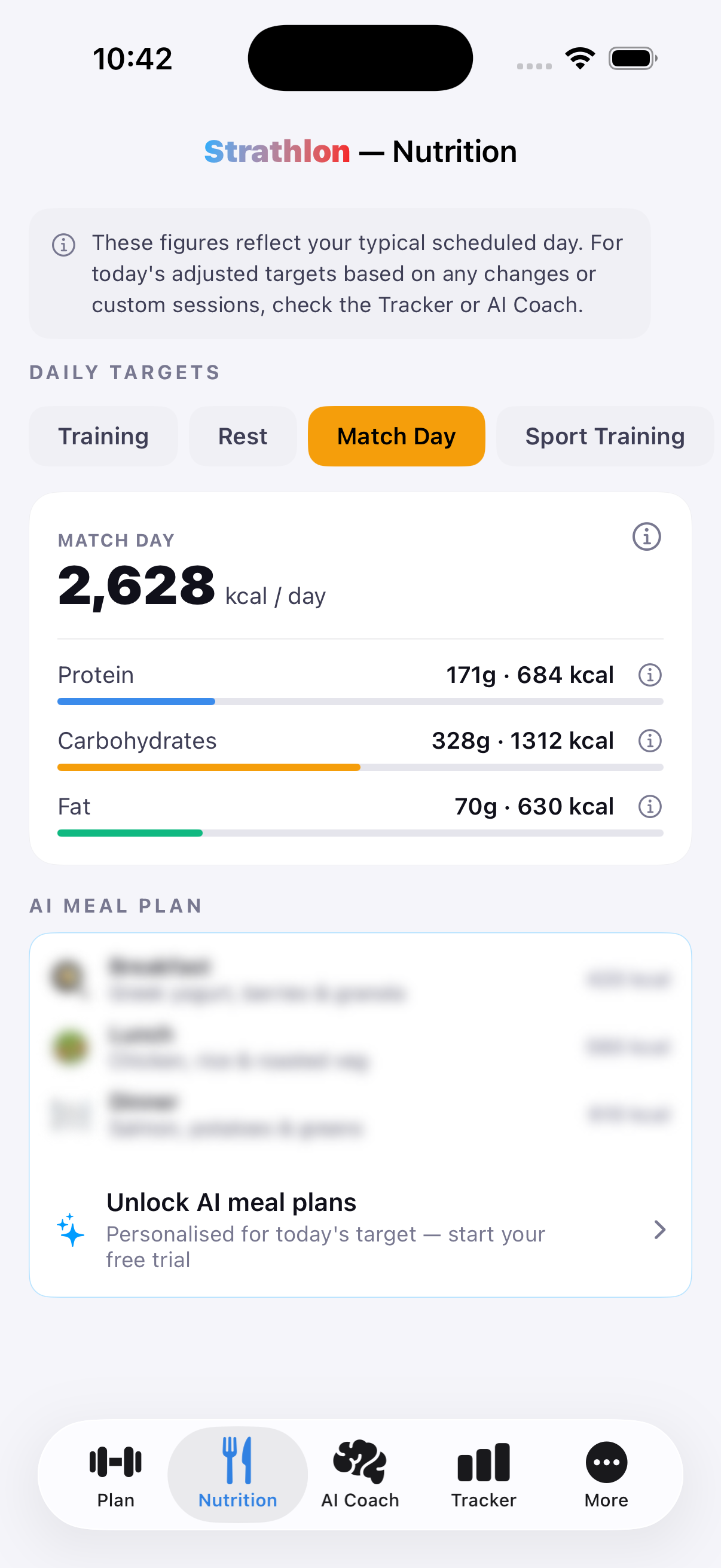
Game-day fuelling starts a day or two out. Because a game is long and glycogen-draining across repeated bouts, it's worth arriving with stores well stocked, but football rarely needs the full carbohydrate "load" of an endurance race. Position-stand guidance reserves true loading (36–48 hours at 10–12 g/kg a day) for events involving more than 90 minutes of sustained or intermittent exercise, and describes simple "fuelling up" at 7–12 g/kg over 24 hours for shorter events, so a normal high-carbohydrate day or two is usually plenty.[2] On the day itself, the same stand describes a pre-event meal or snack of 1–4 g of carbohydrate per kilogram of body weight, eaten one to four hours beforehand[2]: the larger end if you eat three or four hours out with time to digest, the smaller end if you're topping up in the final hour before kick-off.
Composition and familiarity are the art. Favour familiar, carbohydrate-rich, lower-fat and lower-fibre food you've already tested: the position stand specifically advises that choices high in fat, protein or fibre may need to be avoided to reduce the risk of gastrointestinal trouble during the event,[2] and include fluid so you start well hydrated. The golden rule is to try nothing new on game day: the meal, the timing, the pre-game coffee should all be things your stomach has met before in training.
During a long game day
During the game, football's stop-start nature is an advantage: the frequent breaks give you real chances to drink and take on a little carbohydrate on the sideline. The joint position stand has a row written for exactly this case (endurance exercise "including stop and start sports" lasting one to two and a half hours) and sets it at 30–60 g of carbohydrate per hour.[2] Sports drinks, gels, chews or simple snacks all work, and the "multiple transportable" glucose–fructose blends are reserved in that same table for ultra-endurance efforts beyond two and a half to three hours, so they aren't necessary here.[2] For a shorter, sharper bout of 45 to 75 minutes, the stand suggests only small amounts of carbohydrate, including a mouth rinse: frequent contact of carbohydrate with the mouth stimulates parts of the brain and central nervous system and raises self-chosen work output, without anything needing to be swallowed.[2]
But the honest priority during a game is not carbohydrate: it's fluid. Given the heat, the pads and the sweat rates below, the sideline routine that matters most is drinking to a plan, and letting carbohydrate ride along in the sports drink you're already using. Fuel the plays. Hydrate to survive the day.
Hydration, sweat and the heat-illness danger
This is the section that matters most for safety. American football carries disproportionately higher rates of exertional heat illness and heat stroke than other sports, and a review of the football literature lays out why: the encapsulating nature of the required protective equipment, the large body size of players, and pre-season practice falling in the hottest part of the year.[11] The scale of the gap is stark. Across six years of United States high-school injury surveillance, exertional heat illness occurred at 4.42 per 100,000 athlete-exposures in football (11.4 times the rate in all other sports combined), with 60% of cases in August.[12] Laboratory work confirms the uniform is the mechanism rather than a bystander: the full American football uniform creates uncompensable heat stress, driving core temperature up faster and bringing exhaustion on sooner than lighter clothing at the same work rate.[13]
Larger players are the most exposed: greater body-mass index, higher body fat, a lower surface-area-to-body-mass ratio, lower aerobic capacity and the more stationary nature of the position all reduce heat dissipation, and larger players consistently sweat more.[11] The same review reports mean sweating rates from 1.0 to 2.9 litres per hour in college and professional players, with several studies finding 3.0 L/h or more in some larger players.[11] Measured directly in one small study of 12 players at an NFL pre-season camp, the eight linemen sweated at 2.39 ± 0.52 L/h against 1.41 ± 0.66 L/h in the four backs and receivers, and the single highest rate recorded (3.28 L/h) belonged to an offensive guard.[14]
The goal is to keep fluid loss from tipping into meaningful dehydration. Both the joint position stand and the National Athletic Trainers' Association (NATA, United States) set the target at a body-mass loss of less than 2% by the end of exercise.[2][15] The reason is physiological rather than arbitrary: core temperature climbs roughly 0.15–0.20°C for every 1% of body weight lost to sweating, and past 2% the sweat rate itself starts to fall.[15] Because sweat rates vary so widely, there is no universal millilitre-per-hour number. NATA's recommendation is that athletes be taught sweat-rate calculation and given an individualised hydration plan, monitoring body weight before and after exercise.[15] Do it in representative kit and conditions, and treat each kilogram lost as roughly a litre of sweat. On sodium: sweat sodium averages about 50 mmol/L (around 1 g per litre), and the joint stand advises taking sodium during exercise when sweat rates exceed about 1.2 L/h, when sweat is salty, or when exercise runs beyond two hours, all three of which describe a hot football practice.[2]
The most important thing to understand is where this ends if it goes wrong. Exertional heat stroke is a life-threatening medical emergency characterised by central-nervous-system dysfunction (confusion, collapse) alongside organ and tissue damage and a core temperature frequently, though not always, above 40°C (104°F). The "not always" is why you never rule it out on a thermometer reading alone.[16] It is disproportionately a football problem: a review of exertional heat stroke in sport and the military relays United States catastrophic-injury registry figures of 67 heat-stroke deaths between 1995 and 2019 (48 of them in high-school students) and, citing separate epidemiological work, names American football as the sport with the greatest number of such fatalities.[16] The life-saving response is immediate, aggressive whole-body cooling, cold-water immersion where available. Across 18 years of medical-tent records at one road race, 274 heat-stroke patients arrived at an average core temperature of 41.4°C, were cooled on site at about 0.22°C a minute, and every one of them survived.[17] That evidence comes from distance running rather than football, but the treatment principle is the same. Good hydration, sensible acclimatisation to the heat, and shedding pads when practice allows all reduce the risk, but if a player becomes confused, stops sweating, or collapses in the heat, treat it as an emergency.
Recovery: rehydrate, refuel, repair
After a hot, physical session there are three jobs: replace fluid, refill glycogen, and repair muscle.
- Rehydrate. If you've sweated heavily, plain thirst under-replaces what you lost. Because sweat and obligatory urine losses continue afterwards, effective rehydration takes 125–150% of the deficit (about 1.25 to 1.5 litres for every kilogram of body weight lost), with sodium from food or fluid to help you hold onto it.[2][15] Weighing before and after tells you the target.
- Refuel. Replace the glycogen spent on repeated sprints with carbohydrate. When there are fewer than eight hours between two fuel-demanding sessions (a two-a-day, or an evening practice after a morning one), the position stand's "speedy refuelling" target is 1–1.2 g of carbohydrate per kilogram per hour for the first four hours, then back to normal daily intake.[2] When you have a full day or more before the next session, there's no rush: normal meals that hit your daily carbohydrate target refill stores comfortably.
- Repair. Support the collision damage with protein (the same per-feed doses described above, including a serving after training and one before bed[7]) as part of a daily total in the 1.4–2.0 g/kg range.[4] Protein and carbohydrate together after a hard session cover both repair and refuelling at once.
The eating-for-results guide covers the broader nutrition picture (total energy, protein and building habits) in more depth, and applies directly to a player trying to add or hold size across a season.
Common questions
How should an American football player fuel on game day?
Treat it as a long, hot day of repeated sprints rather than one continuous effort. Build glycogen with a normal high-carbohydrate day or two beforehand, eat a familiar carbohydrate-focused meal around one to four hours before kick-off (roughly 1 to 4 grams of carbohydrate per kilogram of body weight), and keep topping up small amounts of carbohydrate and fluid on the sideline through the game. Position stands suggest around 30 to 60 grams of carbohydrate an hour is plenty for intermittent efforts of this length. The single biggest priority, though, is fluid: football players can lose 1 to 2 litres of sweat an hour or more in pads and heat, so drink to a plan built around your own sweat rate.
How much protein does a football player need to build and hold muscle?
The International Society of Sports Nutrition puts the useful range at 1.4 to 2.0 grams of protein per kilogram of body weight per day for building and maintaining muscle. The largest meta-analysis of protein and resistance training found gains in lean mass stopped improving beyond about 1.62 g/kg per day, with the confidence interval reaching 2.2 g/kg, which is where the commonly quoted 1.6 to 2.2 g/kg figure comes from. What matters as much as the total is spreading it across the day: about 0.3 g/kg after key sessions and every three to five hours, or roughly 0.4 g/kg across at least four meals, stimulates muscle repair more effectively than loading it all into one sitting. For a collision sport that damages muscle on every play, hitting protein consistently is one of the highest-value habits there is.
How do I gain size safely for a position like the line?
Slowly, and with resistance training doing the real work. Research on lean gaining points to a modest energy surplus of around 10 to 20 percent above maintenance and a target rate of roughly 0.25 to 0.5 percent of body weight gained per week, so more of the gain is muscle and less is fat. Chasing mass with a see-food dirty bulk tends to add fat fast, and large American football linemen already carry above-average body fat and cardiometabolic risk, so the quality of the weight matters. Lead with protein, resistance training and mostly nutritious calories, and let the scale move gradually rather than overnight.
Why is heat illness such a risk in football, and how much should I drink?
Football stacks up nearly every heat-illness risk factor at once: large, heavily muscled bodies, encapsulating pads and helmets that trap heat, pre-season practice in the hottest part of the year, and sweat rates that studies put at 1.0 to 2.9 litres an hour, with some large linemen above 3 litres an hour. Because of that, football has among the highest rates of exertional heat illness in sport. The goal is to keep fluid loss under about 2 percent of body weight, because larger deficits raise core temperature and heat-illness risk. There is no single number that fits everyone: the reliable method is to weigh yourself before and after practice, count each kilogram lost as roughly a litre of sweat, and build a drinking plan around that. Exertional heat stroke is a medical emergency, and rapid whole-body cooling within minutes is what saves lives.
What should I eat before a game or practice?
Favour familiar, carbohydrate-rich, lower-fat and lower-fibre food you have already tested in training. Position stands describe a pre-exercise meal of about 1 to 4 grams of carbohydrate per kilogram of body weight, eaten one to four hours beforehand: larger and earlier when you have time to digest, smaller and closer to kick-off if you are nervous or short on time. Include fluid, keep the fat and fibre modest so your stomach settles, and never try a brand-new meal on game day.
How should I recover between practices or games?
Rehydrate, refuel and repair. Replace fluid generously after a hot session: position-stand guidance is 125 to 150 percent of the deficit, roughly 1.25 to 1.5 litres for every kilogram of body weight lost, to cover ongoing urine losses, with some sodium to help you hold onto it. Refill glycogen with carbohydrate and support muscle repair with protein. When the next hard session is under eight hours away, aim for about 1 to 1.2 grams of carbohydrate per kilogram per hour for the first few hours. When you have a full day or more before the next session, normal balanced meals that hit your daily carbohydrate and protein targets do the job without any rush.
Takeaways
- Football is a collision, stop-start power sport. Video analysis of a youth international championship puts the average play at five to six seconds, with team-average rests of 43 to 56 seconds between plays, so fuelling is mostly about building and powering a big body and getting through heat safely, rather than endurance-style carb-loading.[1]
- Eat enough, and match it to the week. Targets are set per kilogram because athlete body sizes vary so widely, and energy needs move with training volume and intensity across the year, so a hard two-a-day demands far more food than a rest day.[2]
- Keep daily carbohydrate solid. Around 5–7 g/kg for a moderate load, up toward 6–10 g/kg in the heaviest phases, keeps glycogen stocked so you're as explosive on the last play as the first.[2]
- Protein builds the player. Position stands land on 1.4–2.0 g/kg/day for building muscle, more (2.3–3.1 g/kg/day) only to hold lean mass while cutting, and the meta-analytic breakpoint is about 1.62 g/kg/day. Spread it as ~0.3–0.4 g/kg every three to five hours. Consistency beats one huge serving.[4][5][2][6]
- Gain mass slowly and cleanly. A modest 10–20% surplus and ~0.25–0.5% body weight per week, led by protein and resistance training[8], rather than a dirty bulk. College linemen already average 25.6% body fat against 12–14% in other positions.[9]
- Top up before and during games. A familiar carb meal (1–4 g/kg, one to four hours out) beforehand. 30–60 g of carbohydrate per hour on the sideline is the stated target for stop-start sports of this length.[2]
- Hydration and heat are the top safety priority. Mean sweat rates run 1.0–2.9 L/h and exceed 3 L/h in some big players[11]. Keep loss under 2% of body mass, because core temperature climbs 0.15–0.20°C per 1% lost.[15]
- Know the emergency. Exertional heat stroke (central-nervous-system dysfunction with a core temperature frequently, but not always, above 40°C) is reported to have caused more deaths in American football than in any other United States sport[16]. Immediate on-site cold-water immersion is what saves lives.[17]
- Recover in three jobs. Rehydrate with 125–150% of the deficit (1.25–1.5 L per kg lost), refuel with carbohydrate, and repair with protein, urgently only when the next session is under eight hours away.[2][15]
If you remember one thing, make it this: football fuelling isn't about the fanciest supplement. It's about eating enough to build and power a big body, keeping carbohydrate and protein honest day after day, and respecting the heat like the genuine danger it is. Strathlon's job is to keep that base honest by adjusting your targets around the sessions you actually log, so the everyday fuelling that underpins every game is one less thing to guess at.
References
Sources for the specific figures on this page. Where a number reflects established consensus rather than a single trial, the citation is to the relevant expert body’s position stand, with the country or region that body belongs to named: guidance is written by national and regional organisations, and no one country’s advice is universal. American football is played mainly in the United States, so most of the sport-specific heat and hydration research below is American; the general fuelling numbers come from joint United States and Canadian position stands and from international peer-reviewed research. Where a source is produced or funded by a commercial interest, that is noted too.
- Prioul V, Slawinski J, Guersent S, et al. Analyzing exercise-to-rest ratios in U19 American football European championship: implications for team success and injury prevention. Frontiers in Sports and Active Living. 2024;6:1466118. Video analysis of 12 matches between the top eight teams at the 2019 IFAF Under-19 European Championship; timings are from youth international football rather than the NFL. https://pmc.ncbi.nlm.nih.gov/articles/PMC11701232/
- Thomas DT, Erdman KA, Burke LM. Position of the Academy of Nutrition and Dietetics, Dietitians of Canada, and the American College of Sports Medicine: nutrition and athletic performance. Journal of the Academy of Nutrition and Dietetics. 2016;116(3):501–528. Joint position stand of the Academy of Nutrition and Dietetics (United States), Dietitians of Canada (Canada) and the American College of Sports Medicine (ACSM, United States). https://pubmed.ncbi.nlm.nih.gov/26920240/
- Krustrup P, Mohr M, Steensberg A, Bencke J, Kjaer M, Bangsbo J. Muscle and blood metabolites during a soccer game: implications for sprint performance. Medicine & Science in Sports & Exercise. 2006;38(6):1165–1174. Single biopsy study of 31 Danish fourth-division association-football players, used here as the closest available evidence in a stop-start team sport; no equivalent biopsy study exists in American football. The paper offers low fibre glycogen as a possible explanation for the late-game sprint decline rather than a demonstrated one. https://pubmed.ncbi.nlm.nih.gov/16775559/
- Jäger R, Kerksick CM, Campbell BI, et al. International Society of Sports Nutrition position stand: protein and exercise. Journal of the International Society of Sports Nutrition. 2017;14:20. Position stand of the International Society of Sports Nutrition (ISSN, United States). https://pubmed.ncbi.nlm.nih.gov/28642676/
- Morton RW, Murphy KT, McKellar SR, et al. A systematic review, meta-analysis and meta-regression of the effect of protein supplementation on resistance training-induced gains in muscle mass and strength in healthy adults. British Journal of Sports Medicine. 2018;52(6):376–384. https://pubmed.ncbi.nlm.nih.gov/28698222/
- Schoenfeld BJ, Aragon AA. How much protein can the body use in a single meal for muscle-building? Implications for daily protein distribution. Journal of the International Society of Sports Nutrition. 2018;15:10. https://pubmed.ncbi.nlm.nih.gov/29497353/
- Res PT, Groen B, Pennings B, et al. Protein ingestion before sleep improves postexercise overnight recovery. Medicine & Science in Sports & Exercise. 2012;44(8):1560–1569. https://pubmed.ncbi.nlm.nih.gov/22330017/
- Iraki J, Fitschen P, Espinar S, Helms E. Nutrition recommendations for bodybuilders in the off-season: a narrative review. Sports (Basel). 2019;7(7):154. Narrative review of off-season bodybuilding practice rather than football-specific. https://pmc.ncbi.nlm.nih.gov/articles/PMC6680710/
- Borchers JR, Clem KL, Habash DL, Nagaraja HN, Stokley LM, Best TM. Metabolic syndrome and insulin resistance in Division 1 collegiate football players. Medicine & Science in Sports & Exercise. 2009;41(12):2105–2110. https://pmc.ncbi.nlm.nih.gov/articles/PMC3872996/
- Selden MA, Helzberg JH, Waeckerle JF, et al. Cardiometabolic abnormalities in current National Football League players. American Journal of Cardiology. 2009;103(7):969–971. 69 of 91 current, active players from one NFL team, screened before the 2008 pre-season camp; a single-club sample rather than a league-wide one. https://pubmed.ncbi.nlm.nih.gov/19327424/
- Davis JK, Baker LB, Barnes K, Ungaro C, Stofan J. Thermoregulation, fluid balance, and sweat losses in American football players. Sports Medicine. 2016;46(10):1391–1405. Peer-reviewed review; all five authors are employed by the Gatorade Sports Science Institute (United States), which is owned by PepsiCo. Its equipment, body-size and heat-illness findings are corroborated independently by references 12, 13 and 14. https://pubmed.ncbi.nlm.nih.gov/27071988/
- Kerr ZY, Casa DJ, Marshall SW, Comstock RD. Epidemiology of exertional heat illness among U.S. high school athletes. American Journal of Preventive Medicine. 2013;44(1):8–14. https://pubmed.ncbi.nlm.nih.gov/23253644/
- Armstrong LE, Johnson EC, Casa DJ, et al. The American football uniform: uncompensable heat stress and hyperthermic exhaustion. Journal of Athletic Training. 2010;45(2):117–127. https://pubmed.ncbi.nlm.nih.gov/20210615/
- Godek SF, Bartolozzi AR, Burkholder R, Sugarman E, Peduzzi C. Sweat rates and fluid turnover in professional football players: a comparison of National Football League linemen and backs. Journal of Athletic Training. 2008;43(2):184–189. https://pmc.ncbi.nlm.nih.gov/articles/PMC2267333/
- McDermott BP, Anderson SA, Armstrong LE, et al. National Athletic Trainers’ Association position statement: fluid replacement for the physically active. Journal of Athletic Training. 2017;52(9):877–895. Position statement of the National Athletic Trainers’ Association (NATA, United States). https://pmc.ncbi.nlm.nih.gov/articles/PMC5634236/
- Périard JD, DeGroot D, Jay O. Exertional heat stroke in sport and the military: epidemiology and mitigation. Experimental Physiology. 2022;107(10):1111–1121. Review; the 1995–2019 death counts are United States catastrophic-injury registry data (Kucera and colleagues, 2020) relayed by this review, and the “greatest number of fatalities” attribution is drawn from separate epidemiological studies it cites. https://pmc.ncbi.nlm.nih.gov/articles/PMC9826288/
- DeMartini JK, Casa DJ, Stearns R, Belval L, Crago A, Davis R, Jardine J. Effectiveness of cold water immersion in the treatment of exertional heat stroke at the Falmouth Road Race. Medicine & Science in Sports & Exercise. 2015;47(2):240–245. Cohort of distance runners rather than American footballers; cited for the treatment principle. https://pubmed.ncbi.nlm.nih.gov/24983342/
This is general educational information rather than medical, dietary or coaching advice. The sports-nutrition figures here are drawn from established consensus and are framed as population-level guides; individual needs vary widely with body size, position, conditions, gut tolerance and health, and are best personalised with a qualified professional. Heat illness is a serious, potentially fatal risk in football; hydration, acclimatisation and emergency response should be managed with qualified athletic-training and medical staff. Anyone with a health condition, a history of disordered eating, or who is pregnant or postpartum should consult a sports physician or registered dietitian before making changes. See our Terms for more.
← All guides · American football strength & conditioning guide · Eating for results · Understanding your stats · Home