
Body recomposition: building muscle while losing fat
An evidence-based guide to the goal everyone wants and few understand: changing what your body is made of rather than just what it weighs. Who can build muscle and lose fat at the same time, who finds it slow, the handful of conditions that actually make it work, why the bathroom scale is the wrong tool for the job, and honest expectations about how fast it goes. Practical, hedged, and grounded in published exercise-science and sports-nutrition consensus.
The short answer: yes, you can build muscle and lose fat at the same time, most readily if you're new to training, returning after a break, carrying higher body fat, or newly dialling in protein and progressive lifting. For lean, well-trained lifters it still happens, but slowly.[1] The recipe is the same either way: enough protein (roughly 1.6–2.0 g per kg of body weight a day),[2][3] progressive resistance training, a small or no calorie deficit, and patience, and the scale is almost useless for tracking it. Everything below is the detail behind that sentence.
On this page
- What recomposition actually is
- Who can recompose readily
- Who finds it slow: lean, trained lifters
- The conditions that make it work
- Protein: the non-negotiable
- Progressive resistance training
- A small or no deficit
- Why the scale is a poor guide
- Honest expectations on speed
- Common questions
- Takeaways
- References
A framing note before the detail. The physiology here is well studied, but people differ enormously: training age, sex, starting body fat, genetics, sleep, protein intake and health status all shift how much and how fast anyone recomposes. So this is written as can, tends to and is associated with, never as a guarantee, and every specific figure is a population-level guide from published research rather than a personal prescription. It's general education rather than medical or dietary advice, and it isn't a personalised plan.
What recomposition actually is
Body recomposition ("recomp" for short) means changing the ratio of muscle to fat in your body while your total weight stays roughly the same. You add lean muscle and shed fat simultaneously, rather than in the separate "bulk" (eat in a surplus to gain) and "cut" (eat in a deficit to lose) phases that bodybuilders traditionally alternate. The result is a body that looks and performs very differently at almost the same number on the scale.
For years the received wisdom was that this is impossible: that muscle building strictly requires a calorie surplus and fat loss strictly requires a deficit, so you can only do one at a time. That framing turns out to be too tidy. A 2020 narrative review in the Strength and Conditioning Journal, the journal of the National Strength and Conditioning Association (NSCA, United States), by Barakat and colleagues gathered the evidence and concluded that simultaneous muscle gain and fat loss is documented in untrained and novice lifters, in people who are overweight or obese, and in resistance-trained individuals too, with progressive resistance training and evidence-based nutritional strategies named as the two key factors influencing those adaptations.[1]
One piece of physiology explains a great deal about who recomposes easily and who doesn't: how much of the weight you lose comes out of fat rather than lean tissue depends on how much fat you started with. Classic work by Forbes described an inverse relationship between starting body-fat content and the share of weight loss made up of lean tissue: thin people give up proportionally more lean tissue than people carrying more fat, and the steeper the energy deficit, the bigger that lean share becomes.[4] So someone with fat to spare can run a deficit and lose comparatively little muscle to it, which leaves hard training and enough protein free to add some. A very lean person on the same deficit is asking the body to give up muscle it is already reluctant to spare.
Who can recompose readily
Recomposition isn't equally easy for everyone. It's fastest for people with the most untapped room to adapt, and there are four classic profiles who tend to see it work well:
- Beginners. Anyone in roughly their first year of proper resistance training is in the rapid-response window often called "newbie gains." Both training age and the sheer novelty of starting a resistance-training programme have been shown to affect how quickly muscle mass is accrued, which is why recomposition is so readily seen in untrained and novice lifters.[1] We've deliberately not put a monthly figure on it: published rates vary far too much with sex, programme and how muscle is measured to be worth quoting as a personal target.
- Returners after a layoff. If you built muscle before and lost it to time off, injury or life, muscle memory appears to be on your side. In a study that put participants through seven weeks of training, seven weeks off and seven weeks of retraining, lower-limb lean mass after the retraining block was about 6% higher than after the first training block, and about 12% above where it started.[5] The popular explanation (that muscle keeps the extra nuclei it gained, so it can rebuild faster) is genuinely contested: a systematic review and meta-analysis found that in humans myonuclear number fell back towards untrained levels during detraining,[6] while a later human trial did find myonuclei retained after detraining but stopped short of showing what benefit that confers.[7] The effect is worth planning around. The mechanism is still being argued over. Either way, regaining lost muscle while stripping the fat that crept on during the break is one of the most favourable recomposition scenarios there is.
- Those carrying higher body fat. The more fat you start with, the smaller the share of any weight you lose that comes out of lean tissue[4], so a deficit costs you less muscle, and training and protein have a freer hand. Recomposition has most often been described in overweight and obese groups for exactly this reason,[1] and someone starting at a higher body-fat percentage can often change their shape a great deal without the scale dropping as much as they expect.
- Anyone newly optimising protein and training. Plenty of people "train" without ever truly progressively overloading, or eat far too little protein, or both. If you were one of them and you now start lifting hard with a plan and eating adequate protein, a stretch of rapid change opens up even if you're not a literal beginner: you've been leaving easy adaptation on the table, and recomposition is what claiming it looks like.
Who finds it slow: lean, trained lifters
The honest flip side: if you're already lean and well-trained, recomposition tends to be slow and hard-won. Two things work against you. First, training age is one of the things shown to govern how fast muscle accrues, and years of training mean you're closer to your genetic ceiling, so new muscle arrives in trickles rather than surges.[1] Second, being lean means a larger share of anything you lose in a deficit comes out of lean tissue rather than fat, so the arithmetic is working against you from the start.[4]
This doesn't mean recomposition is off the table for the lean and experienced: the Barakat review's whole point is that it's been shown in resistance-trained individuals[1]. But it does mean the margins are thin and the requirements get stricter. Protein has to be pushed higher, fat loss has to be slower, effort in the gym has to be genuine, and progress is measured over months. For this group, many coaches reasonably suggest that dedicated bulk-and-cut phases, or long stretches at maintenance, can be a more efficient way to keep nudging composition than trying to do everything at once. There's no failure in choosing that route. It's simply a trade-off, and it says nothing about your discipline.
The conditions that make it work
Whoever you are, recomposition rides on the same four conditions. Get all four right and you've given yourself the best possible shot. Miss one and progress usually stalls. Here they are at a glance, before we take the load-bearing ones in turn.
| Condition | The target | Why it matters |
|---|---|---|
| High protein | ~1.6–2.0 g/kg/day | Supplies the raw material and protects muscle while energy is at or below maintenance.[2][3] |
| Progressive resistance training | Lift hard, add over time | The signal that tells the body to build muscle rather than just burn fat. Progression is what keeps the adaptation coming.[8] |
| Small or no deficit | Near maintenance | Enough of a gap to lose fat, small enough not to starve muscle building.[9] |
| Patience | Several months | Two opposing jobs at once are slower than either alone. Consistency is the multiplier. |
Protein: the non-negotiable
If recomposition has a single most-important dietary lever, it's protein. It supplies the amino-acid building blocks for new muscle, and (critically when you're eating at or below maintenance) it's the biggest dietary protector of the muscle you already have. The International Society of Sports Nutrition (ISSN, United States) position stand on protein and exercise puts the range for building and maintaining muscle mass at 1.4–2.0 g of protein per kg of body weight per day.[2] Guidance elsewhere in the world lands in much the same place: the British Dietetic Association (United Kingdom) gives about 1.4–2.0 g/kg/day for people training hard and around 1.6–1.7 g/kg/day where muscle gain is the goal,[10] and the joint position of Dietitians of Canada, the Academy of Nutrition and Dietetics (United States) and the American College of Sports Medicine (ACSM, United States) puts athletes' needs at 1.2–2.0 g/kg/day.[9] A large 2018 meta-analysis by Morton and colleagues then found that supplementing beyond a total intake of about 1.6 g/kg/day added nothing further to resistance-training gains in fat-free mass, with the confidence interval around that break point running from roughly 1.0 to 2.2 g/kg.[3]
Because recomposition means eating at or below your energy needs, it makes sense to sit toward the upper part of that range, roughly 1.6–2.0 g/kg/day,[2][3] which is the top of the ISSN's band and at or above Morton's break point. When energy availability is reduced to lose weight or fat, higher protein intakes are needed to support muscle protein synthesis and retention of fat-free mass.[9] A 2025 systematic review with meta-regression of energy-restricted, resistance-trained people reported a dose–response relationship between daily protein and fat-free-mass change that appeared stronger the lower a person's body-fat percentage (the leaner you are, the more the extra protein seems to matter), though its authors call their findings exploratory, given how much the studies differed.[11] Its practical guidance lands in the same zone: energy-restricted lifters may benefit from more than the 1.6 g/kg/day advised at energy balance, and intakes up to about 1.9 g/kg/day were associated, on average, with less fat-free-mass loss in that analysis.[11] The ISSN's separate position stand on diets and body composition puts a number on the extreme end: to maximise muscle retention in lean, resistance-trained people in hypocaloric conditions, intakes of 2.3–3.1 g per kg of fat-free mass may be required.[12] Practically, spreading protein across the day in servings of about 0.25 g/kg (roughly 20–40 g), every few hours, is a sensible default.[2]
The most direct demonstration is a study by Longland and colleagues: young men put in a steep 40% energy deficit and doing resistance training plus high-intensity intervals six days a week for four weeks.[13] The group eating 2.4 g/kg of protein gained about 1.2 kg of lean mass while losing about 4.8 kg of fat. The group eating half that (1.2 g/kg) essentially held their lean mass (+0.1 kg) and lost about 3.5 kg of fat.[13] Both lost fat, but only the high-protein group actually built muscle at the same time, even in a large deficit.[13] That is recomposition, and protein was the difference-maker.
Progressive resistance training
Protein is the material. Resistance training is the signal. Without a genuine stimulus telling the body to build, a high-protein diet in a deficit simply means you lose fat and hold onto the muscle you already have, without gaining more. Lifting weights (or hard bodyweight work) with intent is what turns "preserve muscle" into "build muscle" while the fat comes off. Progressive resistance training is one of the two factors the recomposition review singles out, alongside evidence-based nutrition,[1] and national dietetic guidance says the same thing plainly: where muscle gain is wanted, it takes resistance training combined with a diet supplying adequate energy, carbohydrate and protein.[10]
The key word is progressive. Muscle adapts to being asked to do a little more over time (the principle of progressive overload), so the training has to keep creeping upward in reps, weight, sets or quality rather than staying the same forever. The American College of Sports Medicine (ACSM, United States) opens its position stand on progression with exactly this point: progressive programmes are necessary to keep driving adaptation, and it suggests adding 2–10% to the load once you can manage one or two reps beyond your target.[8] This matters even more during recomposition, because you're trying to build muscle in an energy-constrained state where the body would happily let muscle go. A strong, progressing training stimulus is the argument for keeping and adding it. Our how muscle actually grows guide covers overload, effort and recovery in full. The mechanics are identical here. You're just running them at maintenance rather than in a surplus.
A small or no deficit
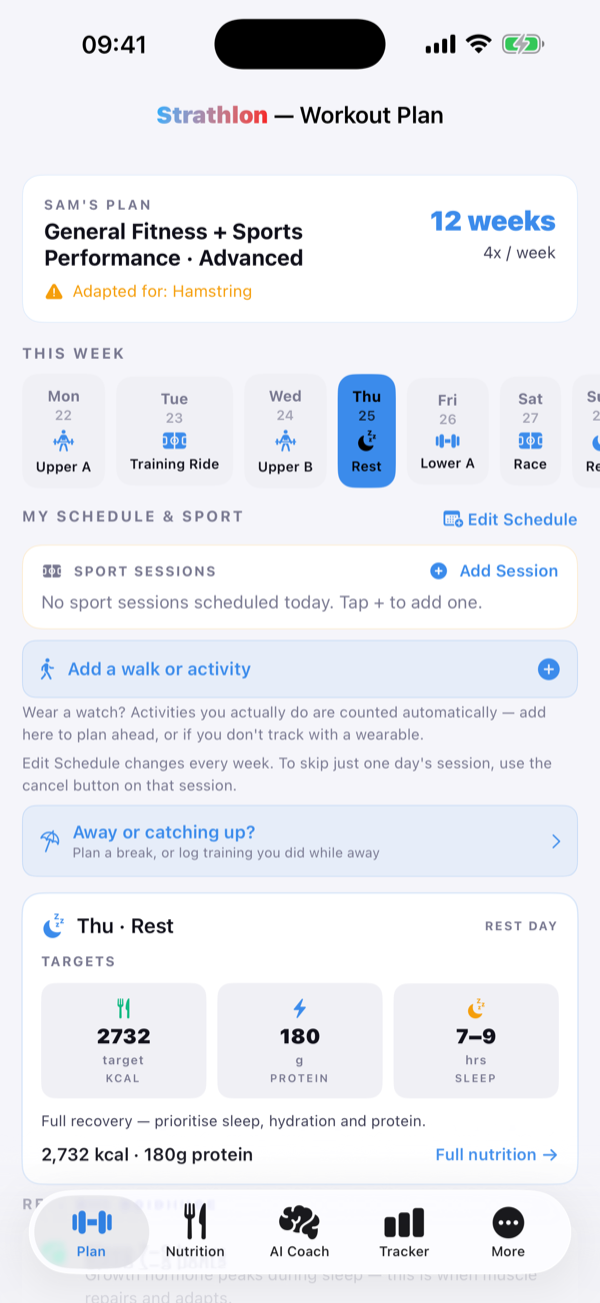
Recomposition lives around energy maintenance: a small deficit, roughly maintenance, or a very slight surplus, well short of the big surplus of a bulk or the big deficit of a cut. The size of the gap should scale with how much fat you have to lose. If you're carrying a lot, a modest deficit pulls fat off nicely while training and protein protect and build muscle. As you get leaner, the deficit should shrink, because aggressive dieting when there's little fat left tends to eat into muscle instead.
Three evidence-based anchors for pace. First, the joint position of Dietitians of Canada, the Academy of Nutrition and Dietetics (United States) and the ACSM (United States) advises a slight energy deficit and a slow rather than rapid rate of loss, and notes that fat-free mass and performance may be better preserved when weekly weight loss is kept to under about 1% of body weight.[9] Second, the ISSN's diets-and-body-composition position stand (ISSN, United States) notes that as people get leaner, slower rates of weight loss better preserve lean mass, pointing to a trial in elite athletes where a weekly loss of about 0.7% of body weight outperformed 1.4%.[12] In that trial the slow group actually gained about 2% lean body mass over the diet while the fast group's was unchanged.[14] The same stand recommends roughly 0.5–1.0% of body weight per week for physique athletes preparing for competition.[12] Third, it is high protein alongside the training that keeps fat loss from costing you muscle, as in the trial above, where only the high-protein group built lean mass in a deficit.[13] The fat-loss fundamentals guide unpacks how to set and run a sensible deficit.
Why the scale is a poor guide
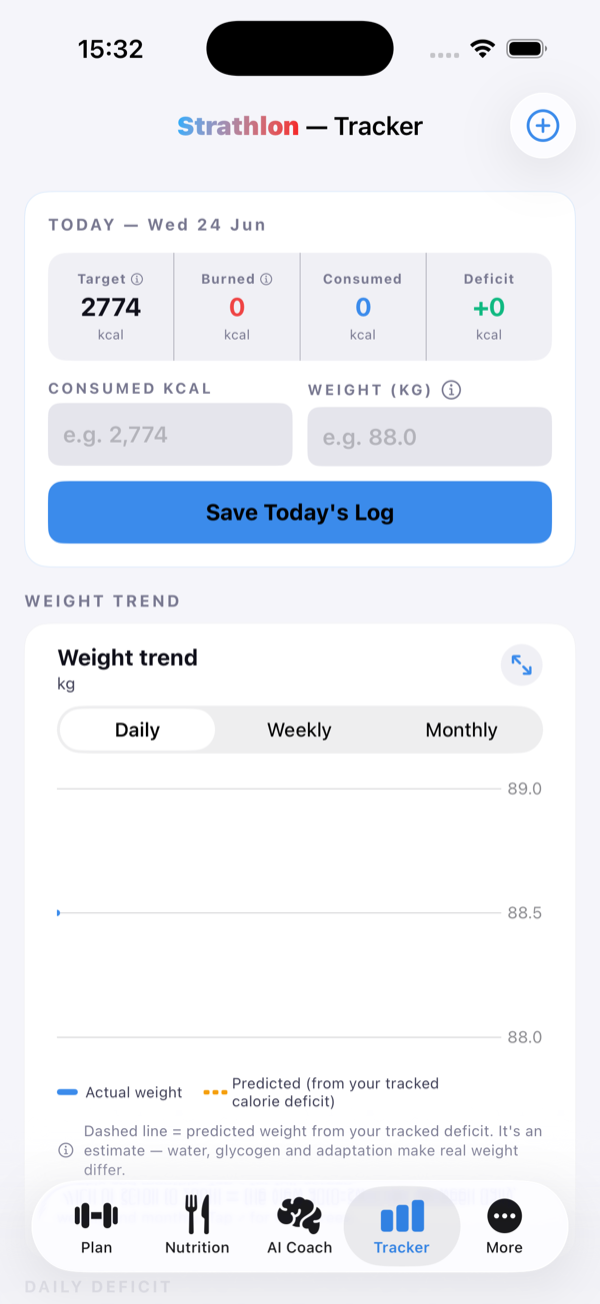
Here's the part that trips up almost everyone: during recomposition the bathroom scale is close to useless, and it's supposed to be. The whole point is to swap fat for muscle at a similar body weight, so if you lose a kilo of fat and add a kilo of muscle, the scale barely moves even though your body has changed substantially. A flat weight line during recomposition is often a success. It isn't a stall.
Two more things muddy the number. Resistance training itself increases the water the body holds, most of it inside the cells: over 16 weeks of progressive lifting, total body water rose by around 7–8% and intracellular water by 8–11% in men and women.[15] That can nudge weight up even as fat is coming off. And ordinary day-to-day noise is larger than most people assume: in a classic study that weighed 28 young women every morning for 68 days, most day-to-day changes fell within ±0.5 kg and almost all within ±1.0 kg, with individual maxima running from 0.6 up to about 2 kg.[16] For anyone who menstruates there's a cyclical layer on top: body weight has been measured about 0.5 kg higher during menstruation than in the first week of the cycle, mostly extracellular fluid rather than tissue.[17] Read daily weigh-ins in isolation and you'll be misled constantly.
So judge recomposition by signals that actually track composition:
- How clothes fit: waistbands loosening while sleeves fill out is the recomposition signature.
- Waist measurement and other tape measurements, taken every couple of weeks under the same conditions.
- Progress photos in consistent lighting, often the clearest evidence when the scale won't budge.
- Strength in the gym: steadily lifting more is a strong proxy for building or keeping muscle.
- The weight trend over weeks: a smoothed line reveals the slow drift that any single daily reading buries in noise.
Honest expectations on speed
Set expectations honestly and you'll stick with recomposition long enough for it to pay off. Expect a transformation in six weeks and you'll quit right before it shows. The core truth is that recomposition is slower than a dedicated bulk or cut, because you're asking your body to do two partly opposing jobs at once (build tissue and shed fat) at an energy balance near maintenance. A focused surplus builds muscle faster. A focused deficit strips fat faster. Recomposition deliberately trades peak speed on either front for doing both together while your weight stays comfortable.
How good that trade is depends entirely on who you are, which is the thread running through this whole guide. For a beginner, a returner, or someone with higher body fat, recomposition can be remarkably effective: enough spare fat and enough untapped adaptation that you genuinely reshape your body over a few months at a near-stable weight. For a lean, advanced lifter, the same approach yields slow, incremental change, and dedicated phases may serve you better. Either way, think in months and seasons, keep protein high, keep the training progressing, keep the deficit gentle, and let the composition markers (not the scale) tell you it's working.
Common questions
Can you really build muscle and lose fat at the same time?
Yes. It was long assumed that you must gain muscle in a surplus and lose fat in a deficit as separate phases, but a body of research (including a 2020 Strength and Conditioning Journal review by Barakat and colleagues) documents simultaneous muscle gain and fat loss in untrained and novice lifters, in people who are overweight or obese, and in resistance-trained individuals too.[1] The two engines are progressive resistance training (the signal to build muscle) and evidence-based nutrition, especially adequate protein. It works best when there is fat to spare because the more fat you start with, the smaller the share of any weight you lose that comes out of lean tissue.[4]
Who does body recomposition work best for?
It happens fastest for people with the most room to adapt: beginners in their first year or so of training (the rapid-response window often called newbie gains, since training age and the novelty of starting a programme both affect how fast muscle accrues[1]), those returning after a layoff (muscle memory: one study found lean-mass gains over a retraining block about 6% larger than over the first training block, though the cellular mechanism is still contested[5][6][7]), those carrying higher body fat (a smaller share of the weight they lose comes out of lean tissue[4]), and anyone who was training or eating sub-optimally and now dials in protein and progressive lifting. Lean, well-trained lifters can still recompose, but it tends to be slow because they are closer to their genetic ceiling and give up proportionally more lean tissue in any deficit.
How much protein do I need for body recomposition?
Protein is the non-negotiable nutrient here. The International Society of Sports Nutrition (ISSN, United States) puts the range for building and maintaining muscle at 1.4–2.0 g of protein per kg of body weight per day,[2] much as the British Dietetic Association (United Kingdom) does,[10] and a large 2018 meta-analysis by Morton and colleagues found that supplementing beyond about 1.6 g/kg/day added no further resistance-training gains in fat-free mass, with the confidence interval running to about 2.2 g/kg.[3] Because you are eating at or below maintenance during recomposition, aiming toward the upper part of that band, roughly 1.6–2.0 g/kg/day, helps protect muscle, since reduced energy availability raises protein needs.[9] Lean people dieting hard may need more still: the ISSN's diets-and-body-composition stand cites 2.3–3.1 g per kg of fat-free mass to maximise muscle retention.[12] Spread it across the day in servings of roughly 0.25 g/kg (about 20–40 g).[2]
Should I eat in a calorie deficit or a surplus for recomposition?
Recomposition happens around energy maintenance: a small deficit, roughly maintenance, or a very slight surplus, rather than the large surplus of a bulk or the large deficit of a cut. In a controlled study by Longland and colleagues, young men in a steep 40% energy deficit who ate 2.4 g/kg of protein and trained hard six days a week gained about 1.2 kg of lean mass while losing about 4.8 kg of fat over four weeks.[13] If you have a lot of fat to lose, a modest deficit works well. The leaner you are, the smaller the deficit should be, and the more you may lean toward maintenance so muscle building isn't starved of energy. Guidance for athletes points the same way: a slight deficit, a slow rather than rapid rate of loss, and weekly weight loss kept under about 1% of body weight.[9]
Why isn't the scale moving during recomposition?
Because recomposition is the one goal where the scale is designed to lie to you. If you lose a kilo of fat and add a kilo of muscle, body weight barely changes even though your body has changed a lot. On top of that, resistance training increases the water the body holds, mostly inside the cells, which can nudge weight up.[15] Day-to-day noise adds more still: most morning-to-morning changes fall within about half a kilo, and almost all within a kilo.[16] Judge recomposition by other signals: how clothes fit, waist measurement, progress photos, strength going up in the app, and the long-term weight trend. A single day's reading is the wrong tool here, built to stay flat while composition is actually shifting.
Is recomposition slower than a dedicated bulk or cut?
Generally, yes, and it helps to expect that up front. You are asking the body to do two partly opposing things at once (build tissue and shed fat) at an energy balance near maintenance, so each happens more slowly than it would in a phase dedicated to just one. A focused surplus builds muscle faster. A focused deficit loses fat faster. Recomposition trades peak speed on either front for doing both together and staying at a comfortable weight. For beginners, returners and those with higher body fat, that trade is very favourable. For lean, advanced lifters, dedicated phases are often the more efficient route.
Takeaways
- Recomposition is real. Building muscle and losing fat at once is documented even in resistance-trained people. The received "you can only do one at a time" rule is too absolute.[1]
- Who you are sets the pace. Beginners, returners (muscle memory[5]), those with higher body fat[4], and anyone newly optimising protein and training recompose readily. Lean, advanced lifters do it slowly.
- Protein is the non-negotiable. Aim roughly 1.6–2.0 g/kg/day[2][3]. Lean dieters may need more (the ISSN's diets stand cites 2.3–3.1 g/kg of fat-free mass[12]), spread across the day.
- Lift, and lift progressively. Resistance training is the signal that turns "keep muscle" into "build muscle" while fat comes off. It must keep progressing.[1][8]
- Stay near maintenance. A small deficit, or none, shrinking the gap the leaner you get. Slower fat loss (physique-athlete guidance is about 0.5–1.0% of body weight a week, and general athlete guidance says under 1%) protects muscle.[9][12][14]
- Ignore the scale, read the composition. Flat weight is often success. Track clothes, waist, photos, strength and the weight trend instead.
- Expect it to be slower. Two opposing jobs at once beat a dedicated bulk or cut on convenience, though not on peak speed. Think in months. Patience is the multiplier.
If you take one thing away, make it this: recomposition is less about a clever trick and more about holding four unglamorous conditions steady for long enough (enough protein, progressive training, a gentle energy balance and patience) while refusing to let a flat scale talk you out of progress that's genuinely happening. Strathlon's job is to keep those conditions honest around the training you actually log, and to show the trend rather than the noise, so the slow, real change is something you can see.
References
The figures in this guide come from the sources below. Where a number reflects established guidance rather than a single trial, the citation is to the position stand of the professional body that issued it, with the country it belongs to named: guidance differs a little between nations, and no one country's advice is the last word.
- Barakat C, Pearson J, Escalante G, Campbell B, De Souza EO. Body recomposition: can trained individuals build muscle and lose fat at the same time? Strength and Conditioning Journal. 2020;42(5):7–21, the journal of the National Strength and Conditioning Association (NSCA, United States). Narrative review; states that body recomposition is demonstrated in resistance-trained individuals as well as untrained/novice and overweight/obese populations, and names progressive resistance training and evidence-based nutritional strategies as the 2 key factors. doi:10.1519/SSC.0000000000000584
- Jäger R, Kerksick CM, Campbell BI, et al. International Society of Sports Nutrition (ISSN, United States) position stand: protein and exercise. Journal of the International Society of Sports Nutrition. 2017;14:20. Source of the 1.4–2.0 g/kg/day range for building and maintaining muscle mass and of the 0.25 g/kg (or 20–40 g) per-serving guidance. PMC5477153
- Morton RW, Murphy KT, McKellar SR, et al. A systematic review, meta-analysis and meta-regression of the effect of protein supplementation on resistance training-induced gains in muscle mass and strength in healthy adults. British Journal of Sports Medicine. 2018;52(6):376–384. Reports that protein supplementation beyond a total intake of 1.62 g/kg/day produced no further resistance-training gains in fat-free mass (break point 95% CI 1.03–2.20). PubMed 28698222
- Forbes GB. Body fat content influences the body composition response to nutrition and exercise. Annals of the New York Academy of Sciences. 2000;904:359–365. Describes the inverse curvilinear relationship between initial body-fat content and the proportion of weight loss consisting of lean tissue, and notes that the lean fraction grows as the energy deficit deepens. PubMed 10865771
- Seaborne RA, Strauss J, Cocks M, et al. Human skeletal muscle possesses an epigenetic memory of hypertrophy. Scientific Reports. 2018;8:1898. Across 7 weeks of loading, 7 of unloading and 7 of reloading, lower-limb lean mass after reloading was 12.4% above baseline and 5.9% above the level reached after the earlier loading period. PMC5789890
- Rahmati M, McCarthy JJ, Malakoutinia F. Myonuclear permanence in skeletal muscle memory: a systematic review and meta-analysis of human and animal studies. Journal of Cachexia, Sarcopenia and Muscle. 2022;13(5):2276–2297. Concludes that in humans myonuclei gained with training were not retained through detraining, so myonuclear number cannot be the mechanism of muscle memory. PMC9530508
- Cumming KT, Reitzner SM, Hanslien M, et al. Muscle memory in humans: evidence for myonuclear permanence and long-term transcriptional regulation after strength training. The Journal of Physiology. 2024;602(17):4171–4193. Finds myonuclei elevated and maintained after detraining, while stating that the physiological benefit remains to be determined. Cited here alongside reference 6 because the two disagree. PubMed 39159314
- American College of Sports Medicine (ACSM, United States) position stand. Progression models in resistance training for healthy adults. Medicine & Science in Sports & Exercise. 2009;41(3):687–708. States that progressive protocols are necessary to stimulate further adaptation, and recommends a 2–10% load increase once the current workload can be performed for one to two repetitions beyond the target. PubMed 19204579
- Thomas DT, Erdman KA, Burke LM. Nutrition and athletic performance. Medicine & Science in Sports & Exercise. 2016;48(3):543–568, joint position of Dietitians of Canada (Canada), the Academy of Nutrition and Dietetics (United States) and the American College of Sports Medicine (ACSM, United States). Source of the 1.2–2.0 g/kg/day protein range, of the statement that reduced energy availability raises protein needs for muscle protein synthesis and fat-free-mass retention, and of the guidance to use a slight energy deficit with weekly weight loss under about 1% of body weight. PubMed 26891166 · full text (Dietitians of Canada, PDF)
- British Dietetic Association (BDA, United Kingdom). Sport and exercise nutrition: Food Fact Sheet. BDA, May 2026 (review date May 2029). Gives approximately 1.4–2.0 g/kg/day for strength and endurance athletes and approximately 1.6–1.7 g/kg/day where muscle gain is the goal, and states that muscle gain requires resistance training combined with a diet containing adequate energy, carbohydrate and protein. bda.uk.com/resource/sport-exercise-nutrition.html
- Refalo MC, Trexler ET, Helms ER. Effect of dietary protein on fat-free mass in energy restricted, resistance-trained individuals: an updated systematic review with meta-regression. Strength & Conditioning Journal. 2025, published ahead of print (no volume, issue or page numbers assigned at the time of writing); the journal of the National Strength and Conditioning Association (NSCA, United States). Reports that results suggest a >97% probability of a linear dose–response relationship between daily protein intake and fat-free-mass change, stronger when protein is expressed relative to fat-free mass, in interventions longer than 4 weeks, in men, and when body-fat percentage is lower; the authors state that heterogeneity between studies renders their findings exploratory. Its practical-application section states that during energy restriction such individuals may benefit from higher intakes than the 1.6 g/kg body weight/day or higher advised at energy balance or surplus, and that increasing intake up to 1.9 g/kg body weight/day (or 2.5 g/kg fat-free mass/day), on average, is associated with less fat-free-mass loss. doi:10.1519/SSC.0000000000000888
- Aragon AA, Schoenfeld BJ, Wildman R, et al. International Society of Sports Nutrition (ISSN, United States) position stand: diets and body composition. Journal of the International Society of Sports Nutrition. 2017;14:16. Source of the 2.3–3.1 g/kg fat-free mass figure for lean, resistance-trained subjects in hypocaloric conditions, of the observation that slower weight loss better preserves lean mass as subjects get leaner (citing Garthe's 0.7% versus 1.4% per week), and of the 0.5–1.0% of body weight per week recommendation for bodybuilders in contest preparation. PMC5470183
- Longland TM, Oikawa SY, Mitchell CJ, Devries MC, Phillips SM. Higher compared with lower dietary protein during an energy deficit combined with intense exercise promotes greater lean mass gain and fat mass loss: a randomized trial. American Journal of Clinical Nutrition. 2016;103(3):738–746. Four weeks, ~40% energy deficit, resistance training plus high-intensity intervals 6 days a week: lean body mass +1.2 kg on 2.4 g/kg/day protein versus +0.1 kg on 1.2 g/kg/day; fat mass −4.8 kg versus −3.5 kg. PubMed 26817506
- Garthe I, Raastad T, Refsnes PE, Koivisto A, Sundgot-Borgen J. Effect of two different weight-loss rates on body composition and strength and power-related performance in elite athletes. International Journal of Sport Nutrition and Exercise Metabolism. 2011;21(2):97–104. Lean body mass rose 2.1% in the 0.7%-per-week group and was unchanged (−0.2%) in the 1.4%-per-week group. PubMed 21558571
- Ribeiro AS, Avelar A, Schoenfeld BJ, Ritti Dias RM, Altimari LR, Cyrino ES. Resistance training promotes increase in intracellular hydration in men and women. European Journal of Sport Science. 2014;14(6):578–585. Over 16 weeks of progressive resistance training, total body water rose 7.5% in men and 7.6% in women and intracellular water rose 8.2% and 11.0% respectively. PubMed 24471859
- Robinson MF, Watson PE. Day-to-day variations in body-weight of young women. British Journal of Nutrition. 1965;19:225–235, University of Otago, New Zealand. Of 1,459 day-to-day variations recorded in 28 women weighed each morning for 68 days, most lay within ±0.5 kg and almost all within ±1.0 kg; individual maxima ranged from 0.59 to 2.07 kg. PubMed 14290861
- Kanellakis S, Skoufas E, Simitsopoulou E, et al. Changes in body weight and body composition during the menstrual cycle. American Journal of Human Biology. 2023;35(11):e23951. Body weight was about 0.5 kg higher during menstruation than in the first week of the cycle, mostly attributable to extracellular fluid. PubMed 37395124
This is general educational information rather than medical, dietary or coaching advice. The physiology and figures here are drawn from established exercise-science and sports-nutrition consensus and are framed as population-level guides: individual results vary widely with training age, sex, starting body composition, genetics and health, and mechanisms are described as tendencies and associations rather than certainties. Anyone with a health condition, a history of disordered eating, or who is pregnant or postpartum should consult a qualified physician or registered dietitian before starting or changing an exercise or nutrition programme. See our Terms for more.
← All guides · Eating to build muscle · Fat-loss fundamentals · How much protein · How muscle grows · Eating for results · Understanding your stats · Home