
Your workout plan should know your sport†
If you play a sport, you've almost certainly been handed a "strength programme" at some point, and it was almost certainly the same one a powerlifter, a runner and a weekend five-a-side player would all be given. Three sets of ten. Bench, squat, a bit of cardio. It isn't wrong, exactly. It's just generic. And generic is the reason so much gym work never actually shows up where it matters: on the pitch, the court, the road.
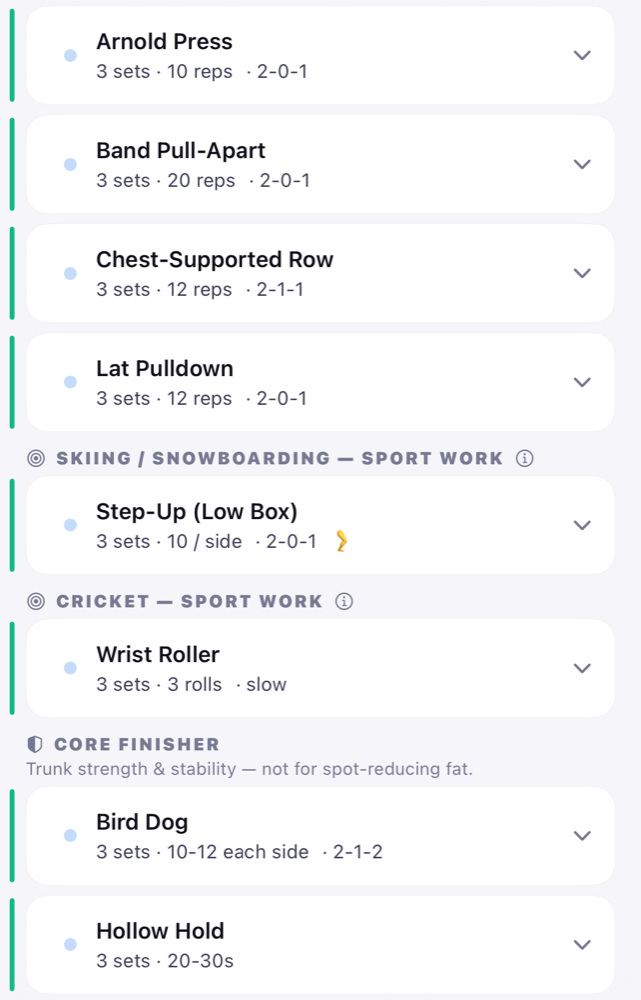
What the sport blocks are actually for
The lifts at the top of that screen are not sport-specific, and they are not meant to be. Base strength is what makes everything else possible, and it looks broadly similar whoever you are. What changes is what sits on top of it: the sport blocks, which come with the Sports Performance goal.
A wrist roller is a strange exercise to prescribe someone in general. For a cricketer holding a bat through a long innings, or a bowler repeating the same grip hundreds of times, it targets exactly the tissue their sport overloads. A low-box step-up is unremarkable until you consider that skiing is a sport of repeated single-leg eccentric control. Neither replaces the base work. Both are chosen because the sport asks something of you that squats and rows alone do not.
That is why the blocks are labelled and separated rather than shuffled into one undifferentiated list. If your sport work is invisible, it reads as filler and it is the first thing dropped when you are short on time, which is precisely backwards, because it is the part doing the job the rest of the session cannot.
If you play more than one sport, the sport work comes from your top sports, primary first, and Strathlon caps how much it stacks so two sports do not quietly turn one gym session into two.
The complementary work: why the finisher gets shorter
The core finisher at the bottom is the counterweight. It is trunk strength and stability, not, as the app itself says on that screen, anything to do with spot-reducing fat.
It is also the clearest example of the sport work and the general work being planned together rather than side by side. When one of your sport movements is already a core pattern, it consumes one of the day's core slots and the finisher below shortens to match. Your sport's version wins. You do not do a near-identical trunk movement twice in one session just because two different parts of a workout plan each asked for one. Tap the ⓘ beside any sport block in the app and it will tell you when that has happened, and why.
Strathlon takes a different view. We build your gym programme around the demands of your sport (38 of them) when Sports Performance is one of your goals. And the classes you take alongside it count too: log any of 41 gym-class types, from Spin and barbell classes to Yoga, with the calories scaled to you.
Why generic workout plans quietly fail athletes
Every sport asks something different of your body. A cricketer or a tennis player generates power through rotation: the bat or racket speed comes from the ground, up through braced hips and a stiff trunk, with the arm contributing comparatively little. A footballer or a netballer spends ninety minutes accelerating, stopping and changing direction, which is a single-leg, side-to-side game. A distance runner's form doesn't fall apart at mile twenty because their lungs give out. It's the muscular fatigue in the hips and legs that lets the technique slip.
Hand all three the same back-and-biceps split and you've trained none of them for what they actually do. Worse, you've left the exact qualities associated with lower injury risk and with better performance completely untouched.
What "sport-specific" actually means in Strathlon
When you tell Strathlon what you play and choose Sports Performance as one of your goals, your programme is shaped around the movement patterns and qualities that sport relies on. Rotational athletes get rotational power and the anti-rotation work that lets them express it. Field-sport players get the single-leg strength and change-of-direction resilience that survives a full match. Endurance athletes get the unglamorous posterior-chain and single-leg work that holds their form together when they're tired.
Play more than one sport? You can set a primary, and your gym work is tuned to your top sports while the others still shape your schedule and your nutrition. It's the kind of thinking a good strength-and-conditioning coach would apply: applied automatically, around your real week.
Strathlon does the deciding
It works out what you actually need, and when. Your sport informs the programme. The programme informs your day. And your AI coach already knows the whole thing, so you're never re-explaining yourself.
The result is gym time that earns its place. Less of the work that simply makes you tired, more of the work that makes you better at the thing you turn up to play.
The honest bit
This won't make you a county cricketer or a sub-three marathoner on its own. Sport-specific training is the multiplier on top of skill, practice and consistency. But it's a multiplier most amateur athletes never get, because proper strength-and-conditioning coaching has always been expensive and hard to access. Putting that thinking in your pocket is exactly why we built Strathlon.
Strathlon is on iPhone and Apple Watch. An AI coach that builds your training and nutrition around your body and your goals, and your sport if you play one, then coaches you through it, day by day. Get Strathlon.